Cite
MLA
“Siege of Seringapatam (1792).” Hindu History, 2026, https://www.hinduhistory.in/battles/siege-of-seringapatam-1792/. Accessed .
APA
Hindu History. (2026). Siege of Seringapatam (1792). Retrieved , from https://www.hinduhistory.in/battles/siege-of-seringapatam-1792/
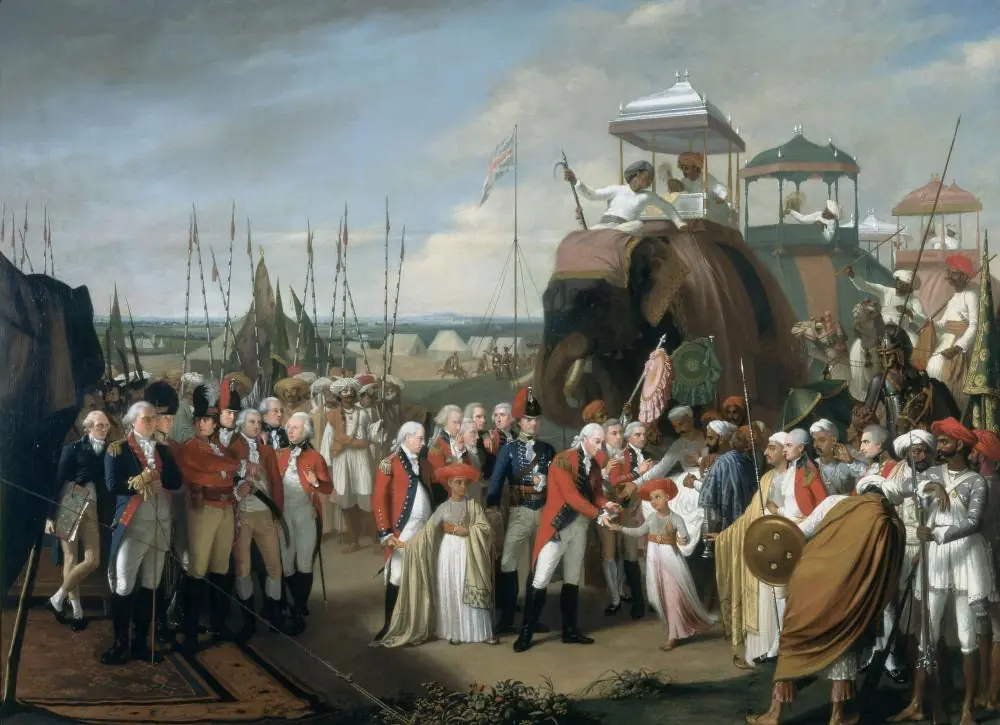
Tipu sued for peace and by the Treaty of Seringapatam gave up half his kingdom, paid a heavy indemnity and handed over two sons as hostages.
01Three allies against Mysore
The war began when Tipu attacked the Travancore Lines in 1789–90, and Travancore was a Company ally. Cornwallis, the Governor-General, took command himself and brought in the Peshwa’s Marathas under Haripant Phadke and the Nizam of Hyderabad, both old rivals of Mysore. Bangalore fell in March 1791. A first advance on Srirangapatna that year failed for want of food. Cornwallis came back in February 1792 with the allied armies.
02The night attack
Tipu’s army lay in a fortified camp on the north bank of the Kaveri, facing the island. On the night of 6 February 1792 Cornwallis sent three columns against it without waiting for the allies. They broke through, crossed onto the eastern end of the island and held the Lal Bagh gardens around Haidar Ali’s tomb. Tipu’s men fought back for two days but could not drive them out. With the siege guns coming up, Tipu opened talks.
03Half a kingdom
By the Treaty of Seringapatam of March 1792 Tipu ceded about half his territories, divided among the Company, the Marathas and the Nizam; the Company took Malabar, Dindigul and the Baramahal. He agreed to a large indemnity, and on 26 February two of his young sons, Abdul Khaliq and Muiz-ud-din, rode out on elephants to Cornwallis’s camp as hostages until it was paid. Coorg’s raja was freed from Mysore.
The treaty cut Mysore down to a power that could no longer face the Company alone; seven years later Srirangapatna fell for good.