
Cite
MLA
“Champa: the Cham Kingdom of Vietnam.” Hindu History, 2026, https://www.hinduhistory.in/world/champa/. Accessed .
APA
Hindu History. (2026). Champa: the Cham Kingdom of Vietnam. Retrieved , from https://www.hinduhistory.in/world/champa/
01Bhadreshvara at My Son
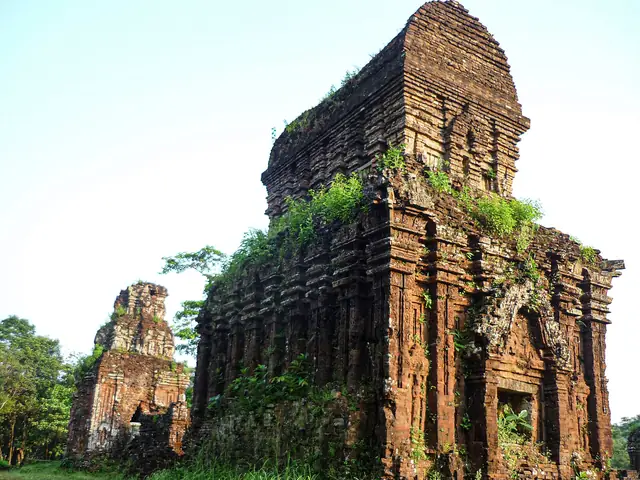
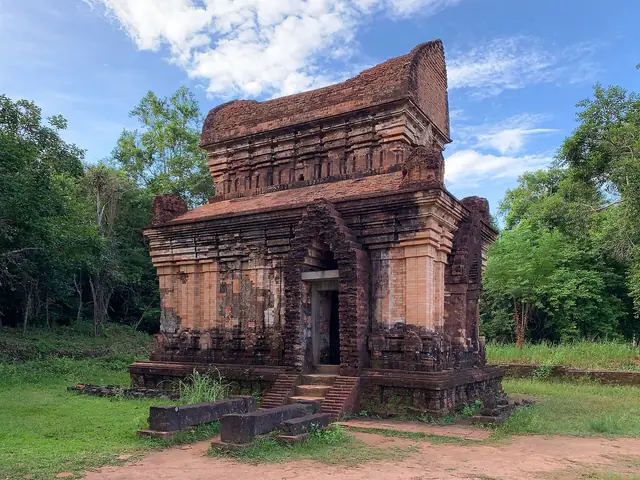
Bhadravarman, who reigned around 380 to 413, is the first king of Champa named in the inscriptions, and at My Son, in a valley ringed by hills in today’s Quang Nam province, he founded the shrine of Bhadreshvara, his own name joined to that of Shiva. That first temple was of wood, and in 535 or 536 it burned. Sambhuvarman, who reigned from 572 to 629, rebuilt it and named it Shambhu-Bhadreshvara. Vikrantavarman I, who came to the throne in 653 as Prakashadharma and knew Sanskrit learning well, endowed many shrines there. For six centuries kings added brick towers to the valley until there were more than seventy, set in groups, each a kalan with its mandapa and gate, the walls carved straight into the fired brick.
02Bombs on the valley, 1969
The French scholars of the École française d’Extrême-Orient mapped the towers in the early 20th century and lettered the groups A to L. During the war in Vietnam the valley was used as a base by the North Vietnamese forces, and in August 1969 American bombers struck it. The tower A1, which the French had thought the finest of all, was reduced to rubble, and the craters are still there among the ruins. About twenty structures survive in some form. Many Cham inscriptions were destroyed in the bombing of those years. The best of the sculpture from My Son and Tra Kieu is now in the Museum of Cham Sculpture at Da Nang, founded by the French in 1915. UNESCO inscribed the My Son sanctuary as a World Heritage Site in 1999.
03Po Nagar, the Bhagavati of Kauthara
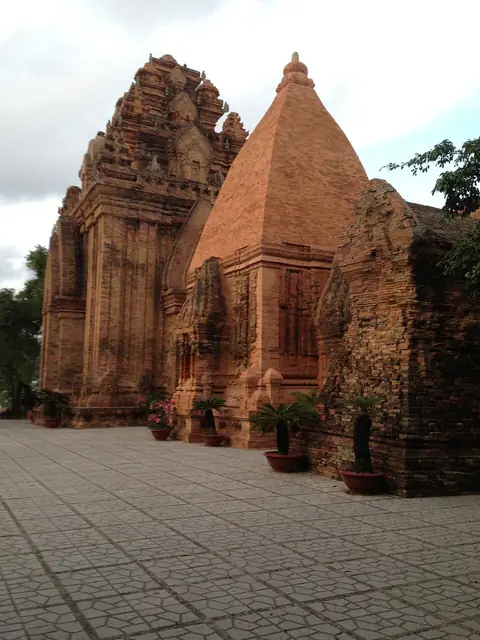
At Nha Trang, on Cu Lao hill above the river mouth, stand the towers of Yan Po Nagar, the Lady of the Land, whom the inscriptions call Bhagavati. A stele of 781 says King Satyavarman restored her temple after raiders from the sea, ‘men living on food more horrible than corpses’, had stolen the jewels of its mukhalinga and broken it; he set up a new linga in 784. In 918 Indravarman III gave the goddess a golden image. The Khmer king Rajendravarman II carried it off in 950, and in 965 Jaya Indravarman I replaced it in stone. Kings gave her land, jewels and lingas into the 12th century. Her seated image, ten-armed, is read as Mahishasuramardini, and above the door the goddess stands on the buffalo. Vietnamese devotees still worship her as Thien Y Thanh Mau.
04Kings with Sanskrit names
The kings of Champa took Sanskrit names with the Kshatriya ending -varman: Bhadravarman, Rudravarman, Vikrantavarman, Indravarman, Harivarman, Jaya Simhavarman. About four hundred inscriptions have been found, in Sanskrit and in Old Cham, and about 250 have been read; the EFEO and New York University’s Institute for the Study of the Ancient World are now gathering them into a Corpus of the Inscriptions of Campa. The Vo Canh stele, among the oldest Sanskrit inscriptions of Southeast Asia, was found in this land. Champa was never one state for long but a set of principalities along the coast, Indrapura and Amaravati in the north, Vijaya in the middle, Kauthara and Panduranga in the south. Shiva was worshipped above all, and from 875, under Indravarman II at Dong Duong, Mahayana Buddhism was the faith of the court for a century.
05Vijaya, 1471, and Panduranga, 1832
Champa fought on two sides for six hundred years: the Khmer of Angkor to the west, who took the north in 1145 and were thrown back by Jaya Harivarman I, and Dai Viet to the north. A Mongol army of Kublai Khan invaded in 1283–85 and was driven out. In the war of 1471 the Vietnamese emperor Le Thanh Tong took the capital Vijaya, in today’s Binh Dinh; Chinese records say a Cham envoy told the Ming court, ‘Annam destroyed our country’, and some 120,000 people were killed or carried off, the king among them. Kauthara held until 1653. Panduranga, round today’s Phan Rang, kept its own kings until August 1832, when Emperor Minh Mang deposed the last, Po Phaok The, and made the land a province. Cham risings in 1833–36 were crushed, temples were burned, and the Cham were ordered to dress and speak as Vietnamese.
06The Balamon Cham and the Kate festival
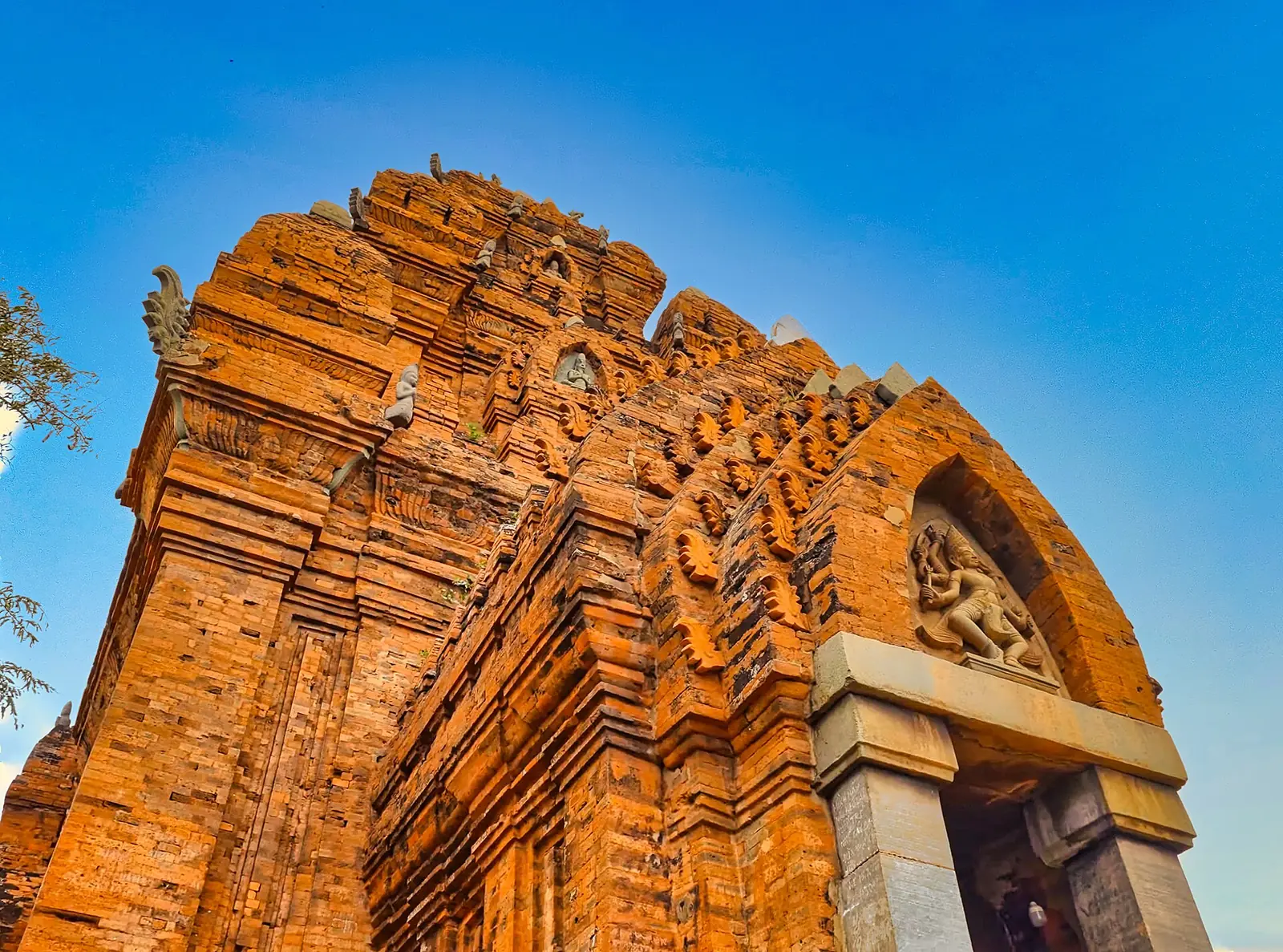
Most Cham today are Muslim: the Bani, whose Islam keeps many old Cham customs, and Sunni Muslims in Cambodia and the Mekong delta. But in Ninh Thuan and Binh Thuan the Balamon Cham, also called Cham Ahier, still keep the old faith; the name comes from Brahman. Their priests serve the towers of Po Klong Garai at Phan Rang, built in the late 13th century by Jaya Simhavarman III in honour of a king of Panduranga, whose mukhalinga they worship as the king himself; and Po Rome, the last Cham temple, of the 17th century. The great festival is Kate, on the first day of the seventh Cham month, when the Balamon gather at Po Klong Garai, Po Rome and Po Sah Inu near Phan Thiet to honour Po Nagar, the gods and their ancestors.
The Balamon Cham of Ninh Thuan and Binh Thuan are among the last communities in mainland Southeast Asia to keep a Hindu priesthood of their own; estimates of their number range from the tens of thousands, and Vietnam’s census does not count them separately. Their Kate festival fills the towers of Po Klong Garai and Po Rome each autumn, and Po Nagar at Nha Trang is still a living shrine.