Cite
MLA
“Yukti Kalpataru: a Sanskrit text on ships.” Hindu History, 2026, https://www.hinduhistory.in/samudra/yukti-kalpataru/. Accessed .
APA
Hindu History. (2026). Yukti Kalpataru: a Sanskrit text on ships. Retrieved , from https://www.hinduhistory.in/samudra/yukti-kalpataru/
What defines it
- 01
Samanya (river) and vishesha (sea-going) vessels
- 02
Cabin types: sarvamandira, madhyamandira, agramandira
- 03
Warns against iron fastenings in sea-going hulls
- 04
Printed at Calcutta, 1917 (ed. Ishvara Chandra Shastri)
01River boats and sea ships
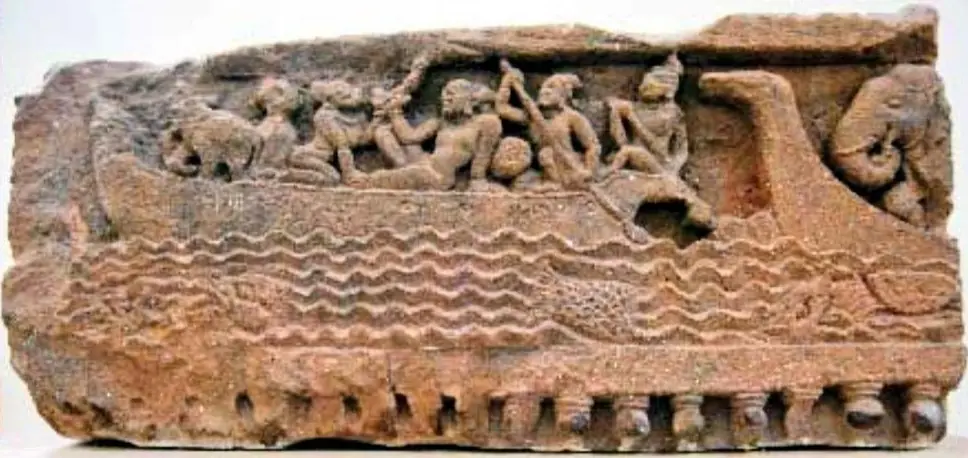
The text divides vessels into two great classes: samanya, ordinary craft for rivers, and vishesha, special ships fit for the sea. Each class is then graded by length, breadth and height. Ships are also sorted by where the cabin stands: sarvamandira with the house running the whole length, madhyamandira with it amidships, and agramandira with it toward the bow, and the text says which kind suits a king’s river progress, a long voyage or war.
02Wood and no iron
The Yukti Kalpataru grades timber into four classes by its qualities, and recommends the lighter, stronger kinds for sea-going hulls. It warns that a ship whose planks are joined with iron will be drawn to magnetic rocks in the sea and come to grief. Whatever the reason given, Indian Ocean shipwrights did sew their hulls with coir instead of nailing them, for many centuries, and the sewn ship INSV Kaundinya was built that way in 2025.
03The text and its date
The work bears Bhoja’s name, the Paramara king of Dhar famed as a patron and author of many treatises. Scholars accept the attribution with caution, since many compendia were gathered under his name. Radha Kumud Mookerji brought its ship chapter to wide notice in his Indian Shipping of 1912, and the text was printed at Calcutta in 1917, edited by Ishvara Chandra Shastri.
In the texts
- Yukti Kalpataru, attributed to Bhoja