
01The king who would not rule
After the water-offerings the Pandavas stayed a month outside the city on the bank of the Ganga. Rishis came to them, Vyasa, Narada, Devala, Kanva and many more. Narada told Yudhishthira the whole life of Karna: how he learned from Parashurama by hiding his birth, how a worm bored into his thigh while the guru slept on it and he did not move, how the guru cursed him, how he killed a Brahmana’s cow by mistake. Yudhishthira, broken, cursed all women thenceforth to be unable to keep a secret, because his mother had kept this one.
02Brothers, wife and rishis plead
Yudhishthira said he would leave the kingdom and live as a forest hermit. Each of his brothers argued with him in turn. Arjuna spoke for wealth and the duty of a king, Bhima mocked his weakness, Nakula and Sahadeva pleaded, and Draupadi reminded him of the forest years and asked why they had suffered them. Then Vyasa spoke at length on the dharma of a kshatriya and told him that the slaughter was the work of time, and he must now protect the people. Krishna added his word. Yudhishthira gave way.
03Coronation at Hastinapura
Yudhishthira entered Hastinapura in a white chariot drawn by sixteen white bullocks, with Bhima holding the reins and Arjuna the white parasol. In the palace he sat on a golden throne, Krishna and Satyaki facing him. With Krishna’s leave the family priest Dhaumya lit the sacred fire and the king was anointed with Draupadi beside him. He made Bhima the yuvaraja, put Vidura over counsel, Sanjaya over income and expense, Nakula over the army’s numbers and pay, and Arjuna over the checking of hostile kings, and he kept Sahadeva always by his side. He gave Dhritarashtra the first place in all things, and asked his people to obey the old king as before.
04To the bed of arrows
Krishna sat in meditation and Yudhishthira found him still. Krishna said his mind had gone to Bhishma, who lay on his bed of arrows at Kurukshetra waiting for the sun to turn north, and who was like a fire about to go out. When he goes, Krishna said, all knowledge of dharma goes with him; go and ask him now. They drove out to the field. Bhishma, seeing Krishna, praised him as Narayana in the hymn called the Bhishma Stavaraja. He said he was too weak and pained to teach. Krishna gave him a boon: no pain, no weariness, and clear memory of all he knew, until his last breath.
05Rajadharma and Apaddharma
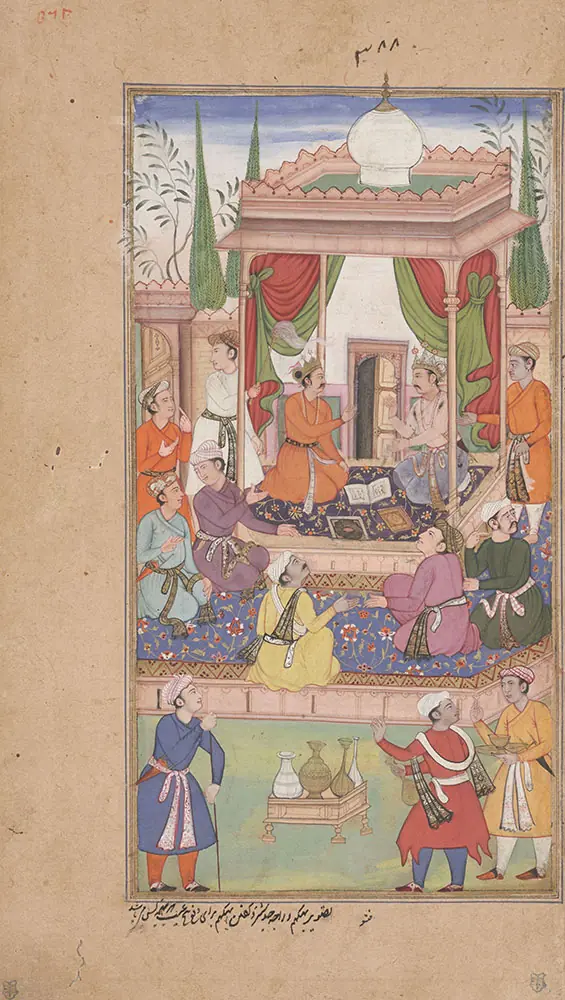
Day after day the Pandavas drove out from Hastinapura, and Bhishma answered Yudhishthira’s questions. The first part is Rajadharma, the duty of kings: why there is a king at all, how the first king was made when men without one devoured each other like fish, how he must guard the people, keep the treasury, choose ministers, punish fairly and make war only by dharma. The king makes the age, Bhishma said; whether it is Krita or Kali depends on him. The second part, Apaddharma, is dharma in times of disaster, when the ordinary rules cannot all be kept, told through kathas such as the cat and the mouse in the banyan.
06Mokshadharma
The third and longest part is Mokshadharma, the dharma of liberation. Here Bhishma speaks of the Self and the body, of Sankhya and Yoga, of creation and dissolution, of the life of Shuka, son of Vyasa, and of the wise who grieve for nothing. He gives the saying of King Janaka of Videha: my wealth is endless, for I own nothing; if Mithila burns, nothing of mine is burned. Many of these dialogues are read on their own, and the Mokshadharma is a chief source for the teachings of Sankhya and Yoga as the Itihasa holds them.
07The Narayaniya
Near the end of the Mokshadharma comes the Narayaniya. Narada goes to Badari, where Nara and Narayana sit in tapas, and asks whom Narayana himself worships. Narayana tells him of the Supreme, and Narada travels on to Shvetadvipa, the white island, to see Bhagwan in his universal form. The Narayaniya speaks of worship with one-pointed devotion and of the avatars Bhagwan takes, and Vaishnavas, the Pancharatra tradition above all, hold it as a foundation of their faith. Bhishma tells it all to Yudhishthira, as Vyasa had told it, so that the king who began the book in grief ends it in knowledge.
Famous verses
कालो वा कारणं राज्ञो राजा वा कालकारणम् । इति ते संशयो मा भूद्राजा कालस्य कारणम् ॥
Is the age the cause of the king, or the king the cause of the age? Let there be no doubt in you: the king is the cause of the age.Mahabharata 12.70.6 (BORI CE)
अनन्तं बत मे वित्तं यस्य मे नास्ति किंचन । मिथिलायां प्रदीप्तायां न मे दह्यति किंचन ॥
Endless indeed is my wealth, for nothing at all is mine. If Mithila is ablaze, nothing of mine is burned.Mahabharata 12.171.56 (BORI CE)