
01Three tellers, one katha
The first words belong to Ugrashravas, son of Lomaharshana, a suta who arrives at the twelve-year satra of the kulapati Shaunaka in the Naimisha forest. The rishis ask him what he has heard. He has heard the Bharata at the sarpa-satra of King Janamejaya, the great-grandson of Arjuna, recited there by Vaishampayana, the disciple of Maharshi Vyasa. So the Mahabharata comes to us through three mouths: Vyasa composed it, Vaishampayana told it to Janamejaya, and Ugrashravas told it again at Naimisha. The tradition also tells how Vyasa dictated the work to Shri Ganesh, who wrote without pause on the condition that Vyasa never stop; the BORI Critical Edition keeps that passage in its apparatus.
02Astika and the snake sacrifice
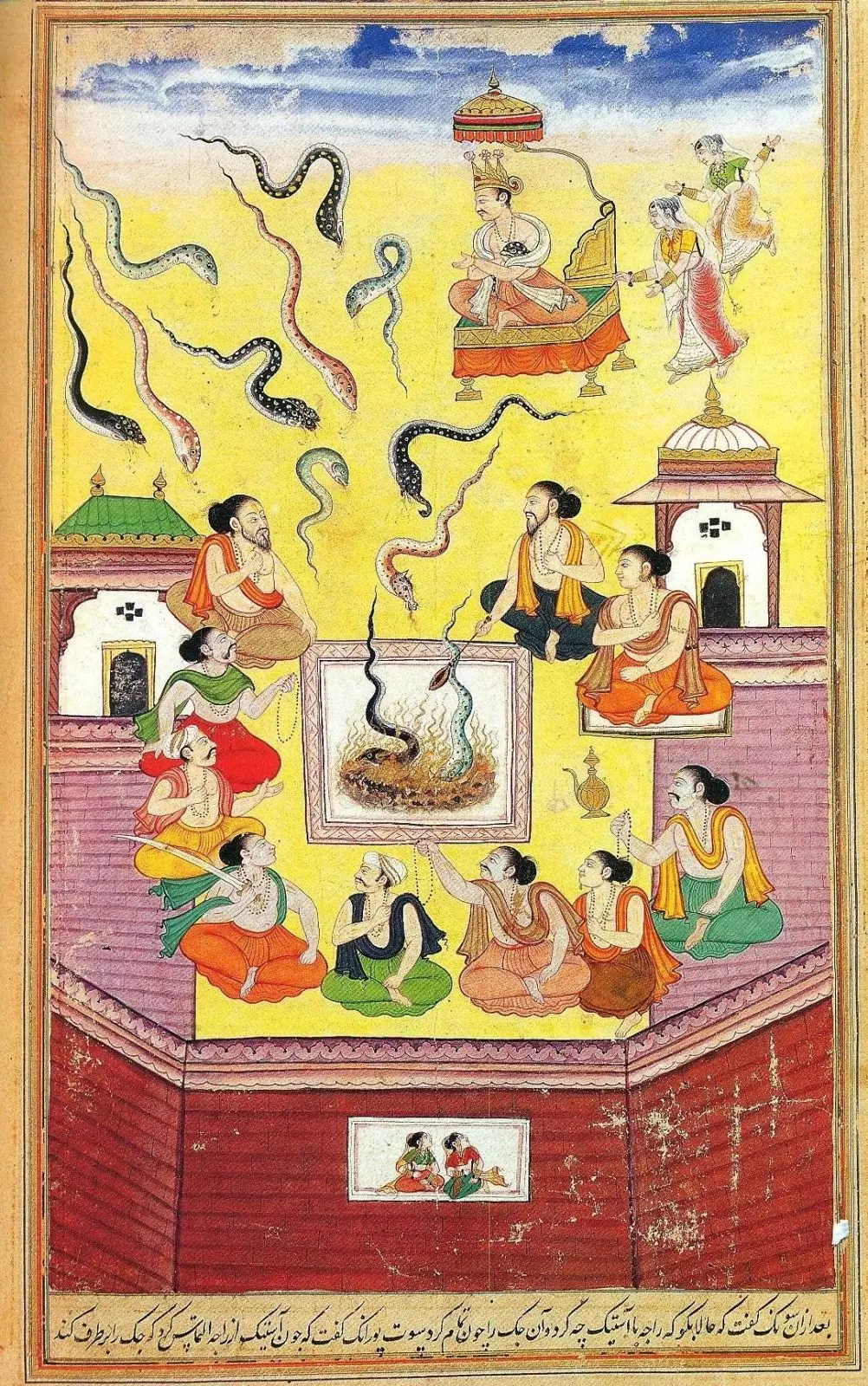
Why was Janamejaya holding a sacrifice of snakes? Because the naga Takshaka had killed his father Parikshit, as a rishi’s curse had foretold. Janamejaya lit the fire and the serpents fell into it by the thousand, drawn by the mantras. The young brahmana Astika, whose mother was a naga and whose father was the rishi Jaratkaru, came to the sacrifice, praised the king and asked for a boon. He asked that the sacrifice stop. It stopped, and Takshaka lived. Between the rites, Janamejaya asked Vaishampayana to tell him how his forefathers, the Pandavas, came to fight their kinsmen.
03Devavrata becomes Bhishma
King Shantanu of Hastinapura married Ganga on her condition that he never question her. She drowned seven newborn sons in the river, freeing the seven Vasus from a curse. When he stopped her at the eighth, she left, and later gave him back the boy grown: Devavrata, trained by Vasishtha and Parashurama. Shantanu then longed for Satyavati, daughter of the chief of the fishermen, who would give her only if her son should rule. Devavrata gave up the throne, and then, so no son of his could ever claim it, vowed lifelong brahmacharya. The gods rained flowers and called him Bhishma, he of the terrible vow. His father granted him death only when he himself chose it.
04Three sons by Vyasa
Satyavati’s sons died young. Chitrangada fell to a gandharva of the same name; Vichitravirya married Ambika and Ambalika, whom Bhishma had carried off from the svayamvara at Kashi, and died childless. Satyavati then called her firstborn, Krishna Dvaipayana Vyasa, born to her from the rishi Parashara before her marriage. By niyoga he gave the line its sons. Ambika shut her eyes before his fierce tapas-worn form, and her son Dhritarashtra was born blind. Ambalika turned pale, and Pandu was born pale. A maid who served him without fear bore Vidura, wise and dharmic, an amsha of Dharma himself.
05Sons of the devas, sons of Gandhari
Pandu ruled, then went to the forest under the curse of the rishi Kindama: he would die if he went to his wife in love. Kunti held a mantra from the rishi Durvasa that could call any deva. As a girl she had tried it on Surya and borne Karna, whom she set afloat in a basket; the charioteer Adhiratha and his wife Radha raised him. Now, at Pandu’s wish, she called Dharma, Vayu and Indra, and bore Yudhishthira, Bhima and Arjuna. She gave the mantra to Madri, who called the Ashvins and bore the twins Nakula and Sahadeva. In Hastinapura Gandhari bore a hundred sons, eldest Duryodhana, and one daughter, Duhshala. When Pandu died in the forest, Madri went with him on the pyre and Kunti brought the five boys home.
06Drona’s school and the tournament
Bhima was strong enough to make the young Kauravas his playthings, and Duryodhana tried to drown him with poison; the nagas below the Ganga revived him. Kripa taught the princes first, then Drona, who had come to Hastinapura nursing a grudge against his boyhood friend Drupada, now king of Panchala. Arjuna saw only the bird’s eye when the others saw the tree. The nishada boy Ekalavya, refused as a pupil, learned before a clay image of Drona and gave his right thumb when Drona asked it as guru-dakshina. As fee from the princes, Drona had Drupada brought to him bound and took half his kingdom. At the public display of arms, Karna stepped out, matched Arjuna feat for feat and was mocked as a charioteer’s son. Duryodhana crowned him king of Anga on the spot.
07Lac house to Panchala
Duryodhana sent the Pandavas and Kunti to a house of lac at Varanavata. Vidura warned Yudhishthira in a riddling tongue and sent a miner, who dug a tunnel. The Pandavas set the fire themselves and escaped while Purochana, the builder, burned in it. In the forest Bhima killed the rakshasa Hidimba and married his sister Hidimbi, who bore Ghatotkacha. At Ekachakra, living disguised as brahmanas, Bhima went in the family’s place as the weekly food for Baka and killed him. Then came Drupada’s svayamvara. Draupadi had risen from the fire of his yajna, with her brother Dhrishtadyumna. A brahmana stranger, Arjuna, strung the great bow and struck the target through the turning device. Kunti, not looking up, told them to share what they had brought. Vyasa himself explained why Draupadi would be the wife of all five.
08Indraprastha and Khandava
Dhritarashtra gave the Pandavas half the kingdom, the wild country of Khandavaprastha, and there they built Indraprastha. Narada set a rule so the brothers would not quarrel over Draupadi; Arjuna broke it to save a brahmana’s cattle and went into exile for twelve years. He married the naga princess Ulupi and Chitrangada of Manipura, and at Dvaraka, with Shri Krishna’s blessing, he carried off Subhadra, Krishna’s sister, who bore Abhimanyu. Then Agni came hungry for the Khandava forest. Varuna gave Arjuna the bow Gandiva and two inexhaustible quivers, and Krishna received the Sudarshana chakra. Together they held off Indra’s rain while the forest burned. Among the few who were spared was Maya, the asura builder, who would repay them with a hall.
Famous verses
धर्मे चार्थे च कामे च मोक्षे च भरतर्षभ । यदिहास्ति तदन्यत्र यन्नेहास्ति न तत्क्वचित् ॥
On dharma, artha, kama and moksha, O best of the Bharatas, what is here is found elsewhere; what is not here is found nowhere.Mahabharata 1.56.33 (BORI CE)