
01Marutta’s gold
After Bhishma’s rites Yudhishthira fell on the bank of the Ganga like an elephant shot through. Dhritarashtra comforted him, then Krishna, then Vyasa. The rishi gave a remedy: perform the ashvamedha, the horse sacrifice, as the kings of old did after great wars. The treasury was empty. Vyasa told him of Marutta, a king of the Ikshvaku line, whose yajna was led by the priest Samvarta after Brihaspati refused him. Marutta’s vessels and ornaments were all of gold, and the brahmins left so much behind that it still lay in the Himalaya. Go and fetch it, Vyasa said.
02The Anugita
In the quiet months at Indraprastha, Arjuna made a confession. What Krishna had told him on the field, at the start of the war, was gone from his mind. Could he hear it again? Krishna was displeased. He had taught him the secret, the eternal dharma, and Arjuna had let it slip. That teaching was complete for knowing Brahman, he said, and he could not speak it again in the same full way. But he would tell an old itihasa on the same matter. What follows is the Anugita, the after-Gita: dialogues of a brahmin and his wife, of a guru and a disciple, on the Self, the gunas and liberation.
03Uttanka on the road
Krishna then set out for Dwaraka. In the desert country he met the sage Uttanka, who asked after the Kurus. When he heard that they were all dead, he grew angry and made ready to curse Krishna for not preventing the war. Krishna asked him to hear first. He explained that he had tried for peace, and that he takes birth in every yoni to guard dharma. Then he showed Uttanka the Vishvarupa, the same universal form Arjuna had seen. Uttanka bowed, and asked only for water in the desert whenever he wished it.
04Parikshit lives
While Bhima and his brothers were away bringing Marutta’s gold on camels, horses and elephants, Uttara gave birth in Hastinapura. The child came stillborn, struck in the womb by Ashvatthama’s weapon. Kunti, Subhadra and Draupadi wept; Uttara begged Krishna to remember his promise. Krishna touched water, and declared: I have never spoken a lie, never turned from battle, and dharma and brahmins are dear to me; by that truth let this child live. The boy stirred. Because he was born when the line had dwindled away, he was named Parikshit.
05Arjuna follows the horse
On the Chaitra full moon the horse was released, and Arjuna rode behind it with the Gandiva. He fought the Trigartas, whose king Suryavarma had an old quarrel with him, and the kings of Pragjyotisha. In Sindhu the warriors rose against him, until Duhshala, Duryodhana’s sister and Jayadratha’s widow, came out with her small grandson and Arjuna laid his bow down. At Manipura his own son Babhruvahana, Chitrangada’s child, met him in battle and shot him dead. Ulupi, the naga princess, brought a jewel from the underworld and laid it on Arjuna’s chest, and he rose again.
06The yajna and the mongoose
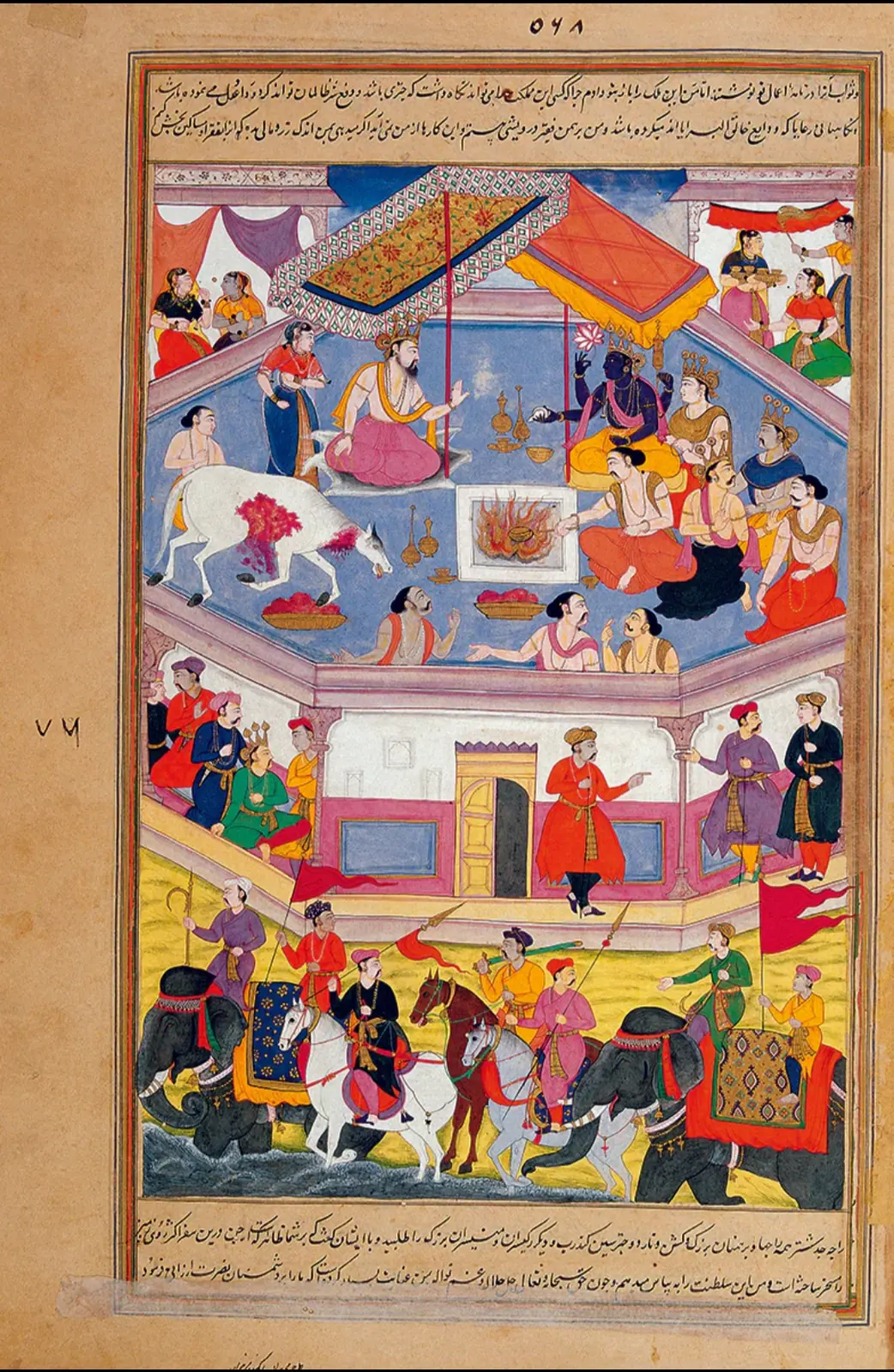
The horse came home, and the ashvamedha was held at Hastinapura with Vyasa presiding. Gifts poured out to the brahmins; the earth itself was given and bought back. When it was over, a mongoose with one side of gold came out of its hole and said aloud that this sacrifice was not equal to a measure of barley flour. It told of a poor brahmin of Kurukshetra who lived on gleaned grain and, after days of hunger, gave his family’s last flour to a guest. The mongoose rolled in the crumbs and half its body turned gold. It had been searching for the other half ever since.
Famous verses
स हि धर्मः सुपर्याप्तो ब्रह्मणः पदवेदने । न शक्यं तन्मया भूयस्तथा वक्तुमशेषतः ॥
That dharma was wholly sufficient for knowing the state of Brahman. I cannot speak it again in the same way, in full.Mahabharata 14.16.11 (BORI CE), Anugita