
01Maya’s hall
Maya the asura, spared in the Khandava fire, built the Pandavas a hall at Indraprastha such as no king had. Floors looked like water and water looked like floor. Crystal pools held lotuses. It took fourteen months, and Maya brought materials from a lake beyond Kailasa, and with them the conch Devadatta for Arjuna and a mace for Bhima. Narada came to the new hall and spoke of the halls of Indra, Yama, Varuna, Kubera and Brahma. He told Yudhishthira that Pandu, in the world of the ancestors, wished his son to perform the Rajasuya, the sacrifice of a king of kings.
02Jarasandha at Girivraja
Shri Krishna told Yudhishthira that no Rajasuya could happen while Jarasandha of Magadha lived. He held eighty-six kings captive in his fort at Girivraja and meant to offer a hundred of them to Rudra. Krishna, Bhima and Arjuna went to Magadha dressed as snataka brahmanas, entered the city by breaking in over the hill rather than through its gate, and refused Jarasandha’s offered worship. He chose Bhima to fight. They wrestled day after day, without food, until on the fourteenth night Jarasandha tired and Bhima, at a sign from Krishna, broke him. The captive kings went free, and Jarasandha’s son Sahadeva was placed on the throne of Magadha.
03The Rajasuya and Shishupala
Arjuna went north, Bhima east, Sahadeva south and Nakula west, and the kings of Bharat sent tribute. At the Rajasuya the first honour, the arghya, had to go to one guest. Bhishma named Shri Krishna, and Sahadeva offered it. Shishupala, king of Chedi, rose in fury and poured abuse on Krishna, on Bhishma and on the Pandavas. Krishna had promised Shishupala’s mother to forgive her son a hundred offences. When the count was passed, he loosed the Sudarshana chakra and Shishupala’s head fell. The sacrifice was completed, and Yudhishthira was hailed as samrat.
04Duryodhana’s envy and Shakuni’s dice
Duryodhana stayed on in Maya’s hall. He took a crystal floor for water and lifted his robes, then walked into real water and fell in, and Bhima and the others laughed. He went home burning. His uncle Shakuni, prince of Gandhara, offered a way to take everything without a battle: invite Yudhishthira to dice, and let Shakuni throw. Dhritarashtra hesitated, then had a hall built and sent Vidura with the invitation. Vidura called dice the root of quarrel, leading to division and to war. Yudhishthira came anyway. A kshatriya, he said, does not refuse a challenge.
05Draupadi’s question
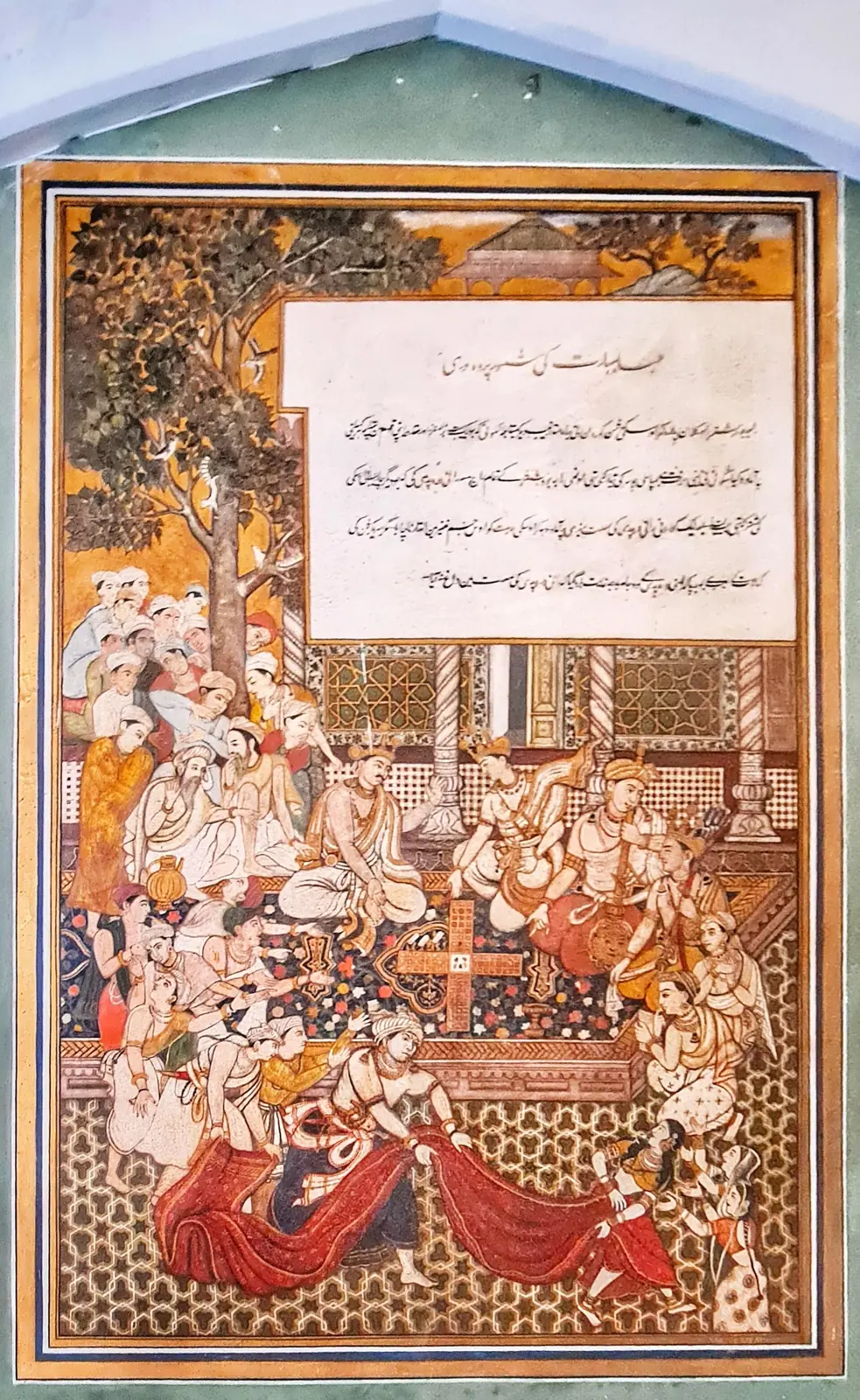
Throw by throw Yudhishthira lost his treasure and kingdom, then his four brothers, then himself, then Draupadi. Duryodhana sent the attendant Pratikamin to fetch her. She sent back a question: whom did the king lose first, himself or me? If he had already lost himself, how could he stake her? Duhshasana dragged her into the hall by the hair. Only Vikarna spoke for her. Karna called her a woman with five husbands and told Duhshasana to strip her. As he pulled at her garment, another garment of the same kind appeared, again and again. In the katha as Bharat recites it she called on Govinda of Dvaraka, and the cloth did not end. The BORI Critical Edition keeps her prayer to Krishna in its apparatus and says the cloths appeared by the power of Dharma.
06Bhima’s vows and the second game
Bhima swore before the assembly that he would tear open Duhshasana’s chest and drink his blood, and break with his mace the thigh Duryodhana had bared to Draupadi. Jackals howled in Dhritarashtra’s agnihotra house. Frightened, the blind king gave Draupadi boons. She asked only for the freedom of her husbands, their weapons and their chariots, and would take no third. The Pandavas left for Indraprastha. Duryodhana persuaded his father to call them back for one more throw: the losers would live twelve years in the forest and a thirteenth year unrecognised, and if found in that year, would go to the forest again. Yudhishthira lost. The Pandavas went out in deerskins, Kunti stayed with Vidura, and Draupadi left with her hair unbound.
Famous verses
गच्छ त्वं कितवं गत्वा सभायां पृच्छ सूतज । किं नु पूर्वं पराजैषीरात्मानं मां नु भारत ॥
Go to the gambler in the hall, son of a suta, and ask him: Bharata, whom did you lose first, yourself or me?Mahabharata 2.60.7ab–cd (BORI CE)
द्यूतं मूलं कलहस्यानुपाति मिथोभेदाय महते वा रणाय ।
Dice is the root of quarrel; it leads to division among kin, or to a great war.Mahabharata 2.56.1ab (BORI CE), Vidura