
01The questions go on
The war was over, the coronation done, and still Yudhishthira could not rest. He came back each day to the field where the grandsire lay on his arrows, the Ganga’s son who could choose the hour of his own death. The Shanti Parva had taught him how a king rules and how a soul is freed. Now he asked smaller, harder things. Who should receive a gift? What does a householder owe a guest? Is a vow broken in need still a sin? Bhishma answered every one, often with an old katha in place of a rule.
02Gautami and the serpent
The parva opens with grief, because grief was what Yudhishthira carried. An old brahmin woman named Gautami found her son dead of snakebite. A fowler, Arjunaka, caught the serpent and offered to kill it. Gautami refused: killing it would not bring the boy back. The serpent pleaded that Mrityu had sent it; Mrityu said Kala had moved him; Kala said the boy’s own past karma had brought the hour. Gautami heard them all and let the serpent go. Bhishma told it so that the king would stop blaming himself alone for Kurukshetra.
03Krishna’s tapas to Mahadev
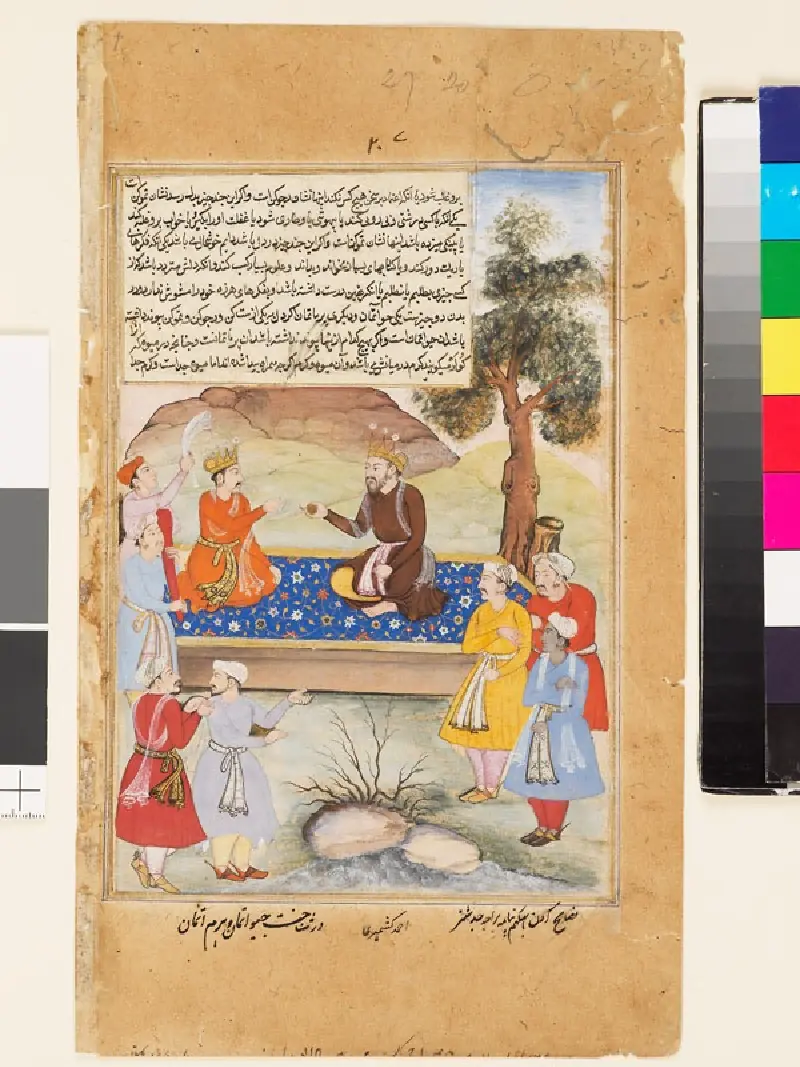
When Yudhishthira asked about the glory of Shiva, Bhishma turned to Shri Krishna, who stood beside him, and asked him to speak. Krishna told how, wishing for a son by Jambavati, he went to the ashrama of the rishi Upamanyu in the Himalaya. Upamanyu, who had won Mahadev’s grace as a boy, gave him diksha. Krishna did tapas, and Shiva appeared with Mata Parvati and granted the boon; Samba was born of it. The katha sits in this parva as a plain sign that Hari and Hara are honoured together.
04The law of giving
Most of the parva is dana dharma. Bhishma names the gifts in order of merit: food first, for no one lives without it; then land, cows, gold, lamps, water and learning. He tells why the cow is honoured, and how the gift of a cow to a worthy brahmin carries the giver across. He speaks of fasts, of the tithis for shraddha, of what a king should never take from a temple or a brahmin. He also teaches ahimsa at length, and the famous line comes here, said twice over in two adhyayas: non-violence is the highest dharma.
05The thousand names
Near the end Yudhishthira asked six questions in two verses. Who is the one deity of the world? Who is the highest refuge? By praising and worshipping whom does a man reach the good? What is the highest dharma? Chanting what is one freed from the bond of birth? Bhishma’s answer was a hymn: the Vishnu Sahasranama, the thousand names of the Lord of the world, beginning with Vishvam, Vishnu, Vashatkara. It is chanted today in homes and temples across Bharat, often every morning, and Adi Shankaracharya wrote a commentary on it.
06Bhishma departs
Yudhishthira went home to Hastinapura and returned when the sun had turned north. Bhishma counted the days for him: fifty-eight nights on the arrows, and now it was Magha, the bright fortnight, a third of it left. He blessed the Pandavas, spoke a last word to Dhritarashtra, and asked Krishna’s leave to go. Then he drew his breath up through the body, limb by limb, and the arrows fell away from each place it left. His life went out through the crown of his head. The day is kept as Bhishma Ashtami.
07Ganga mourns her son
The Pandavas and Vidura covered the body in silk and garlands and burned it with full rites, and then everyone went down to the Ganga to offer water. The river rose out of her stream as a woman, weeping. This was her son, she said, who had beaten Parashurama himself in single combat, and Shikhandi had brought him down. Shri Krishna answered her gently: Bhishma had gone to the Vasus, from whom he had come, and she should not grieve. Ganga went back into her waters. Only then did the Pandavas turn for home.
Famous verses
विश्वं विष्णुर्वषट्कारो भूतभव्यभवत्प्रभुः । भूतकृद्भूतभृद्भावो भूतात्मा भूतभावनः ॥
He is the universe, Vishnu, the call of the sacrifice, lord of what was, is and will be; maker and bearer of beings, existence itself, the Self of all beings, who brings them forth.Mahabharata 13.135.14 (BORI CE); Vishnu Sahasranama, first verse of the names
अहिंसा परमो धर्मस्तथाहिंसा परं तपः । अहिंसा परमं सत्यं ततो धर्मः प्रवर्तते ॥
Non-violence is the highest dharma; non-violence is the highest tapas. Non-violence is the highest truth, and from it dharma goes forth.Mahabharata 13.116.25 (BORI CE)