
01Fifteen years
Yudhishthira kept the old king like a father. Dhritarashtra was served first, honoured in council, given wealth for shraddha of his sons. Kunti waited on Gandhari. Only Bhima could not forgive, and now and then let fall a word about the hundred he had killed, loud enough for the blind king to hear. Fifteen years went by this way. Then Dhritarashtra told Yudhishthira that the words burned him, that he had eaten little in secret all this while, and that he wished to end his life in tapas in the forest, as kings of their line had done.
02Kunti goes too
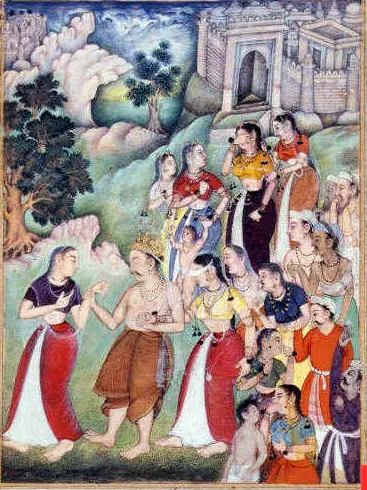
Yudhishthira resisted, then gave way when Vyasa came and told him to let his uncle go. The people of Hastinapura gathered, and Dhritarashtra asked their pardon. On the day of departure Gandhari walked with her hand on Kunti’s shoulder, and the blind king held Gandhari’s. At the city gate Kunti would not turn back. Her sons begged her. She told them she had roused them to war so that they would not live as beggars, not for her own pleasure in a palace; now she would serve her elders and do tapas. They went on to the Ganga, then to Kurukshetra, to the ashrama of the royal sage Shatayupa.
03Vidura’s last yoga
In time the Pandavas came with the queens and the people to see their elders. Vidura was not in the ashrama. He was living on air, the old king said, and was seen only now and then in the empty forest. Just then a thin figure with matted hair, naked and grey with dust, was seen at a distance and turned away. Yudhishthira ran after him alone, calling, I am Yudhishthira, your dear one. Vidura stood against a tree and fixed his eyes on him. Then by the power of yoga he entered Yudhishthira’s body, breath into breath, sense into sense. A voice from the sky forbade a cremation.
04One night with the dead
Vyasa came to the ashrama and offered the grieving elders a boon. Gandhari asked to see her sons; Kunti asked to see Karna. At nightfall Vyasa went into the Ganga and called. Out of the water rose the warriors of both armies in shining bodies, free of anger: Bhishma and Drona at their head, Karna, Duryodhana and his brothers, Abhimanyu, Ghatotkacha, the sons of Draupadi, Drupada, Virata. For that one night Vyasa gave Dhritarashtra sight. Fathers met sons and wives met husbands, and there was no enmity among them. At dawn they went back into the river.
05The widows follow
Before they vanished, Vyasa spoke to the widows of the fallen. Any who wished to reach their husbands’ worlds could enter the Ganga now. Many of them did, and went with the shining host. Janamejaya, hearing this from Vaishampayana at his sacrifice, said he too wished to see his father Parikshit. Vyasa granted it on the spot, and Parikshit appeared with his ministers at the end of the avabhritha bath. It is one of the few places where the frame and the katha touch, and the listener in the hall of the yajna becomes part of what he hears.
06The forest fire
The Pandavas returned to Hastinapura. Two years later Narada came with news. Dhritarashtra, Gandhari and Kunti had gone deeper into the forest near Gangadvara, living on water and then on air. A wind rose and with it a great forest fire. Too weak to flee, the three sat facing east in yoga and were taken by it. Sanjaya escaped and went on to the Himalaya. The fire, Narada said, was the king’s own sacred fire, left in the forest by his priests, so his end was not an ordinary death. Yudhishthira had the shraddha performed on the Ganga.
Famous verses
विवेश विदुरो धीमान्गात्रैर्गात्राणि चैव ह । प्राणान्प्राणेषु च दधदिन्द्रियाणीन्द्रियेषु च ॥
Wise Vidura entered him, limbs into limbs, placing his breaths in his breaths and his senses in his senses.Mahabharata 15.33.25 (BORI CE)