
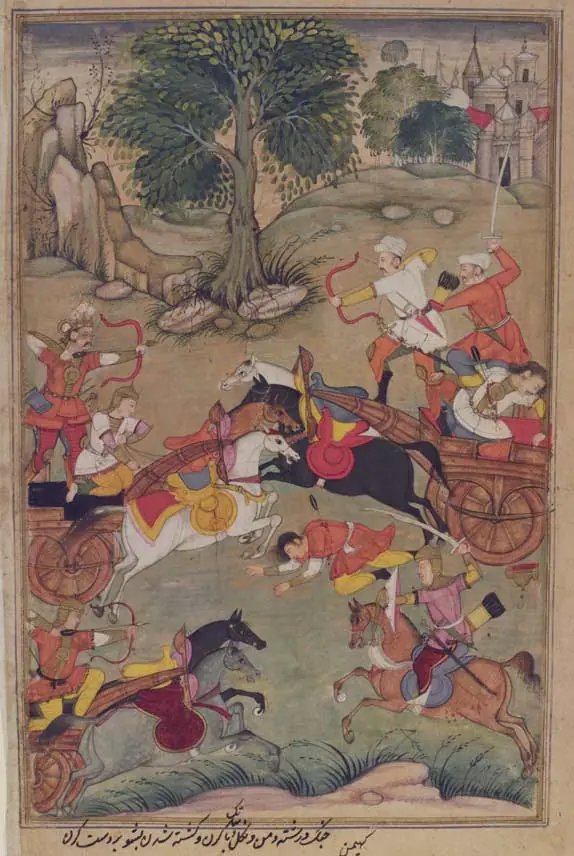
01Radheya
Adhiratha the charioteer found the basket on the river and raised the boy with his wife Radha, so Karna was Radheya, and for the gold he was born with, Vasushena. When the princes showed their skill at Hastinapura, Karna walked into the arena and matched every feat of Arjuna. Kripa asked him to name his father, and he bowed his head. Duryodhana made him king of Anga on the spot. Then old Adhiratha came in, trembling, and Karna, crowned and still wet from the consecration, bowed to him as a son. Bhima laughed and told him to take up a charioteer’s whip.
02Two curses and a gift
Narada tells Yudhishthira after the war how Karna came by his fate. He went to Parashurama claiming to be a brahmin and learned the Brahmastra; one day a stinging insect bored into his thigh while the guru slept on it, and he bore the pain without moving. Parashurama woke in the blood, knew no brahmin could endure so, and cursed him to forget the weapon at his hour of need. A brahmin whose cow he killed by mistake cursed him that his wheel would sink. And when Indra came to him disguised as a brahmin, Karna cut the armour and earrings from his own body and gave them, though Surya had warned him in a dream. Indra gave him the Shakti in return.
03Krishna and Kunti
After the failed embassy Krishna took Karna into his chariot and told him the truth: he was Kunti’s eldest son, and so by dharma the eldest Pandava. If he came over, Yudhishthira would hold the royal umbrella over him and Draupadi would come to him as well. Karna refused. Radha and Adhiratha had raised him; Duryodhana had trusted him for thirteen years; he would not betray either. Kunti came herself, on the bank of the Ganga, and he gave her his word: he would not kill Yudhishthira, Bhima or the twins, only Arjuna, so she would still have five sons.
04The wheel sinks
He would not fight while Bhishma led, and took command on the sixteenth day after Drona’s death, with Shalya as his charioteer. On the seventeenth, in the duel with Arjuna, his left wheel sank into the earth, and the Brahmastra went from his mind. He called on Arjuna to wait by the rules of fair fight. Krishna asked him where his dharma had been in the dice hall and at Abhimanyu’s death, and Arjuna’s arrow took his head. Only at the water rites did Kunti tell her sons who he was. The famous line, “born a suta or a suta’s son, birth is fate’s, manhood is mine,” is from Bhatta Narayana’s drama Venisamhara, not from the Mahabharata.
Famous verses
न ते जातु नशिष्यन्ति पुत्राः पञ्च यशस्विनि । निरर्जुनाः सकर्णा वा सार्जुना वा हते मयि ॥
Your five sons will never be lost, glorious lady: they will be five without Arjuna and with Karna, or with Arjuna if I am slain.Mahabharata 5.144.22 (BORI CE), Karna to Kunti