
01Sanjaya’s divine sight
The armies were drawn up on the plain of Kurukshetra, and rules of fair fight were agreed: chariot against chariot, no striking a man who has fled or laid down his arms. Maharshi Vyasa came to Dhritarashtra and offered him sight to watch the war. The king would not see his kin killed. So Vyasa gave divya-drishti to Sanjaya, who would see everything, by day and night, even thoughts in men’s minds, and not be wounded. Sanjaya first described the earth, Jambudvipa and its varshas, mountains and rivers. On the tenth day he came back from the field to tell the king that Bhishma had fallen, and the king asked him to tell it all from the start.
02The Gita between the armies
Dharmakshetre Kurukshetre: the blind king’s first question opens the Bhagavad Gita. Arjuna asked Krishna to draw the chariot between the two hosts, saw grandfather, teacher, uncles, brothers and sons standing ready to die, and put down his bow. Shri Krishna answered him in eighteen chapters: the Self that is not born and does not die, action done without craving for its fruit, knowledge, devotion and surrender. He showed Arjuna his universal form. In the BORI Critical Edition the Gita is adhyayas 23 to 40 of the Bhishma Parva; in the vulgate, 25 to 42. Arjuna rose saying his delusion was gone and he would do as Krishna said.
03Yudhishthira walks across
Then, to the alarm of both armies, Yudhishthira took off his armour, put down his weapons and walked on foot towards the Kaurava ranks. His brothers and Krishna followed. He bowed to Bhishma, to Drona, to Kripa and to his uncle Shalya, and asked their blessing to fight them. Each was moved and gave it, and each told him how victory would come. Then Yudhishthira called out that whoever wished to join him could come now. Yuyutsu, Dhritarashtra’s son by a vaishya wife, crossed over to the Pandavas. The conches sounded: Panchajanya for Krishna, Devadatta for Arjuna, Paundra for Bhima.
04Nine days of Bhishma
Bhishma fought like the god of death. On the first day Virata’s sons Uttara and Shveta fell. Day after day the old commander broke the Pandava formations while Arjuna held back from striking him with full force. Twice, when Arjuna was fighting gently, Shri Krishna leapt down from the chariot to kill Bhishma himself, breaking his own word not to fight. The first time he raised the Sudarshana; on the ninth day he ran at him with only the whip in his hand. Bhishma put down his bow and welcomed death from Krishna’s hand. Arjuna caught Krishna by the legs and dragged him back, promising to fight in earnest. Ghatotkacha, Bhima and Abhimanyu fought on, and Bhima killed many of Dhritarashtra’s sons.
05Shikhandi before Arjuna
On the night of the ninth day the Pandavas went to Bhishma’s tent and asked him how he could be killed. He told them. He would not raise a weapon against Shikhandi, who had been born a woman. Let Arjuna stand behind Shikhandi and shoot. On the tenth day Shikhandi rode in front, and Bhishma, seeing him, would not fight back. Arjuna’s arrows came over Shikhandi’s shoulder and covered Bhishma until there was no space between them. He knew whose arrows they were. Near sunset he fell from his chariot, and his body did not touch the ground; he lay on the arrows. It was dakshinayana, and he resolved to hold his life until the sun turned north.
06The bed of arrows
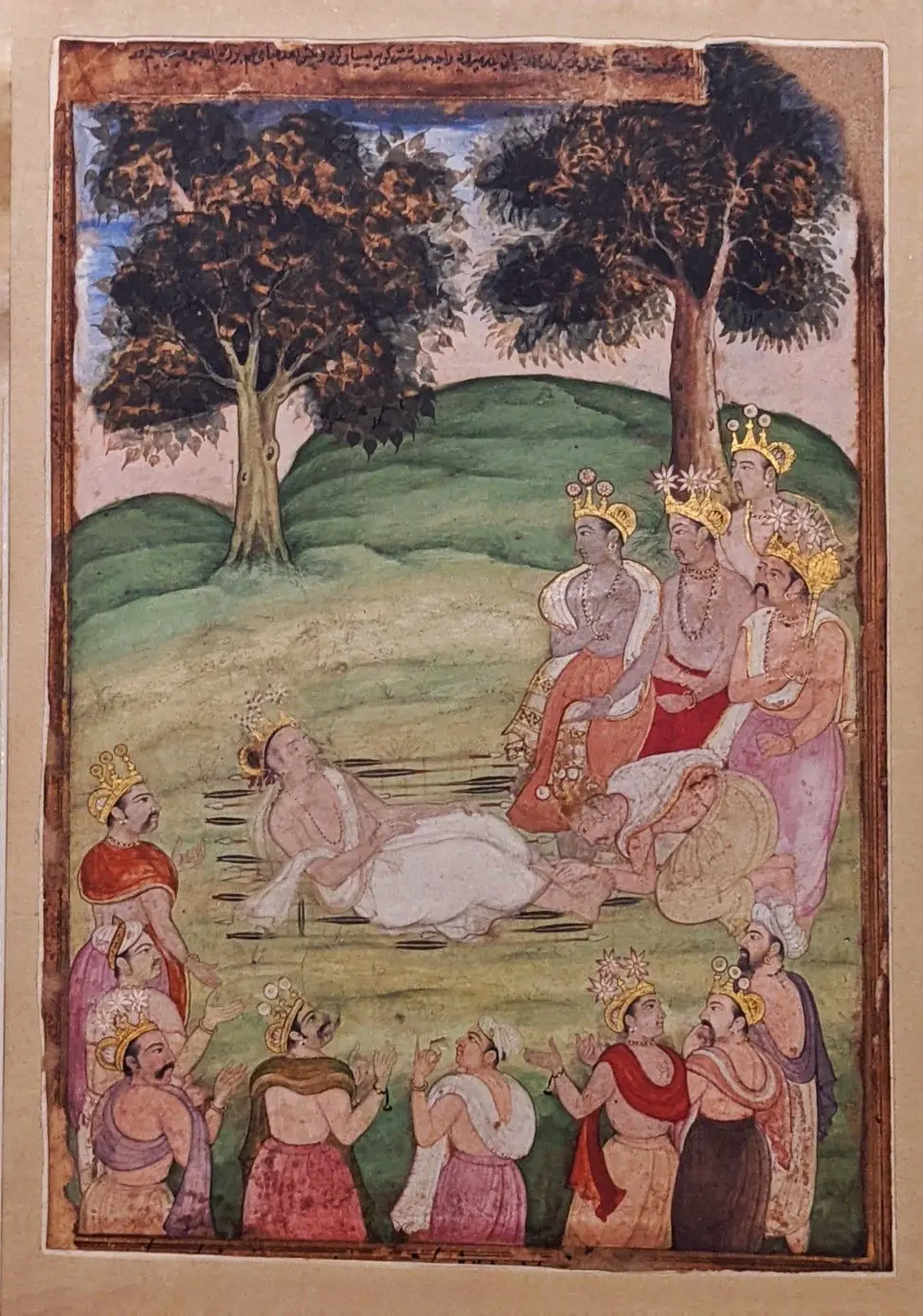
Fighting stopped. Kauravas and Pandavas came together, unarmed, and stood around him. His head hung down, and he asked for a pillow. The princes brought soft ones; he turned to Arjuna, who shot three arrows into the ground to hold his head, and Bhishma was pleased. He asked for water. Arjuna loosed an arrow into the earth beside him and a stream of pure water rose to his mouth. Bhishma told Duryodhana, one last time, to make peace. That night Karna came alone and bowed at his feet. Bhishma told him he knew he was Kunti’s son and asked him to join his brothers. Karna would not, and asked leave to fight. Bhishma gave it.
Famous verses
कर्मण्येवाधिकारस्ते मा फलेषु कदाचन । मा कर्मफलहेतुर्भूर्मा ते सङ्गोऽस्त्वकर्मणि ॥
Your right is to the work alone, never to its fruits. Do not let the fruit be your motive, and do not cling to inaction.Bhagavad Gita 2.47 = Mahabharata 6.24.47 (BORI CE)
यदा यदा हि धर्मस्य ग्लानिर्भवति भारत । अभ्युत्थानमधर्मस्य तदात्मानं सृजाम्यहम् ॥
Whenever dharma declines, O Bharata, and adharma rises, then I bring Myself forth.Bhagavad Gita 4.7 = Mahabharata 6.26.7 (BORI CE)