
01The thirty-sixth year
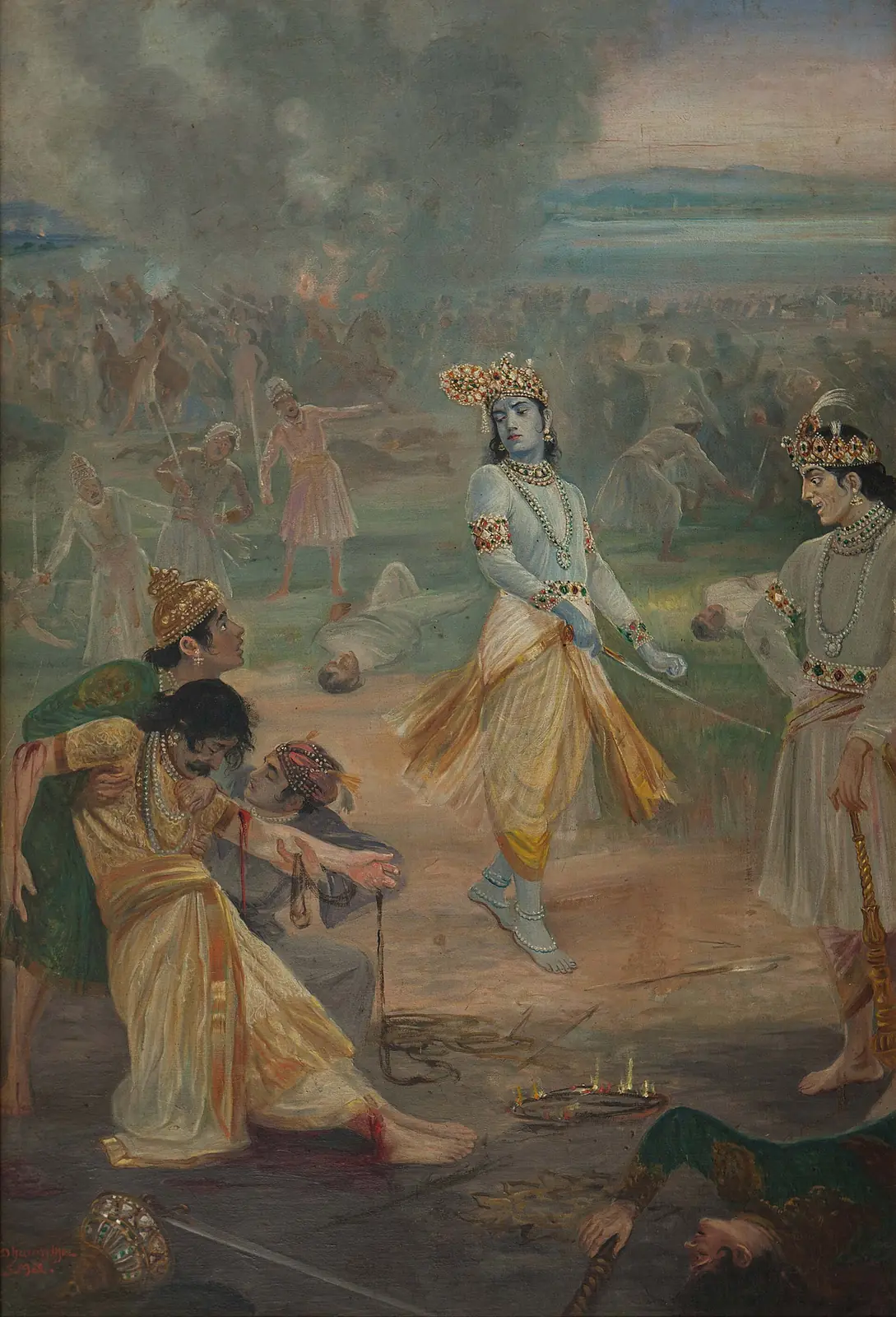
In the thirty-sixth year of his reign Yudhishthira saw ill omens: dry winds that rained gravel, rivers running backward, the sun dimmed at midday. Then the news came from Dwaraka. Vaishampayana tells it to Janamejaya plainly. At Kurukshetra, standing among the dead, Gandhari had cursed Krishna: since he could have stopped the slaughter and did not, his own kinsmen would destroy each other in the thirty-sixth year. Krishna had accepted the word with a smile. He knew the Vrishnis could be ended by no one but themselves.
02The iron pestle
Some young Yadavas dressed Samba, Krishna’s son, as a pregnant woman and brought him before the rishis Vishvamitra, Kanva and Narada, who had come to Dwaraka. What will she bear? they asked, laughing. The rishis saw through it. She will bear an iron pestle, they said, that will destroy the Vrishnis and the Andhakas. Next day Samba gave birth to a terrible pestle of iron. King Ugrasena had it ground to powder and thrown into the sea, and a ban was cried in the city against strong drink. From the powder washed ashore grew the tall eraka grass.
03Prabhasa
Krishna saw the time had come and led the Yadavas to Prabhasa by the sea, as if for a pilgrimage. There they drank. Satyaki mocked Kritavarma for killing sleeping men in the night raid on the Pandava camp; Kritavarma answered with an insult; Satyaki cut off his head in front of Krishna. The Bhojas and Andhakas fell on Satyaki, and Pradyumna died with him. Krishna, in grief and anger, pulled up a handful of eraka grass, and it became an iron club in his hand. Every Yadava who plucked the grass found the same, and they killed one another, father and son, until almost none were left.
04Balarama and Krishna depart
Krishna sent his charioteer Daruka to Hastinapura to fetch Arjuna. He found Balarama seated in yoga under a tree at the edge of the forest. As he watched, a great white serpent with a thousand heads came out of Balarama’s mouth and went into the sea, and the ocean and the nagas received him. Then Krishna lay down on the earth, restraining his senses, in mahayoga. A hunter named Jara, taking him for a deer, shot an arrow into the sole of his foot. Seeing a man in yellow robes, he fell at his feet. Krishna comforted him, and rose to his own abode. By the traditional reckoning, Kali Yuga began that day, 3102 BCE.
05The sea takes Dwaraka
Arjuna came to a city of widows. Vasudeva, Krishna’s father, gave up his life soon after, and Arjuna performed the rites for him and for Krishna and Balarama. Then he gathered the women, the children and the old, and Vajra, Krishna’s great-grandson, and led them out. As the last of them left, the sea rolled in over the walls and towers of Dwaraka, street by street, until nothing of it showed. The Mausala Parva says it plainly. Divers off the coast of Dwarka today search the seabed for the city of the Yadavas.
06The Gandiva fails
In the land of the five rivers, Abhira herdsmen saw a great company of women guarded by one man and attacked with sticks. Arjuna strung the Gandiva only with effort, and the mantras of his divine weapons would not come to him. His arrows ran out. Many women were carried off before his eyes. He brought the rest to Kurukshetra and settled Vajra as king at Indraprastha. Then he went to Vyasa’s ashrama, pale and shaken. Vyasa told him it was time, not his strength, that had changed: the weapons had done their work and gone back. Now, he said, it was time for the Pandavas to go too.
Famous verses
कालमूलमिदं सर्वं जगद्बीजं धनंजय । काल एव समादत्ते पुनरेव यदृच्छया ॥
All this has its root in time, Dhananjaya; time is the seed of the world. It is time that takes everything back again, as it wills.Mahabharata 16.9.33 (BORI CE), Vyasa to Arjuna