
01Vidura’s words
Dhritarashtra lay on the ground in the palace at Hastinapura, all his hundred sons dead. Vidura raised him. Everything that is gathered ends in loss, he said; everything raised high ends in a fall, every meeting in parting, every life in death. Then he told the king the parable of the man in the well. A Brahmana fleeing wild beasts in a dark forest fell into a pit and hung there from a creeper. Below him was a great serpent, above him an elephant, and white and black rats gnawed the creeper. Bees dripped honey from a hive into his mouth, and he went on drinking it. The forest is samsara, Vidura said; the rats are day and night.
02The iron Bhima
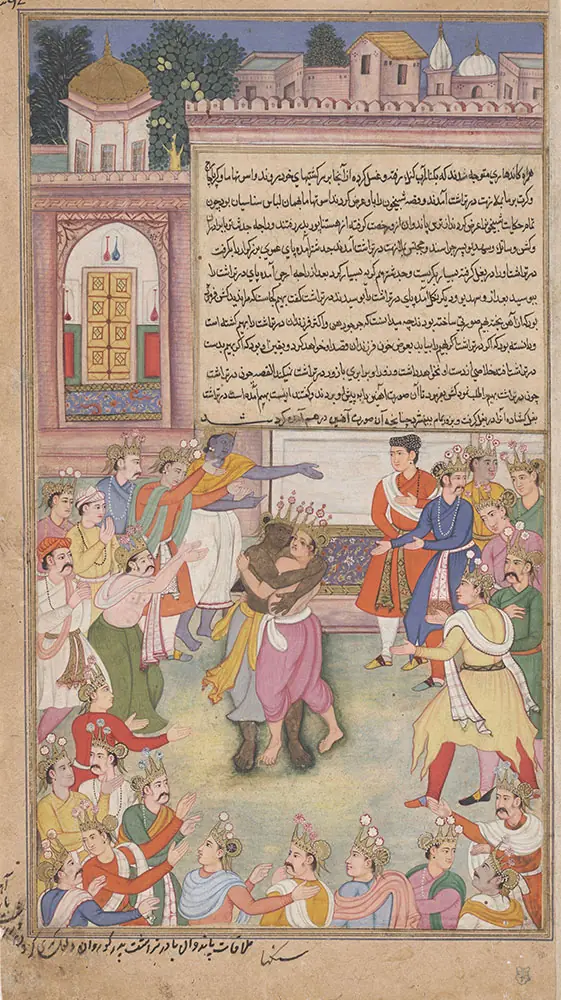
Vyasa came too and spoke of the will of the devas, that the war had been fixed long before to lighten the earth’s burden. Then Dhritarashtra set out for the field with the widows of the Kuru house. On the road he met Kripa, Kritavarma and Ashvatthama, who told him what they had done in the night and went their ways. When the Pandavas came to bow to him, the old king asked to embrace Bhima. Krishna knew his heart and pushed forward an iron image of Bhima instead. Dhritarashtra crushed it to pieces in his arms, then wept, thinking he had killed Bhima. Krishna told him the truth.
03Gandhari’s gaze
Gandhari wanted to curse Yudhishthira. Vyasa came to her first and reminded her of her own words to Duryodhana each day of the war: where there is dharma, there is victory. She held back. Bhima explained himself, the blow to the thigh and the blood he swore to drink, which, he said, never passed his teeth. Yudhishthira came and stood before her with joined hands and asked her to curse him. Through a gap in the cloth over her eyes her glance fell on his toes, and his nails were scorched black.
04The women on the field
Vyasa gave Gandhari divine sight, and from where she stood she saw the whole field of Kurukshetra. The women of the Kuru and Panchala houses went among the dead looking for their own, while jackals and vultures moved between the bodies. Gandhari named what she saw to Krishna. Duryodhana with his mace beside him. Duhshasana torn open. Uttara weeping over Abhimanyu. Karna’s wife over Karna. Jayadratha’s wife Duhshala, her own daughter. Drona with his wife Kripi beside him. Her lament is among the most grieving passages in the Itihasa.
05The curse on Krishna
Then Gandhari turned on Krishna. You could have stopped this, she said, and you did not. By whatever merit I have earned in serving my husband, I curse you: in the thirty-sixth year from now you will see your own kinsmen kill one another, and you will die alone in the forest, and the women of your house will weep as these women weep. Krishna smiled and answered that he had known it would be so. The Vrishnis could be destroyed by no one but themselves, and she had only spoken what was already set.
06Water for the dead
Yudhishthira had the dead burned on great pyres with ghee and sandalwood, friend and foe alike, and Vidura and Dhaumya saw to those who had no kin left. Then all went down to the Ganga to give water to the departed. As they stood in the river, Kunti told her sons to offer water for Karna too, for he was their eldest brother, her son by Surya, born before her marriage. The Pandavas were struck down by it. Yudhishthira grieved that he had killed his own brother, and gave the offering for Karna with his own hands.
Famous verses
सर्वे क्षयान्ता निचयाः पतनान्ताः समुच्छ्रयाः । संयोगा विप्रयोगान्ता मरणान्तं हि जीवितम् ॥
All gathering ends in loss, all rising ends in falling; every union ends in parting, and life ends in death.Mahabharata 11.2.3 (BORI CE)