Cite
MLA
“Battle of Delhi (1803).” Hindu History, 2026, https://www.hinduhistory.in/battles/battle-of-delhi-1803/. Accessed .
APA
Hindu History. (2026). Battle of Delhi (1803). Retrieved , from https://www.hinduhistory.in/battles/battle-of-delhi-1803/
Scindia’s army was beaten; Lake entered Delhi and took the Mughal emperor Shah Alam II under Company protection.
01Scindia’s Delhi
Mahadji Scindia had restored the blind emperor Shah Alam II to Delhi in 1788 after Ghulam Qadir’s outrage, and from then on the Scindias ran the emperor’s affairs. Mahadji died in 1794. His heir Daulatrao kept a large army of regular battalions drilled by French and other European officers. When war with the Company broke out in August 1803, Lake struck from the north, took Aligarh, and marched on Delhi.
02The battle by the Yamuna
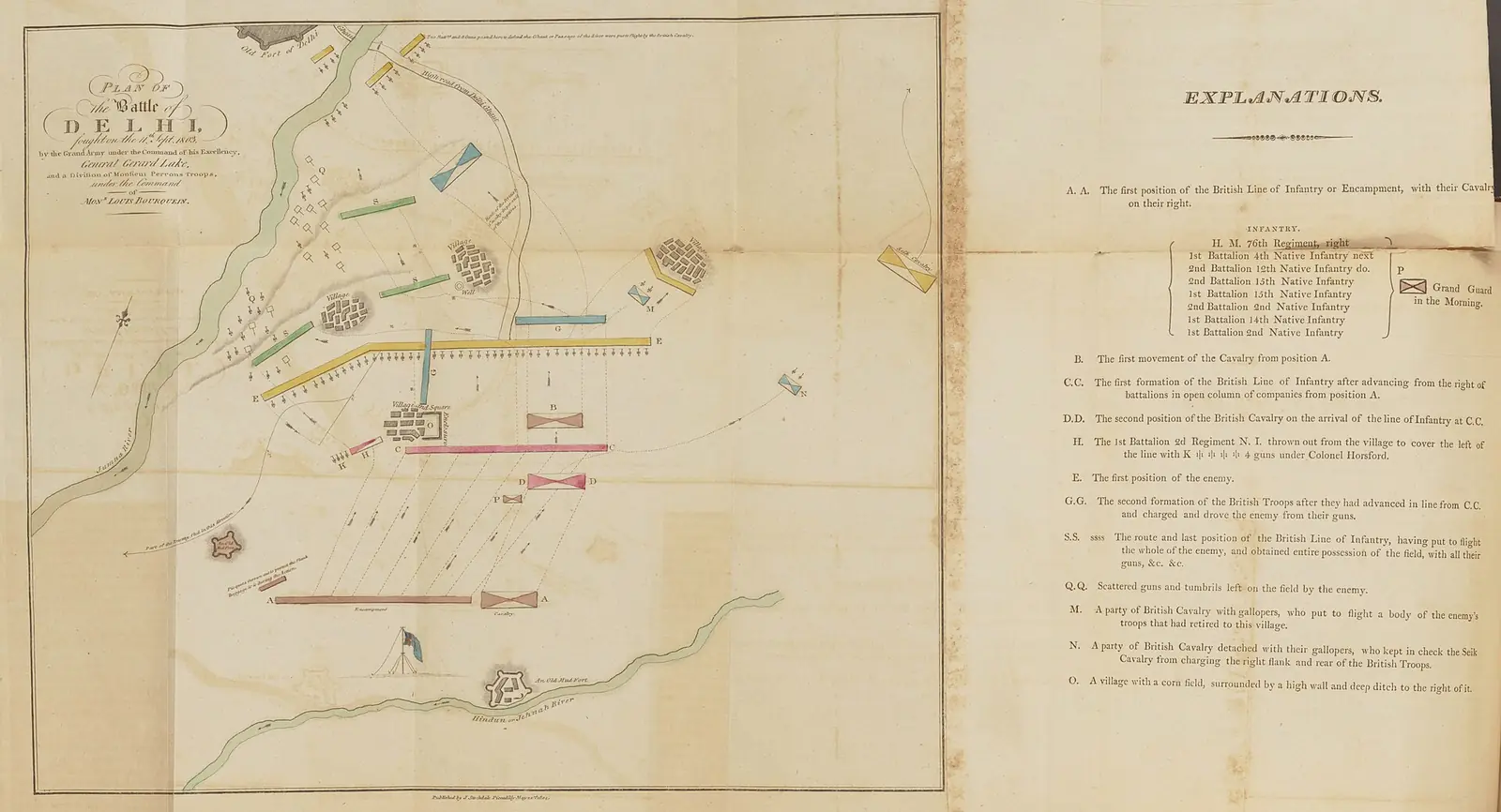
On 11 September 1803 Lake found Scindia’s army under the French officer Louis Bourquien drawn up on rising ground near Patparganj, its front covered by guns and marsh. Lake’s cavalry pretended to fall back and drew the Maratha infantry out of its position; then his infantry turned and charged with the bayonet. The Maratha guns were taken and the battalions driven into the Yamuna. Bourquien surrendered to Lake a few days later.
03The emperor changes hands
Lake crossed into Delhi and called on Shah Alam in the Red Fort. The emperor became a pensioner of the Company, keeping his title and his court inside the fort. A month later Lake beat Scindia’s last brigades at Laswari, and Wellesley won Assaye in the Deccan. By the treaty of Surji-Anjangaon in December 1803 Scindia gave up Delhi, Agra and the doab.
Delhi and the person of the Mughal emperor passed from Maratha to Company control, a change that lasted until 1857.