Cite
MLA
“Supreme Court verdict on Shri Ram Janmabhoomi.” Hindu History, 2026, https://www.hinduhistory.in/ghatana/ram-janmabhoomi-verdict-2019/. Accessed .
APA
Hindu History. (2026). Supreme Court verdict on Shri Ram Janmabhoomi. Retrieved , from https://www.hinduhistory.in/ghatana/ram-janmabhoomi-verdict-2019/
01Five centuries
Hindus have long held the spot to be the birthplace of Shri Ram. A mosque was built there in 1528–29, in Babur’s time, by his officer Mir Baqi, according to the inscriptions it carried. Hindus went on worshipping at the Ram Chabutra in the outer courtyard, and the first suit to build a temple on it was filed in 1885. In December 1949 idols of Ram Lalla were placed under the central dome; the gates were locked, and later opened by court order in 1986.
021992 and the High Court
On 6 December 1992 a crowd of kar sevaks demolished the mosque. Riots followed in several cities. The Liberhan Commission reported on the demolition in 2009, and a special CBI court in 2020 acquitted all 32 accused in the criminal case, finding no proof of a conspiracy. In 2003, on the High Court’s order, the ASI excavated the site and reported a large structure beneath the mosque. On 30 September 2010 the Allahabad High Court divided the land three ways, and every party appealed.
03The judgment
The bench of Chief Justice Ranjan Gogoi with Justices S. A. Bobde, D. Y. Chandrachud, Ashok Bhushan and S. Abdul Nazeer heard the appeals for forty days. Its judgment in M. Siddiq v. Mahant Suresh Das held that the ASI had found an underlying structure that was not Islamic, that the Hindu side had proved continuous worship in the outer courtyard while the Muslim side had not shown exclusive possession of the inner structure before 1857, and that the placing of idols in 1949 and the demolition of 1992 had both broken the law. It gave the land to the deity and told the Union government to form a trust to build the temple.
04After the verdict
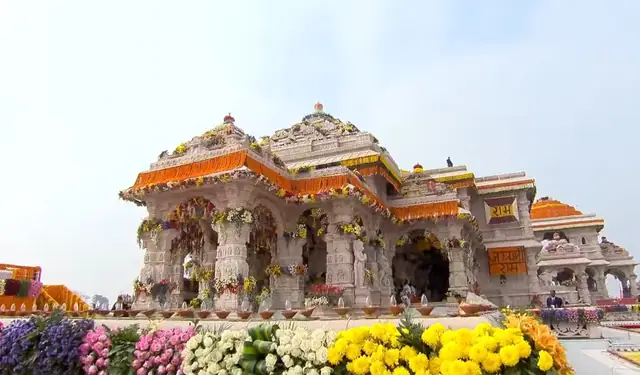
The verdict was received peacefully across the country. The Shri Ram Janmabhoomi Teerth Kshetra trust was set up in February 2020, and the bhoomi pujan for the temple was performed on 5 August 2020. The five acres for the mosque were allotted at Dhannipur, about 25 km from the site; the court used its special power under Article 142 of the Constitution to make that grant, so that complete justice might be done.