
Cite
MLA
“Cochin Royal House (Perumpadappu Swaroopam).” Hindu History, 2026, https://www.hinduhistory.in/dynasties/cochin-perumpadappu/. Accessed .
APA
Hindu History. (2026). Cochin Royal House (Perumpadappu Swaroopam). Retrieved , from https://www.hinduhistory.in/dynasties/cochin-perumpadappu/
01Perumpadappu and the flood of 1341
The house takes its name from Perumpadappu, near Ponnani, its first seat; the Zamorin of Calicut drove it south, first to Mahodayapuram near Kodungallur, the old Chera capital. Succession followed the Kerala custom of marumakkathayam: the crown passed to the eldest male of the family through the female line, brother to brother and then to sisters’ sons, never from father to son. In 1341 a great flood of the Periyar broke a new mouth through the sandbar, silted up the old port of Kodungallur, and opened a deep harbour at Kochi. Early in the fifteenth century the rajas moved there, and the kingdom of Perumpadappu became the kingdom of Cochin.
02Between the Zamorin and the Portuguese
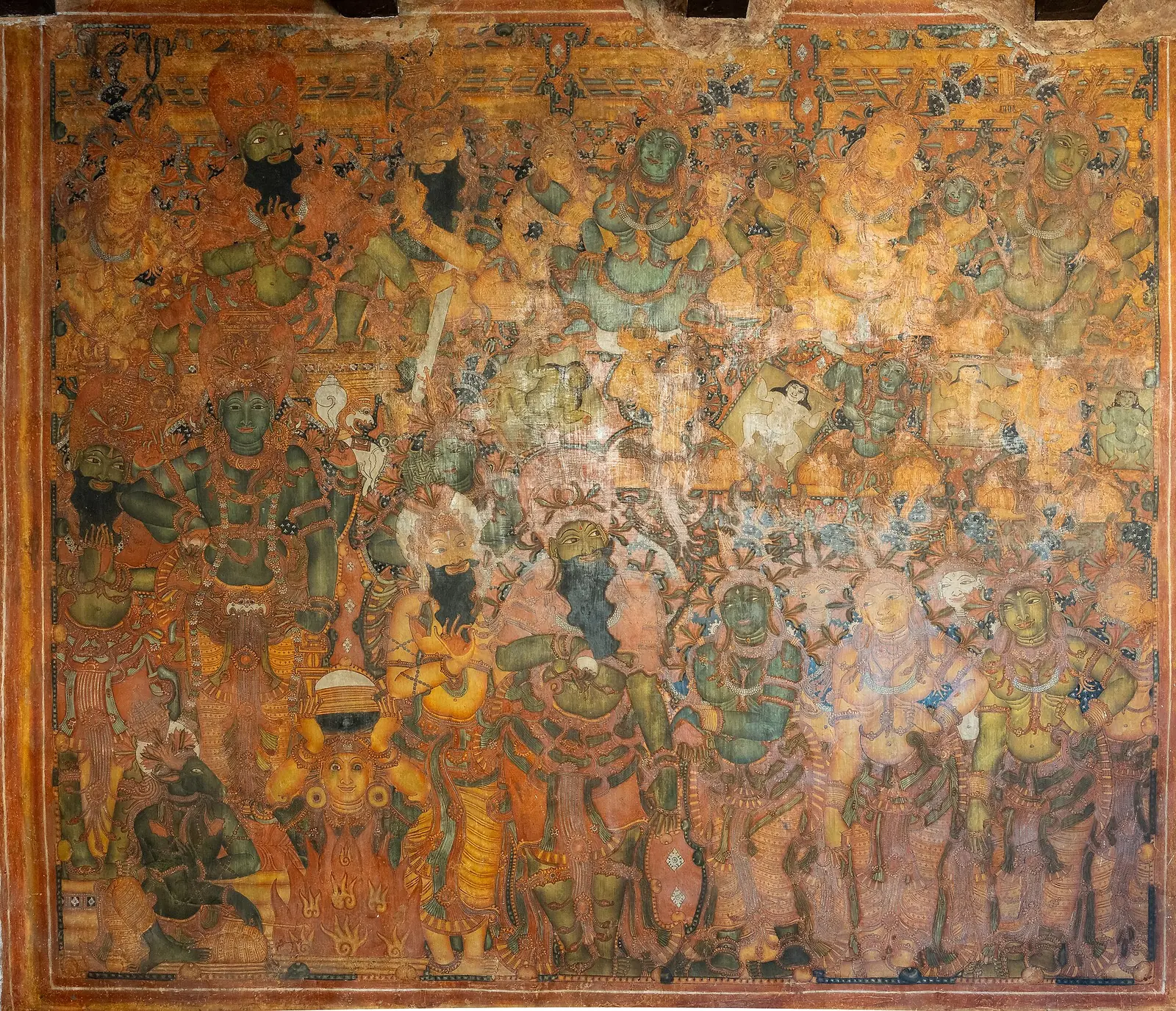
When the Portuguese arrived, Cochin was half a vassal of the Zamorin. In December 1500 the raja, Unni Goda Varma, welcomed Pedro Álvares Cabral, who had been driven from Calicut, and signed a treaty of friendship. The Zamorin attacked Kochi in 1503 and again in 1504, and the Portuguese held the town for the raja; in 1503 they laid the foundations of Fort Manuel, their first fort in India. For a century and a half Cochin lived under Portuguese protection. In 1555 they built a palace at Mattancherry for Veera Kerala Varma, and its walls were covered over the next century with murals of the Ramayana, Shri Krishna’s leelas and the Devi, among the finest in Kerala.
03The Dutch, Mysore and Sakthan Thampuran
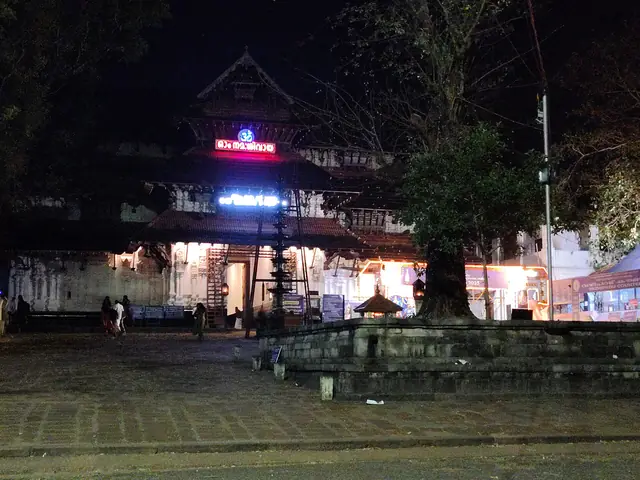
The Dutch took Kochi from the Portuguese in 1663 and repaired the Mattancherry palace, which is why it is still called the Dutch Palace. In the 1760s and 1770s Hyder Ali of Mysore overran Malabar and Cochin had to pay him tribute. Rama Varma, called Sakthan Thampuran, the strong king, ruled from 1790 to 1805. He signed a treaty with the East India Company in 1791, broke the power of the feudal chiefs, cleared the forest round the Vadakkunnathan temple, and laid out the town of Thrissur around it. He brought ten temples together in a single festival before Vadakkunnathan, and the Thrissur Pooram he began is still the greatest temple festival in Kerala.
04The harbour and the merger
Under British paramountcy Cochin was a small, well-run state with high literacy. Rama Varma XV, the Rajarshi, gave up the throne in 1914 to live as a scholar. From 1920 the state shared the cost of the harbour engineer Robert Bristow’s work, which over twenty years turned Kochi into a modern deep-water port around the new Willingdon Island. Kerala Varma, who ruled from 1946 to 1948, called for a single state of the Malayalis and is remembered as the Aikya Keralam Thampuran. Cochin acceded to India in 1947, joined Travancore in 1949 as Travancore-Cochin, and became part of Kerala in 1956. The Hill Palace at Thrippunithura, the last royal seat, is now a museum.
The rulers
- 1Unni Goda VarmaWelcomed Cabral and allied with Portugalc. 1500
- 2Veera Kerala Varma IMattancherry palace built for him, 15551537–1565
- 3Rama Varma IX (Sakthan Thampuran)Built Thrissur; began Thrissur Pooram1790–1805
- 4Rama Varma XV (Rajarshi)Abdicated to live as a scholar1895–1914
- 5Rama Varma XVI1914–1932
- 6Rama Varma XVII1932–1941
- 7Kerala Varma (Aikya Keralam Thampuran)Called for a united Kerala1946–1948
- 8Rama Varma (Parikshith Thampuran)Last ruling raja; merger with Travancore1948–1949
What they left
- The Mattancherry (Dutch) Palace and its Ramayana murals
- Thrissur town and the Thrissur Pooram
- The Sri Poornathrayeesa temple at Thrippunithura
- The Hill Palace at Thrippunithura, now a museum
- The modern port of Kochi