
Cite
MLA
“Bhati Rawals of Jaisalmer.” Hindu History, 2026, https://www.hinduhistory.in/dynasties/bhati-jaisalmer/. Accessed .
APA
Hindu History. (2026). Bhati Rawals of Jaisalmer. Retrieved , from https://www.hinduhistory.in/dynasties/bhati-jaisalmer/
01Yaduvanshi of the desert
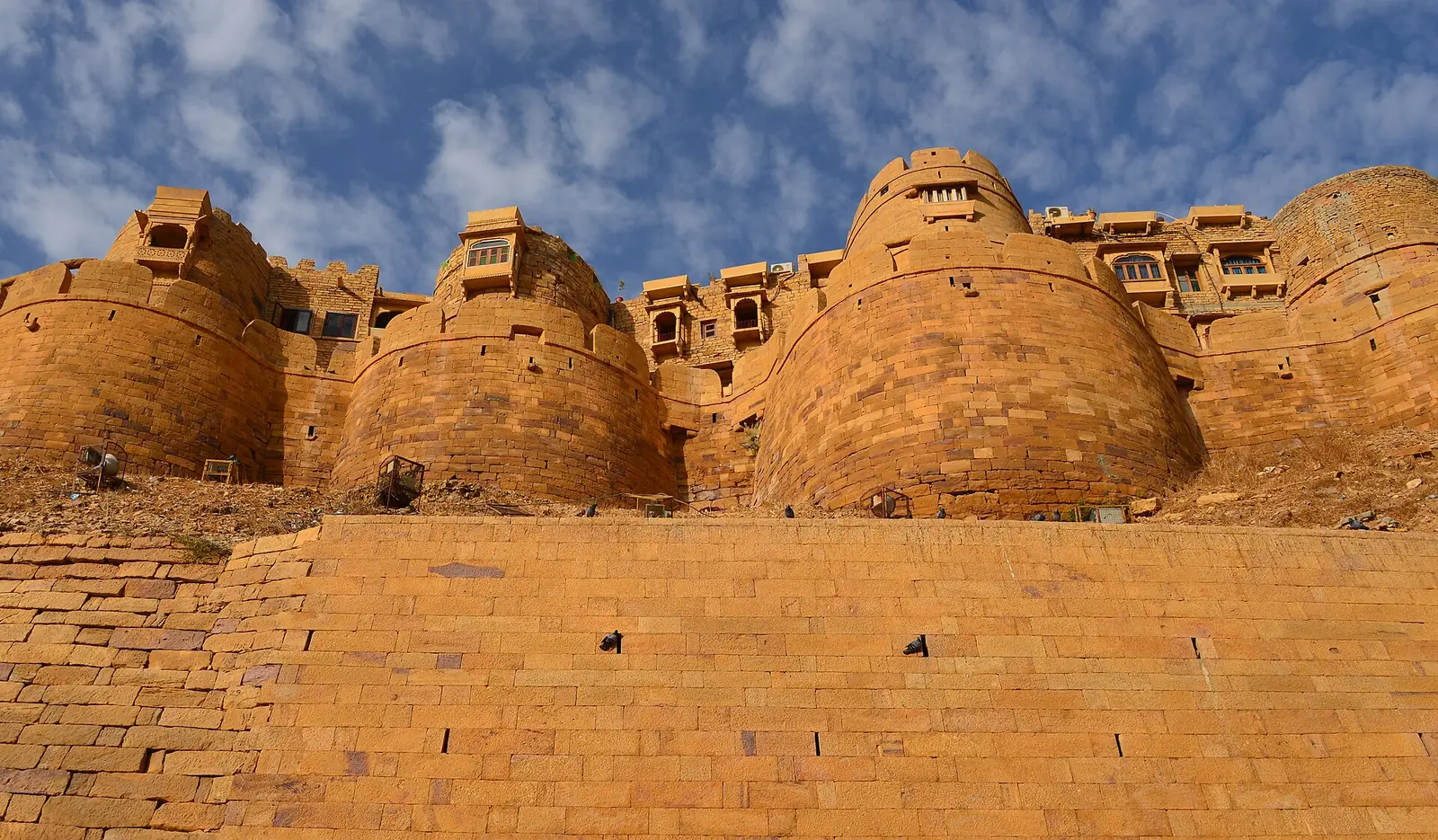
Bhati genealogies, as Muhnot Nainsi recorded them in the seventeenth century, trace the clan from the Yadavas of Mathura through Rao Bhati, and tell of earlier seats at Bhatner, Tanot, Derawar and Lodurva. Tanot, now on the Pakistan border, keeps its temple of Tanot Mata, honoured by the Bhatis long before soldiers of the Border Security Force took over its care. Lodurva, the last of these capitals, lies sixteen kilometres north-west of Jaisalmer, and its Jain temple was rebuilt in the seventeenth century. In 1156 Rawal Jaisal left Lodurva, which lay open on the plain, for the hill of Trikuta, and began the fort that gave the state its name.
02The sakas of Jaisalmer
Jaisalmer speaks of its two and a half sakas. A saka is the last act of a fort that cannot hold: the women commit jauhar, and the men put on saffron and ride out to die. The first came at the end of the thirteenth century, when Alauddin Khalji’s army besieged the fort for a long time, said to have been provoked by a Bhati raid on a treasure caravan; the women gave themselves to the fire and the men fell under Rawal Mularaj and his brother Ratan Singh. The second is placed in the fourteenth century under Rawal Duda. The half saka, in Rawal Lunkaran’s time in the sixteenth century, is called half because the men fell fighting but there was no jauhar.
03Caravans, havelis and the treaty
For centuries the state lived on the caravans that crossed the Thar with camels loaded with silk, opium, indigo and spices, and on the duties its rawals took from them. The yellow sandstone of the fort, its seven Jain temples of the twelfth to sixteenth centuries, and the carved havelis of merchant families in the town below all rose on that trade. Maharawal Akhai Singh struck his own silver Akhaishahi rupee in the eighteenth century. Maharawal Mulraj II, who ruled for nearly sixty years, signed a treaty with the East India Company on 12 December 1818. When sea trade through Bombay replaced the desert roads, Jaisalmer grew poor, and the famine of 1895–1900 killed much of its livestock.
04A living fort
Maharawal Jawahir Singh, who ruled from 1914, brought water works and schools, and in 1949 Jaisalmer joined the Union of India and then Rajasthan. The fort did not empty. A few thousand people still live inside its ninety-nine bastions, in houses and lanes their families have held for generations, which makes it one of the very few living forts in the world. In 2013 it was inscribed by UNESCO with five other forts as the Hill Forts of Rajasthan. The Gadisar tank below the walls, where the town drew its water, is named for Rawal Gharsi.
The rulers
- 1Rawal JaisalFounded Jaisalmer fort, 1156c. 1156–1168
- 2Rawal Mularaj IFell in the first saka against Alauddin Khaljilate 13th century
- 3Rawal DudaThe second sakac. early 14th century
- 4Rawal GharsiGadisar tank bears his namec. 14th century
- 5Rawal LunkaranThe half sakac. 1530–1551
- 6Rawal Harrajc. 1562–1578
- 7Maharawal Amar Singh1661–1702
- 8Maharawal Akhai SinghStruck the Akhaishahi rupee1722–1762
- 9Maharawal Mulraj IITreaty with the Company, 18181762–1820
- 10Maharawal Gaj Singh1820–1846
- 11Maharawal Salivahan SinghFamine of 1895–19001891–1914
- 12Maharawal Jawahir SinghLast ruler before accession to India1914–1949
What they left
- Jaisalmer fort, Sonar Qila, still lived in, a UNESCO site since 2013
- The Laxminath temple and the seven Jain temples inside the fort
- The Jain manuscript libraries of Jaisalmer, among the oldest in India
- Gadisar tank and the merchant havelis of the town
- The temple of Tanot Mata on the western border