Cite
MLA
“Khatu Shyam Ji.” Hindu History, 2026, https://www.hinduhistory.in/devata/khatu-shyam/. Accessed .
APA
Hindu History. (2026). Khatu Shyam Ji. Retrieved , from https://www.hinduhistory.in/devata/khatu-shyam/
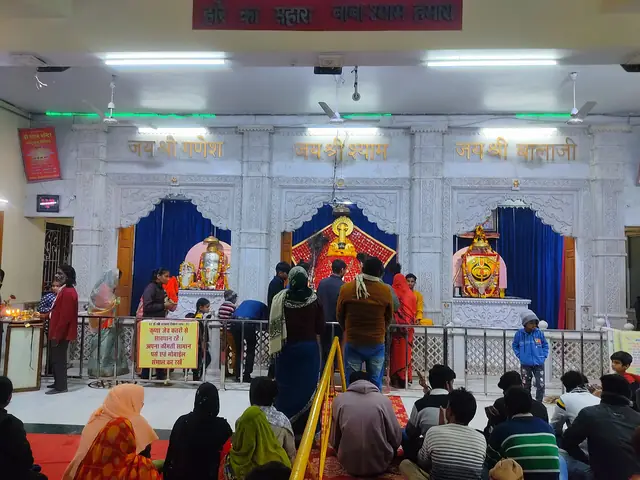
Only a head, the sheesh, dark in colour, with large eyes and a moustache, dressed each day in a fresh shringar of flowers, a crown and a turban; behind it a blue horse in pictures, and three arrows.
01The warrior with three arrows
Barbarika was the son of Ghatotkacha and Maurvi, a daughter of the asura Mura of Pragjyotisha, and so the grandson of Bhima and Hidimba. He learned war from his mother and won three arrows from the Devi that would never miss: the first marked every target, the second spared what was to be spared, the third destroyed the rest. His mother made him promise to fight always on the losing side. When the armies gathered at Kurukshetra, he set out to join them. Vyasa’s Mahabharata does not tell of him; his katha is told in the Skanda Purana and in the songs of Rajasthan, Haryana and Gujarat, where he is also Baliyadev.
02The gift of the head
Shri Krishna met him on the road disguised as a brahmin and asked how he would fight. With one arrow, Barbarika said, he could end the war. Krishna saw the danger: whichever side he joined would begin to lose, and by his vow he would have to change sides again and again until no one was left. So Krishna asked for a gift, and when Barbarika promised, he asked for his head. Barbarika knew then who stood before him. He asked only to see the war, and gave his head. Krishna set it on a hilltop, from where it watched all eighteen days, and blessed him that in the Kali Yuga he would be worshipped by Krishna’s own name, Shyam, and would be the support of all who have lost.
03The head found at Khatu
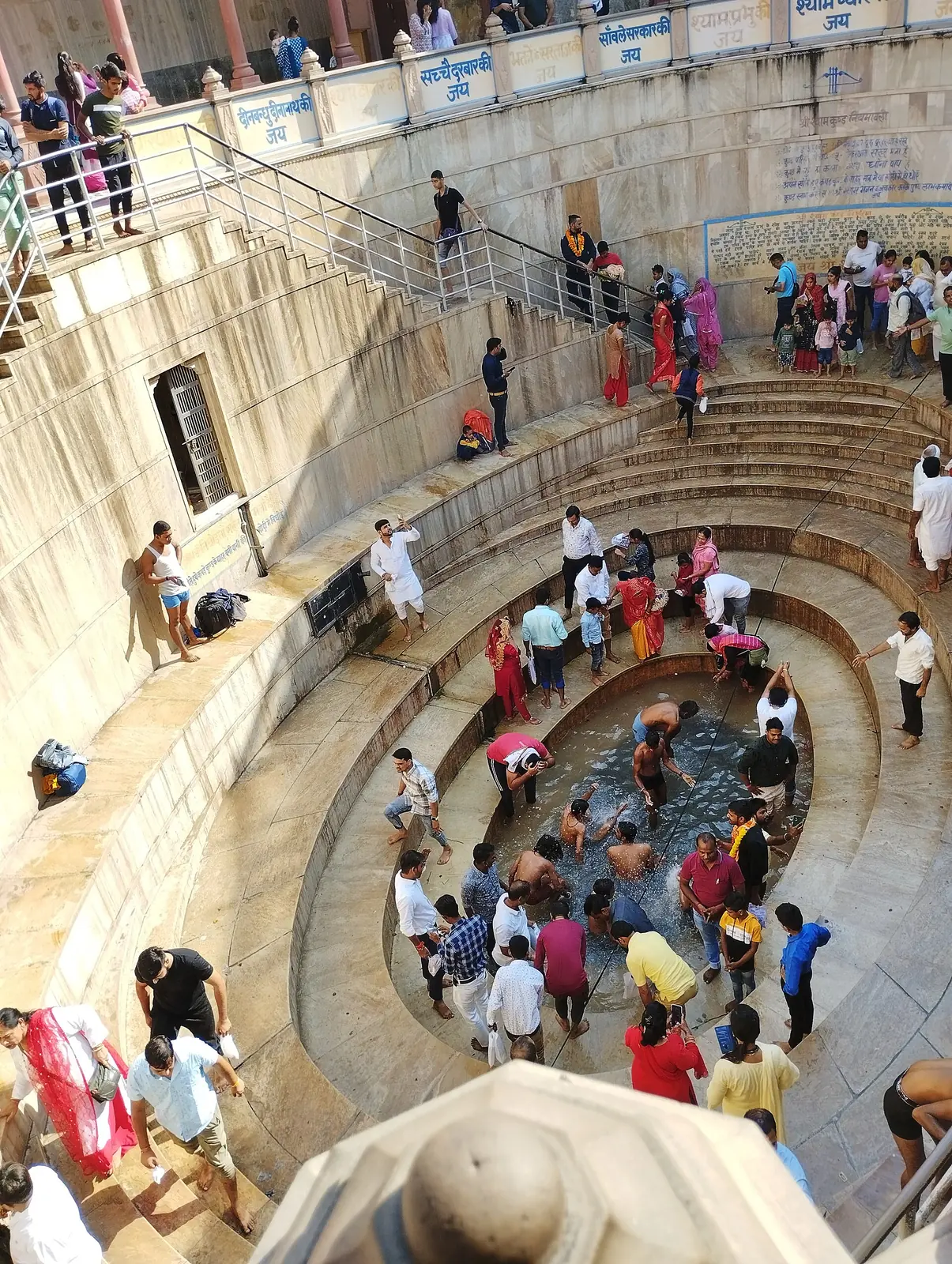
The temple’s tradition says the head lay buried at Khatu and forgotten, until the Devata showed its place in a dream. When the ground was dug, the head was found, at the place now called Shyam Kund, where pilgrims bathe. Roop Singh Chauhan, the local ruler, and his wife Narmada Kanwar, guided by a dream, built the first temple, in 1027 CE by the temple’s reckoning; some accounts give an earlier century. The present temple was renovated in 1720 (Samvat 1777) by Diwan Abhay Singh, acting for the ruler of Marwar, and has since been rebuilt in white Makrana marble. Khatu lies in Sikar district, about eighty kilometres from Jaipur.
04The Phalgun mela and the nishan
His great day is Phalgun Shukla Ekadashi and Dwadashi, in February or March, when lakhs walk to Khatu, many of them barefoot from Ringas, about seventeen kilometres away, carrying the nishan, a saffron, orange or red triangular flag, to offer at the temple. A white nishan is carried on foot all the way from Surajgarh, some 150 kilometres, and hoisted on the temple’s spire during the mela. Kartik Shukla Ekadashi, when his birth is kept, is the second great day. Bhajan evenings in his name, Shyam jagran, now fill halls from Kolkata to Mumbai, and his devotees greet one another with ‘Jai Shri Shyam’.
In the texts
- Skanda Purana, Maheshvara Khanda, Kaumarika Khanda (Barbarika’s katha)
- Shyam bhajans and the Shyam Chalisa