Cite
MLA
“Battle of Gujrat.” Hindu History, 2026, https://www.hinduhistory.in/battles/battle-of-gujrat-1849/. Accessed .
APA
Hindu History. (2026). Battle of Gujrat. Retrieved , from https://www.hinduhistory.in/battles/battle-of-gujrat-1849/
The Sikh army was broken by the Company’s artillery and pursued; it surrendered in March and the Punjab was annexed.
01The battle of the guns
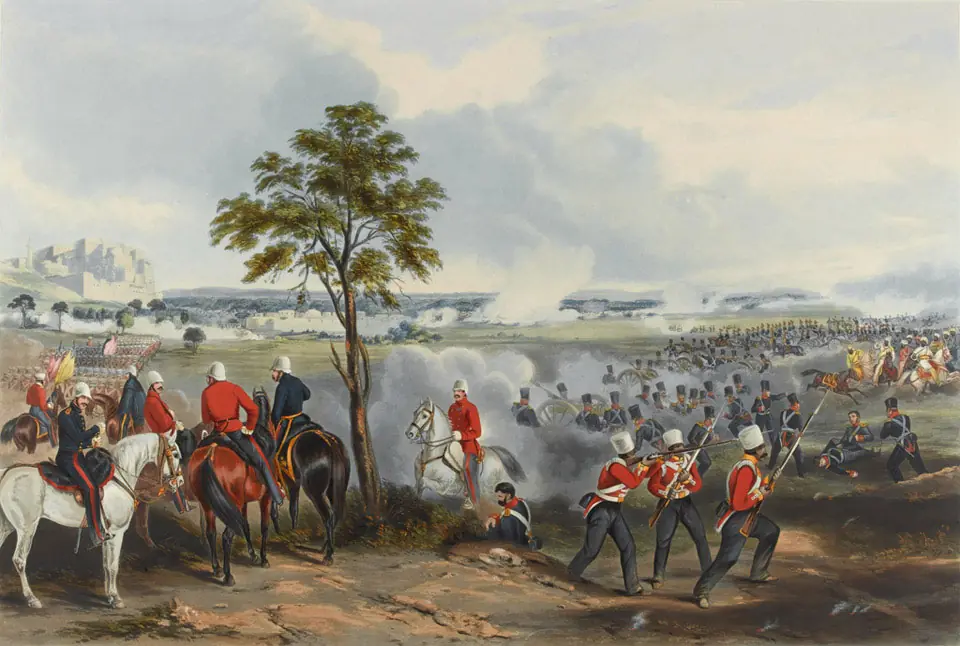
After Chillianwala the Sikh army, joined by Chattar Singh’s men and a body of Afghan horse sent by Dost Muhammad Khan, moved towards Gujrat. Multan had fallen in January, freeing more Company troops. On the clear morning of 21 February 1849 Gough opened with nearly a hundred guns, the largest artillery the Company had yet brought to an Indian field. For close to three hours the guns fired before the infantry went in.
02Rout and surrender
The Sikh gunners answered as long as they could, but their batteries were silenced and their villages strongpoints taken. By early afternoon the Sikh army was in retreat and the Company cavalry chased it for miles. On 12–14 March 1849, near Rawalpindi, Sher Singh and Chattar Singh laid down their arms. Old Khalsa soldiers, it was said, laid down their swords one by one and saluted them.
03The end of Ranjit Singh’s kingdom
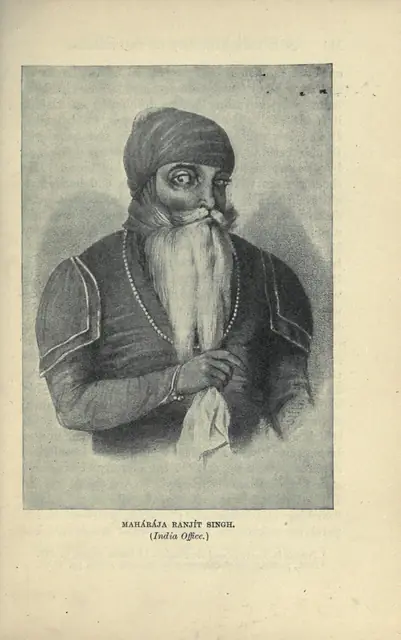
On 29 March 1849 Lord Dalhousie’s proclamation annexed the Punjab. The eleven-year-old Duleep Singh was pensioned off and later taken to England, and the Koh-i-Noor diamond from the Lahore treasury was sent to Queen Victoria. Fifty years after Ranjit Singh entered Lahore, the last independent kingdom of the subcontinent was gone.
Gujrat led straight to the annexation of the Punjab, completing the Company’s conquest of the subcontinent.