
Cite
MLA
“The uru of Beypore.” Hindu History, 2026, https://www.hinduhistory.in/samudra/beypore-uru/. Accessed .
APA
Hindu History. (2026). The uru of Beypore. Retrieved , from https://www.hinduhistory.in/samudra/beypore-uru/
What defines it
- 01
Uru: large wooden trading ship of the Arabian Sea
- 02
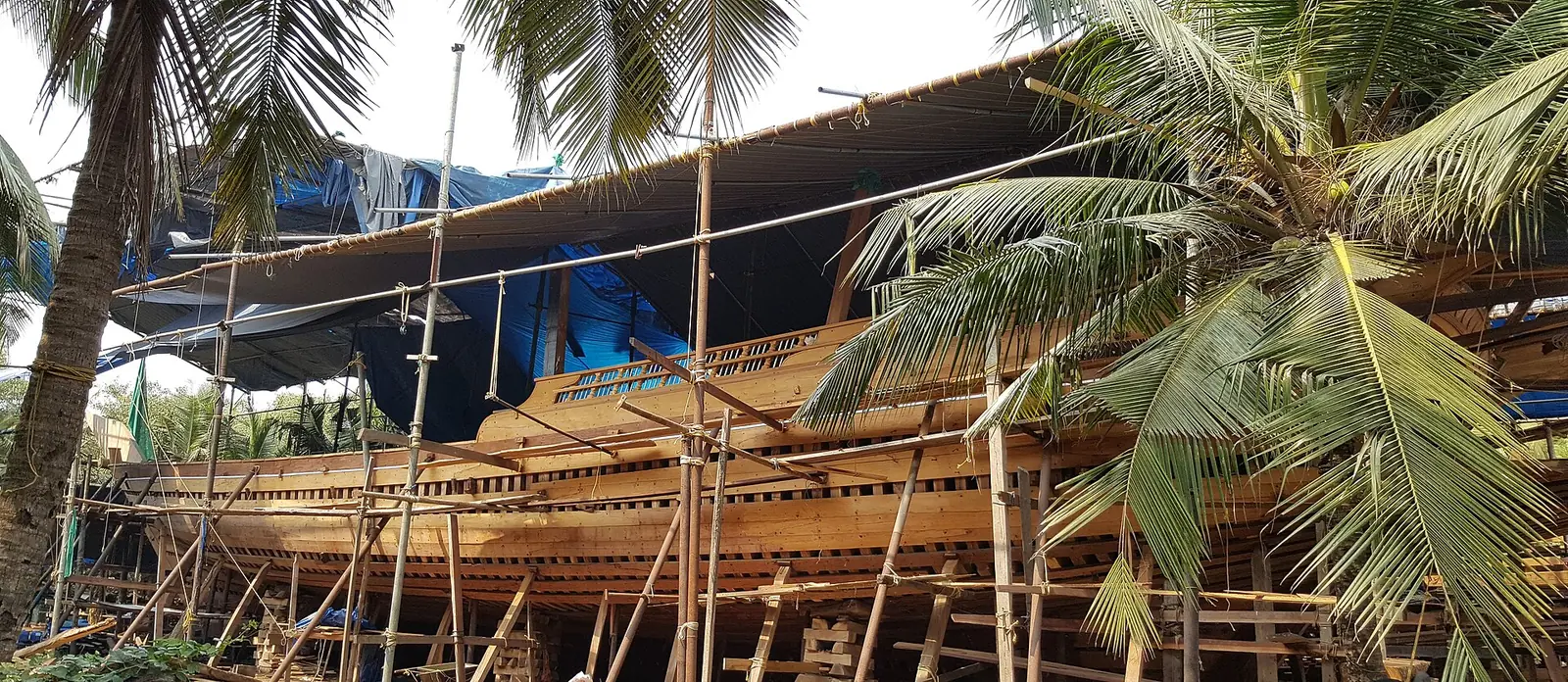
Built of Malabar teak without written plans
- 03
Launched by hand by the khalasis
01Teak from the Malabar hills
Malabar teak was the shipbuilding timber of the western ocean, carried down the Chaliyar from the Nilambur forests. Beypore’s yards turned it into urus for Arab merchants for centuries, and still do. An uru takes a year or more to build. The master carpenters work without written plans, setting the lines of the hull by eye and by rule of thumb passed from father to son.
02The khalasis’ launch
When the hull is done, the khalasis, a guild of Mappila workmen, move it to the water with no crane: wooden rollers, levers, pulleys and ropes, and a hundred men pulling in rhythm to their own work-songs. Their skill is sought for heavy lifting far beyond the shipyard. The launch of an uru at Beypore still draws a crowd.
03A port with a long memory
Beypore sits beside Kozhikode, the Samoothiri’s city, where Chinese, Arab and Indian ships met for centuries, and where Vasco da Gama landed nearby in 1498. Tipu Sultan briefly planned to make it a naval port. Today the urus built here are mostly for Gulf owners, and Kerala Tourism lists the yards as a heritage site.