
Cite
MLA
“Maitrakas of Valabhi.” Hindu History, 2026, https://www.hinduhistory.in/dynasties/maitraka/. Accessed .
APA
Hindu History. (2026). Maitrakas of Valabhi. Retrieved , from https://www.hinduhistory.in/dynasties/maitraka/
01From senapati to chakravartin
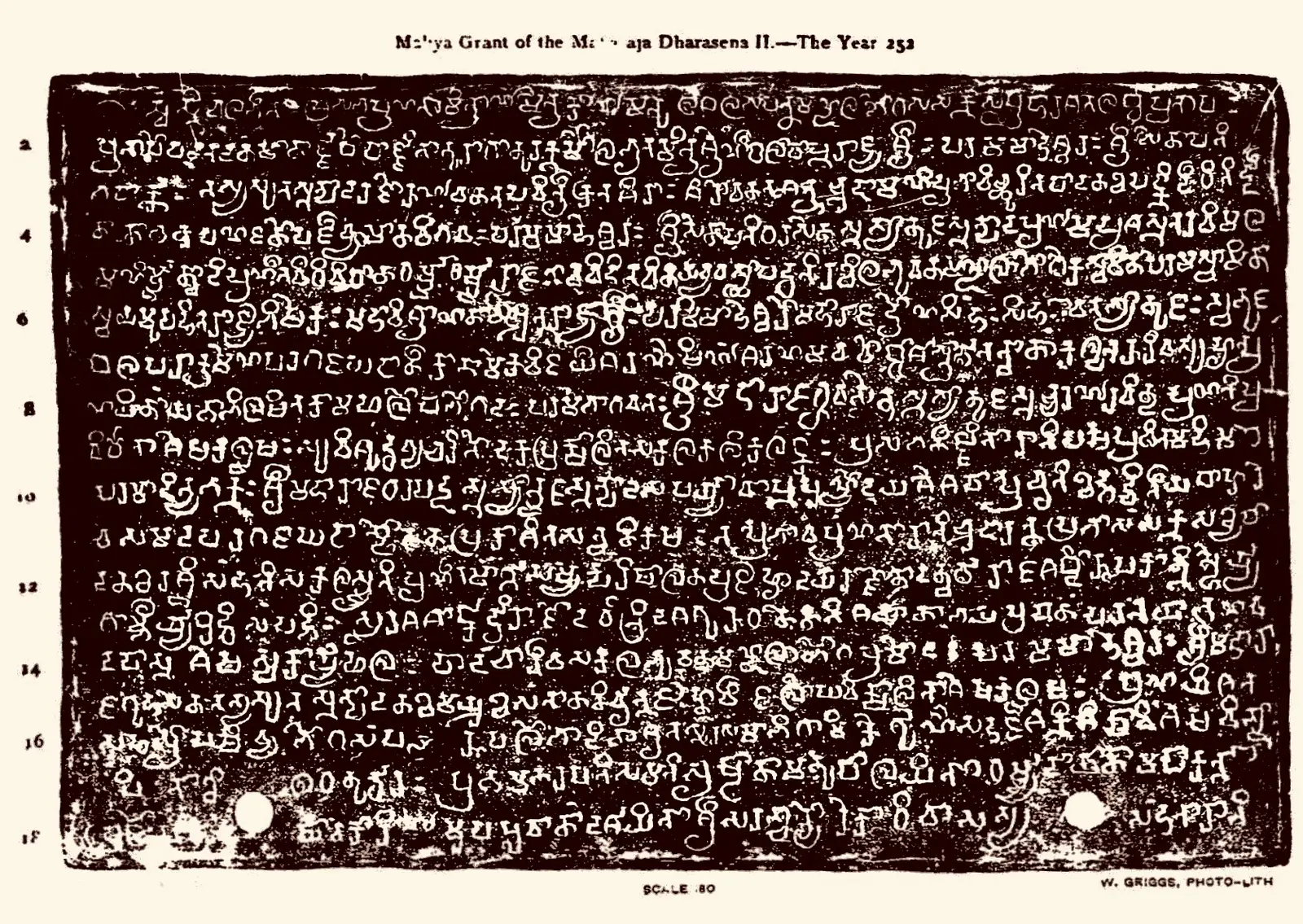
Bhatarka and his son Dharasena I called themselves only senapati, general, and their grants still bow to an unnamed paramount lord. The third ruler, Dronasimha, took the title maharaja. Guhasena dropped the old formula of loyalty to the Guptas, and his son Dharasena II used mahadhiraja; his Maliya copper plate of 572 CE survives. Kharagraha I’s Virdi plate of 616 CE shows Maitraka power reaching Ujjain. In the next generation Dhruvasena II Baladitya married a daughter of Harsha and accepted his overlordship, and his son Dharasena IV took the full imperial style: paramabhattaraka, maharajadhiraja, parameshvara, chakravartin.
02Valabhi the city of learning
Xuanzang came to Valabhi around 640 CE and found a rich port with many monasteries; he praised the earlier king Shiladitya I Dharmaditya for his kindness. Yijing, writing late in the seventh century, named Valabhi with Nalanda as the two places where learned men gathered. The Buddhist teachers Sthiramati and Gunamati lived and wrote here, and Brahmin students came too; graduates of Valabhi are said to have been sent to high office. The poem Bhattikavya, which teaches Sanskrit grammar while telling the life of Shri Rama, was written at Valabhi under a king Shridharasena. Jain tradition places at Valabhi the council of Devarddhi Kshamashramana, where the Agamas were first written down, 980 years after Mahavira’s nirvana.
03Grants, temples and the end
Most of what we know of the Maitrakas comes from their copper plates, each opening with the family’s line and closing with the gift of a village to a Brahmin or a vihara. One series records the Duddha vihara, founded by Duddha, a niece of Dhruvasena I. More than a hundred small stone temples of this age are known along the coast of Saurashtra. In the eighth century Arab fleets and armies from Sindh raided the coast. The last king on record is Shiladitya VII, around 766 CE, and no source says how the dynasty ended. Later Jain accounts tie the fall of Valabhi to raiders from the sea.
The rulers
- 1BhatarkaGupta general; founder, styled senapatic. late 5th century
- 2Dharasena IStill styled senapatic. late 5th century
- 3DronasimhaFirst to take the title maharajac. early 6th century
- 4Dhruvasena IStyled parama-bhagavatac. 520s–540s
- 5DharapattaThe one Surya-worshipping kingc. mid-6th century
- 6GuhasenaDropped the formula of Gupta loyaltyc. 550s–560s
- 7Dharasena IIMaliya copper plate, 572 CEc. 570–595
- 8Shiladitya I DharmadityaPraised by Xuanzangc. 595–615
- 9Kharagraha IVirdi plate of 616 CE names Ujjainc. 615–620s
- 10Dharasena IIIc. 620s
- 11Dhruvasena II BaladityaMarried Harsha’s daughterc. 620s–640s
- 12Dharasena IVTook the title chakravartinc. 640s–650
- 13Shiladitya VIILast king on recordc. 766
What they left
- Hundreds of copper-plate grants, the backbone of Gujarat’s early history
- Valabhi’s schools, named with Nalanda by Yijing
- Bhattikavya, the Rama-katha that teaches Sanskrit grammar
- The Valabhi council where the Jain Agamas were written down
- Early stone temples along the Saurashtra coast