Cite
MLA
“Mata Vaishno Devi.” Hindu History, 2026, https://www.hinduhistory.in/devata/vaishno-devi/. Accessed .
APA
Hindu History. (2026). Mata Vaishno Devi. Retrieved , from https://www.hinduhistory.in/devata/vaishno-devi/
In the cave there is no carved image, only three rock pindis on a single ledge, bathed by the Charan Ganga stream. Pictures show her as a young Devi on a lion, with eight arms holding weapons, under a red canopy.
01Three pindis in a cave
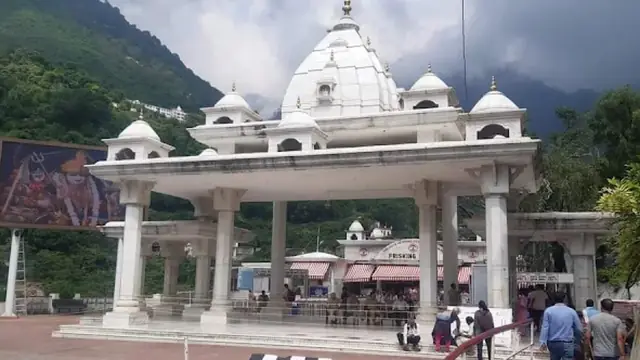
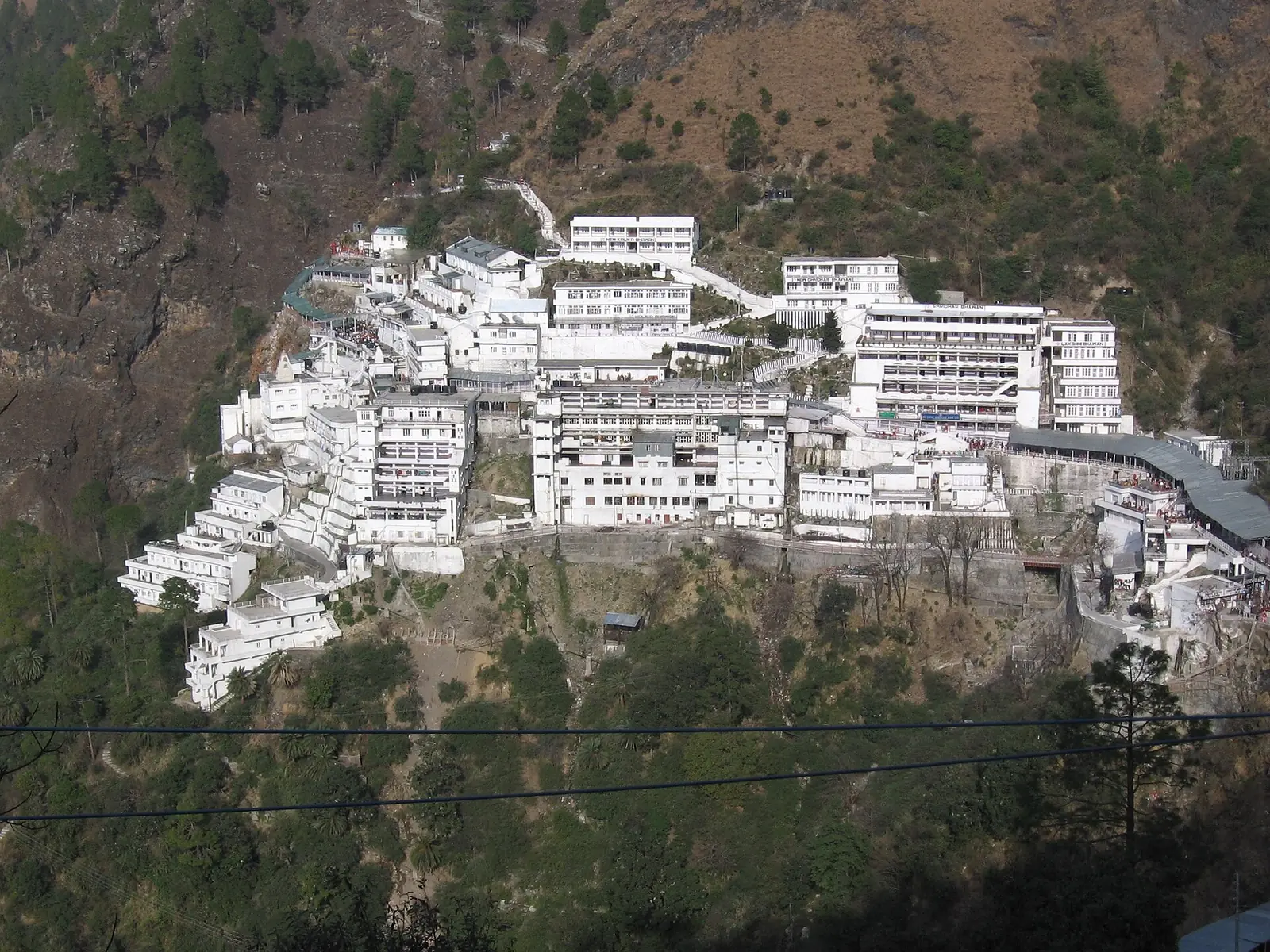
The shrine is a cave at about 1,585 metres on the three-peaked Trikuta mountain in Reasi district, reached by a path of about twelve kilometres from Katra. Inside, on one rock platform, are three natural pindis, worshipped as Mahakali, Mahalakshmi and Mahasaraswati; Vaishno Devi is the Devi in whom all three are one, and the middle pindi is often taken as hers. The old cave is narrow, about thirty metres long, and pilgrims once had to wade through the cold Charan Ganga stream inside it; newer tunnels now carry most of the crowd. Before the cave come Banganga, where the Devi struck the rock with an arrow to bring out water, Charan Paduka, with her footprints, and Ardhkuwari halfway up.
02Shridhar’s bhandara and Bhairon Nath
The katha the Shrine Board tells begins with Pandit Shridhar of Hansali village near Katra, a poor devotee, at whose door the Devi appeared as a young girl and asked him to hold a bhandara for the village. Among the guests came the yogi Bhairon Nath, a disciple of Guru Gorakhnath, who tried to seize her. She slipped away into the hills, stopping at Banganga and Charan Paduka, and hid for nine months in the narrow cave at Ardhkuwari called Garbh Joon, the womb. When Bhairon found her, she broke out through the rock, went up to the holy cave, and at its mouth, as Mahakali, struck off his head. It fell on the ridge above, where the Bhairon temple stands. Repenting, he begged forgiveness; she forgave him and said no pilgrimage to her would be complete without his darshan.
03Waiting for Rama
Another katha, told by her devotees, goes back to the Treta Yuga. The Devi took birth as Vaishnavi, a girl devoted to Vishnu, and did tapas in the forest hoping to wed him. When Shri Rama passed during his exile, she asked him to marry her. He told her he was bound by his vow to one wife, Sita, but promised to return in the Kali Yuga as Kalki and take her then; until that time she was to remain in meditation in the cave of Trikuta. So the Devi sits there still, as Vaishnavi, the Shakti of Vishnu. Her pilgrims offer her red chunris, coconuts and dry fruit.
04The shrine in recorded history
Accounts of the shrine’s age differ. The Shrine Board places Pandit Shridhar’s finding of the cave about seven hundred years ago; other local accounts put it near the tenth century, and land grants to the Baridar families who long served the shrine are said to go back to the eleventh century. Until 1986 the cave was in the care of those families. In August 1986 the government of Jammu and Kashmir took it over under a Shrine Board chaired by the Governor, a step made law by the Shri Mata Vaishno Devi Shrine Act of 1988. Pilgrim numbers rose from about nine lakh in 1981 to over a crore in 2011, and the Board counted about 95 lakh in 2023. Navaratri in Ashvin and Chaitra are the busiest days.
In the texts
- Shri Mata Vaishno Devi Shrine Board accounts of the katha
- Durga Saptashati (the three forms Mahakali, Mahalakshmi, Mahasaraswati)