
Cite
MLA
“Pabuji Rathore.” Hindu History, 2026, https://www.hinduhistory.in/devata/pabuji/. Accessed .
APA
Hindu History. (2026). Pabuji Rathore. Retrieved , from https://www.hinduhistory.in/devata/pabuji/
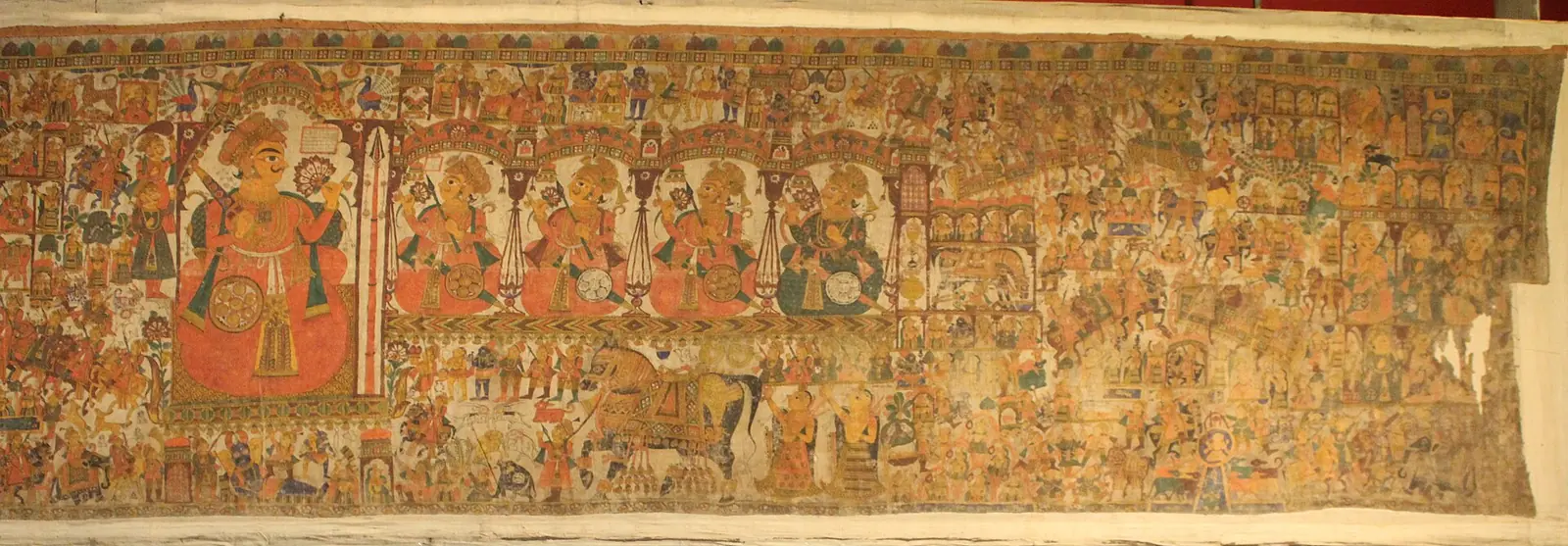
A Rajput warrior on a black mare, Kesar Kalami, with a lance and shield, a curled moustache and a turban; in the par he is drawn larger than everyone else, at the centre, with his court at Kolu around him.
01The man of Kolu
Here the record and the epic can be told apart. Chronicles kept at the Rajasthan Oriental Research Institute in Jodhpur suggest that Pabuji was a real man, a Rathore of the line of Dhandhal, who probably lived in the early fourteenth century near the village of Kolu, on the edge of the Thar. Devotees give his birth as Bhadrapada Shukla Dooj, Samvat 1405, a little later. The earliest written version of his story, from the sixteenth century, runs to about 370 lines and does not call him a god; Muhnot Nainsi’s chronicle of Marwar, about 1650, gives him powers beyond the human. The epic the bhopos sing today runs to some four thousand lines. Between the two, the man became the Devata of the herders.
02Deval’s cattle and the broken wedding
In the epic, Pabuji is born of a celestial nymph who leaves him, promising to return as a mare. He goes to Deval, a Charan woman held to be the Devi herself, and asks for her black mare Kesar Kalami, which the Khinchi chief Jind Rao also wants. Deval gives it when Pabuji swears to guard her herds with his life. For his niece Kelam’s wedding he promises she-camels from Lanka, and his men raid and bring them back. Then he rides to Umarkot to marry the Sodha princess Phulvanti. In the middle of the wedding rounds word comes that Jind Rao has driven off Deval’s cattle. Pabuji leaves the pavilion, recovers the herd, and is killed in the fight with all his men. His nephew Rupnath later avenges him.
03The par and the bhopo
The epic is sung by bhopos of the Nayak community, who travel in pairs, a man and his wife. They carry the par, a cloth about fifteen feet long painted with the whole story, which is unrolled at night between two poles and worshipped as Pabuji’s moving temple. The bhopo plays the ravanhattho, a bowed fiddle, points to each scene with his bow, and dances, his red robe swinging and his ankle bells ringing; the bhopi holds up a lamp to light the scene and sings with him. A full telling takes eight or nine nights. The pars are painted by the Joshi families of Shahpura and Bhilwara. James Tod saw such a performance in 1819; the earliest dated par known to John D. Smith is from 1867.
04Devata of the herders
Pabuji’s chief worshippers are the Rebari, the camel and cattle herders of Marwar, who count Harmal, the Rebari herdsman of the epic, among his companions. A family may vow a par reading to Pabuji, and the bhopos are then called to sing through the night in the village. His main shrine, the Pabuji Maharaj Raan Bhumi, is at Kolu, about twenty-five kilometres south of Phalodi. The Cambridge scholar John D. Smith recorded and translated a full performance by a bhopo of the Nayak community, published as The Epic of Pabuji, the most complete text of any Rajasthani oral epic.
In the texts
- Pabuji ri par (oral epic, Rajasthani)
- Pabuprakash (Rajasthani verse account)
- Vat Pabuji ri, in Muhnot Nainsi ri Khyat (c. 1650)