Cite
MLA
“Gramadevata, the village guardians.” Hindu History, 2026, https://www.hinduhistory.in/devata/gramadevata/. Accessed .
APA
Hindu History. (2026). Gramadevata, the village guardians. Retrieved , from https://www.hinduhistory.in/devata/gramadevata/
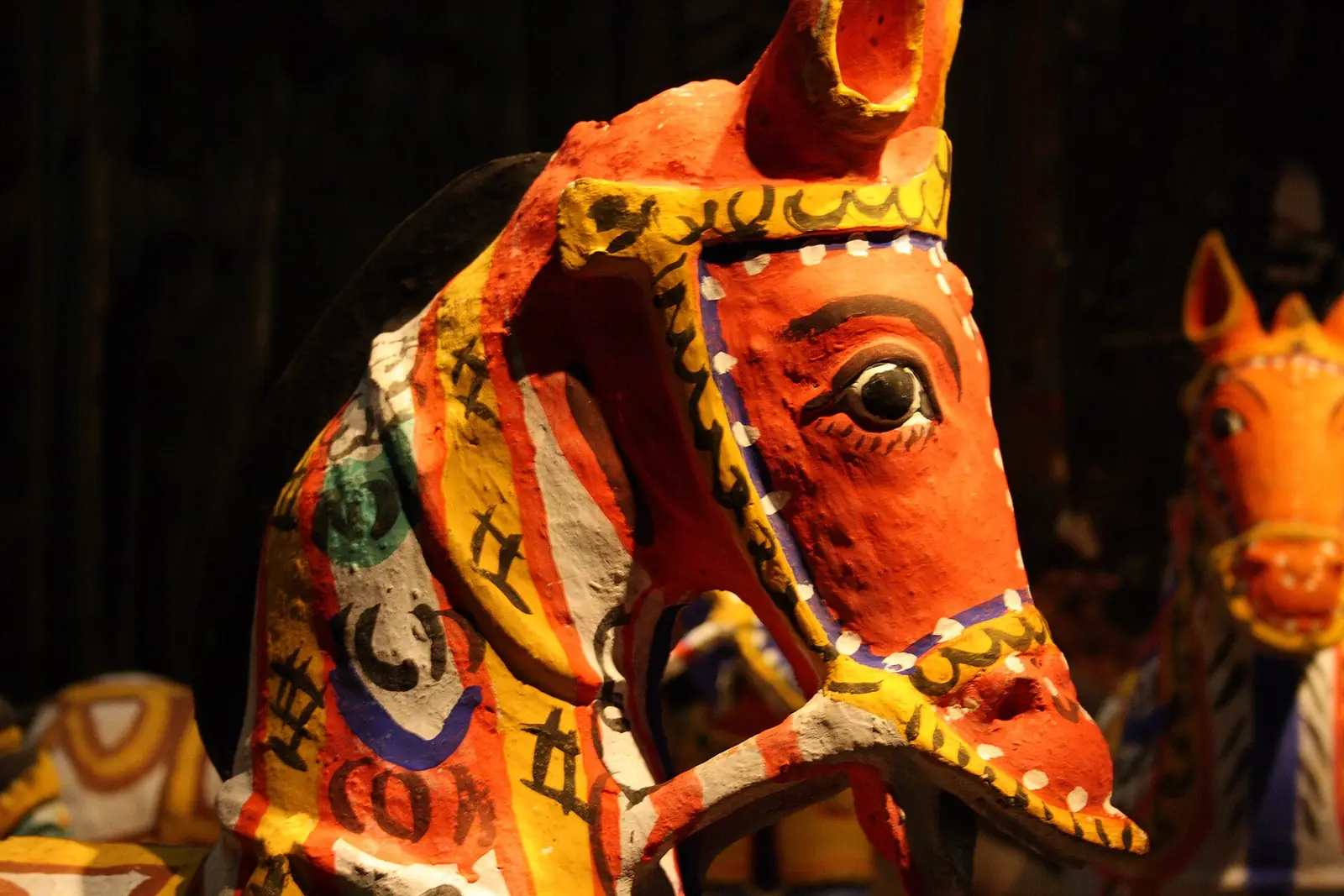
Anything from a rough stone smeared with turmeric and kumkum, a trident or a flag, to a carved head or a full murti; Ayyanar sits armed and crowned with rows of clay horses before him.
01The Devata of one place
Grama means village and devata a deity. Before the great temple of the town and the household shrine, there is the Devata who belongs to this one place: who knows its boundary, watches its cattle and keeps out cholera and pox. Bishop Henry Whitehead, who spent years in the villages of the Tamil, Telugu and Kannada country and published The Village Gods of South India in 1916, found that there they are, with very few exceptions, Devis, and that they belong to the life of the fields. Their shrine is often only a small brick room, sometimes just a stone platform under a tree, and sometimes there is no shrine at all.
02Their names
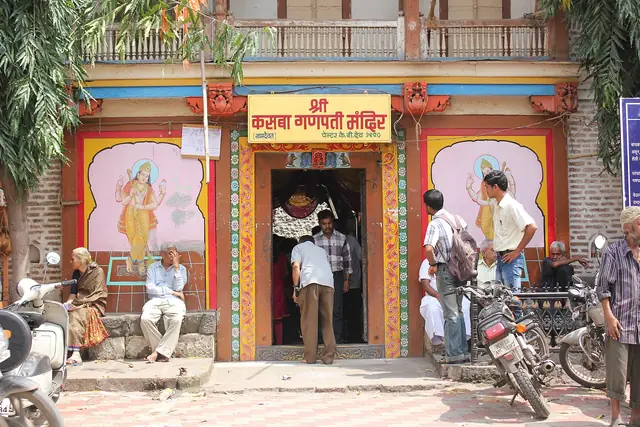
Each region has its own. Whitehead lists Mariamma, who sends and lifts the pox and is the commonest Devi of the Tamil villages; Ankamma, prayed to against cholera; Pidari, who guards against evil spirits and epidemics; Ellamma and Poleramma in the Telugu country, where the names often seem to be names of one Mother. Among the few male guardians is Ayyanar, whom he calls the night-watchman of the village: he has a shrine to himself, and the rows of clay horses before it are the steeds on which he rides his rounds at night. Further north the guardian may be a Ganesh, as at Pune, where Kasba Ganapati, the town’s gramadevata, leads the Ganeshotsav immersion procession every year.
03The village festival
The gramadevata is honoured above all at the yearly festival, the jatra or thiruvizha, and in times of trouble, when an epidemic or a failed monsoon calls for her. Whitehead saw villages where she has no permanent image: a clay figure is made for the festival, worshipped for its days, and then carried in procession beyond the boundary and left there, taking the village’s troubles with it. Her pujari is often not a brahmin but a man of the village, a potter, a washerman or a member of another community, and the office passes in his family. In a temple town the Agamic temple and the village Amman stand side by side, and a household will go to both.
In the texts
- Henry Whitehead, The Village Gods of South India (1916)
- Village songs and the katha of each Amman