Cite
MLA
“Battle of Sitabuldi.” Hindu History, 2026, https://www.hinduhistory.in/battles/battle-of-sitabuldi-1817/. Accessed .
APA
Hindu History. (2026). Battle of Sitabuldi. Retrieved , from https://www.hinduhistory.in/battles/battle-of-sitabuldi-1817/
The Company’s small force held the hills; three weeks later the Bhonsle army was beaten at Nagpur and Appa Sahib was deposed.
01Appa Sahib’s choice
The Bhonsles of Nagpur ruled a great kingdom across central India. Appa Sahib had come to the throne in 1817 after the death of his cousin Parsoji, with Company help, and had signed a subsidiary alliance. When Peshwa Bajirao II turned on the British at Khadki in November 1817, Appa Sahib accepted a robe of honour from him and gathered his army, with a strong body of Arab mercenaries, around Nagpur.
02Two days on the hills
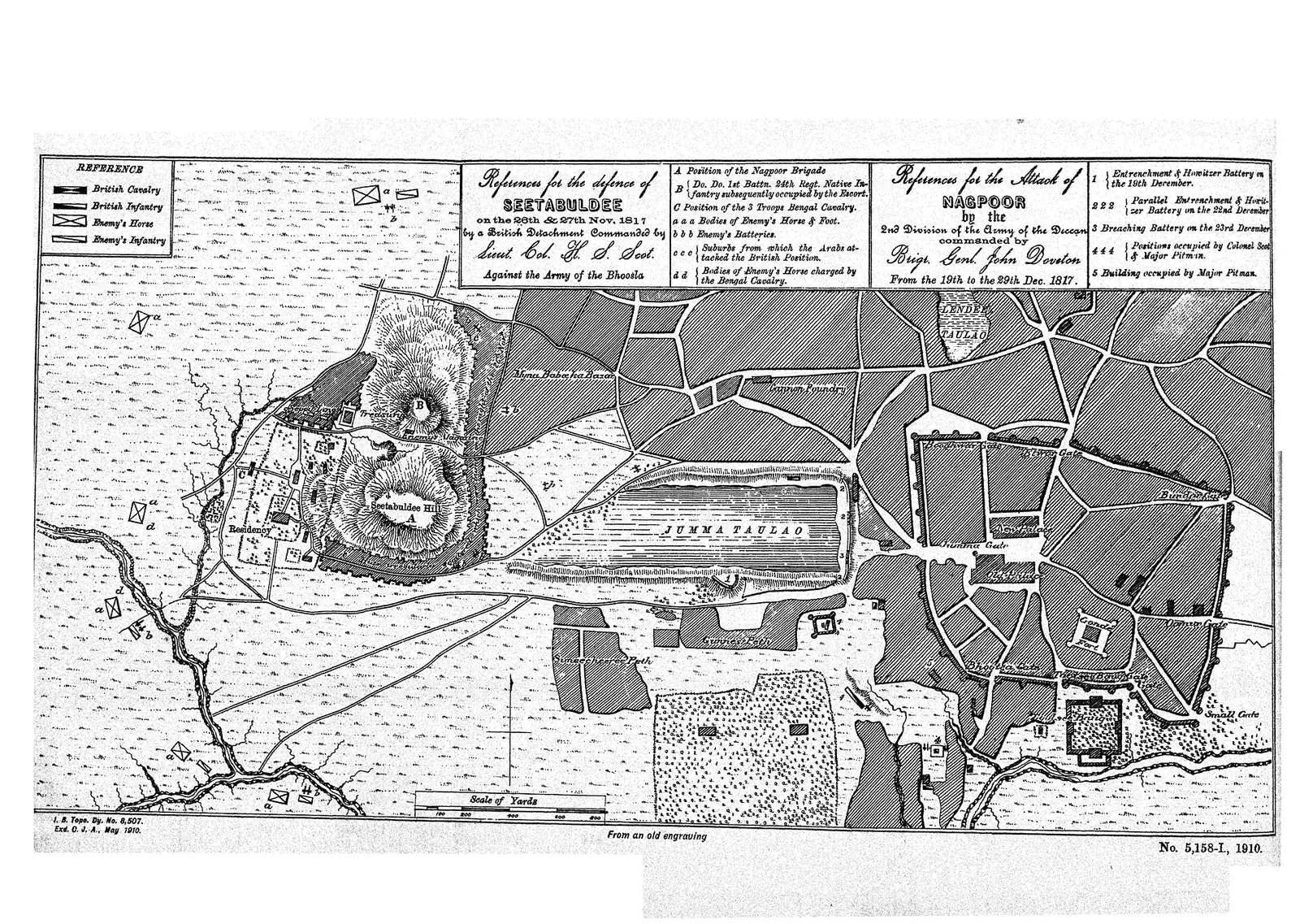
The Resident, Richard Jenkins, moved his small force of Madras sepoys and Bengal cavalry onto the two low hills of Sitabuldi beside the Residency. On the evening of 26 November the Bhonsle army attacked. Through the night and the next morning the Arabs stormed the smaller hill and took it. Then Captain Charles Fitzgerald, against orders, led his Bengal cavalry in a charge into the Maratha horse and guns on the plain. The charge broke the attack, and the infantry retook the hill.
03The end of Bhonsle rule
Reinforcements reached Nagpur, and on 16 December the Bhonsle army was beaten outside the city. Appa Sahib was arrested, escaped on the way to Allahabad, and spent years as a fugitive before dying at Jodhpur in 1840. The Company placed a child of the family on the throne and took a large part of the kingdom. Nagpur was annexed under Dalhousie in 1854. Sitabuldi fort is still held by the Army.
Sitabuldi broke the Bhonsles of Nagpur, one of the great Maratha houses, in the war that ended the Maratha confederacy.