Cite
MLA
“Battle of Pollilur.” Hindu History, 2026, https://www.hinduhistory.in/battles/battle-of-pollilur-1780/. Accessed .
APA
Hindu History. (2026). Battle of Pollilur. Retrieved , from https://www.hinduhistory.in/battles/battle-of-pollilur-1780/
Baillie’s column was destroyed and he was taken prisoner; the Company’s main army under Hector Munro fell back on Madras.
01Haidar comes down the ghats
In July 1780 Haidar Ali poured into the Carnatic plain with a large army, burning the country up to the edge of Madras. The Company gathered its forces at Kanchipuram under Sir Hector Munro, the victor of Buxar. A second force under Colonel William Baillie marched from the north to join him. Haidar placed his army between them and sent Tipu against Baillie.
02The square breaks
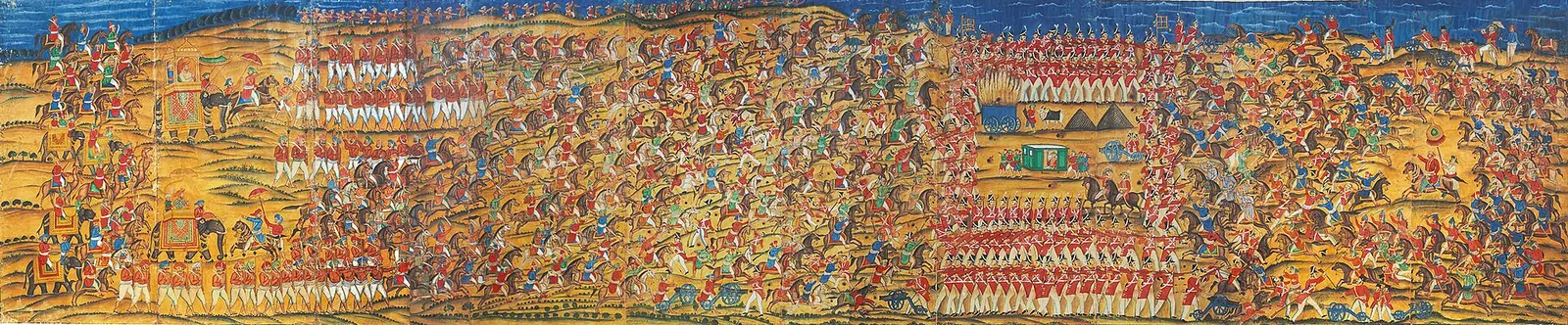
On 10 September Baillie’s column, a few miles from Munro, was surrounded at Pollilur by Haidar’s and Tipu’s horse, infantry and guns. Baillie formed a square. Mysorean rockets and cannon struck his ammunition carts, which blew up and left his men with nothing to fire. The square was broken by cavalry charges, and Baillie, wounded, surrendered with the survivors. Munro, close by, did not come up; he retreated to Madras, throwing his heavy guns into the great tank at Kanchipuram.
03Painted on the palace wall
Baillie died a prisoner at Srirangapatna in 1782. Tipu had the battle painted in a long mural on the walls of his summer palace, the Daria Daulat Bagh, where it can still be seen. The war went on until the Treaty of Mangalore in 1784, after Haidar’s death in 1782 and Sir Eyre Coote’s victory at Porto Novo in 1781.
Pollilur showed that an Indian army trained and armed in the new way, with rockets, could destroy a Company force in the field.