Cite
MLA
“Battle of the Ghaghra.” Hindu History, 2026, https://www.hinduhistory.in/battles/battle-of-ghaghra-1529/. Accessed .
APA
Hindu History. (2026). Battle of the Ghaghra. Retrieved , from https://www.hinduhistory.in/battles/battle-of-ghaghra-1529/
Babur forced the river crossing and beat the Afghans and Bengalis; Nusrat Shah made peace and Bihar came under Mughal overlordship.
01The Afghans regroup
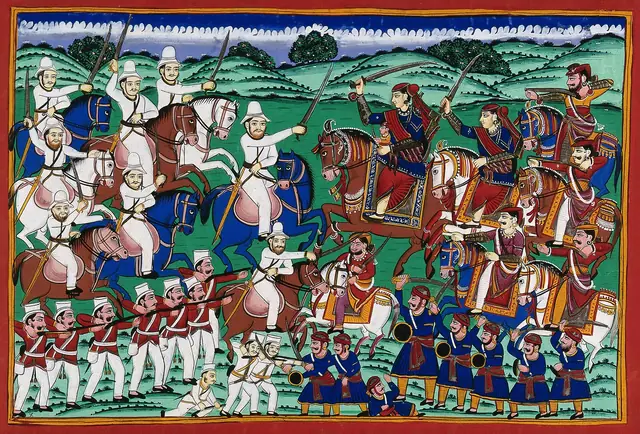
Panipat had broken the Lodi state, and Khanwa had broken Rana Sanga, but the Afghan nobles of the east were still in arms. Mahmud Lodi, a brother of Ibrahim, was proclaimed sultan in Bihar. Nusrat Shah of Bengal, wary of Babur, kept an army on the Ghaghra. In 1529 Babur marched down the Ganga with his guns, the Baburnama recording each stage, and found the Bengal troops holding the far bank.
02The river crossing
Babur’s gunner Ustad Ali Quli kept the Bengal boats and the far bank under fire while columns crossed the Ghaghra above and below. On 6 May the Mughals came over and attacked from several sides. The Bengalis and Afghans gave way. Babur then made terms with Nusrat Shah, who agreed not to shelter Babur’s enemies, and the Afghan chiefs of Bihar submitted. His memoirs break off a few months later, and he died at Agra in December 1530.
Ghaghra carried Mughal power to the borders of Bengal, though the Afghans of the east would rise again under Sher Khan within ten years.