Cite
MLA
“Battle of Aliwal.” Hindu History, 2026, https://www.hinduhistory.in/battles/battle-of-aliwal-1846/. Accessed .
APA
Hindu History. (2026). Battle of Aliwal. Retrieved , from https://www.hinduhistory.in/battles/battle-of-aliwal-1846/
The Sikh force was driven back across the Sutlej with the loss of its guns.
01The threat to Ludhiana
After the bloody stalemate at Ferozeshah in December 1845, the Khalsa held a bridgehead at Sobraon. Ranjodh Singh Majithia crossed upstream with a strong force and guns, burned part of the Ludhiana cantonment and cut at the Company’s supply line. Gough sent Sir Harry Smith with a division to clear him away. Ranjodh Singh took up a position between the villages of Aliwal and Bhundri, with the river behind him.
02Squares and lancers
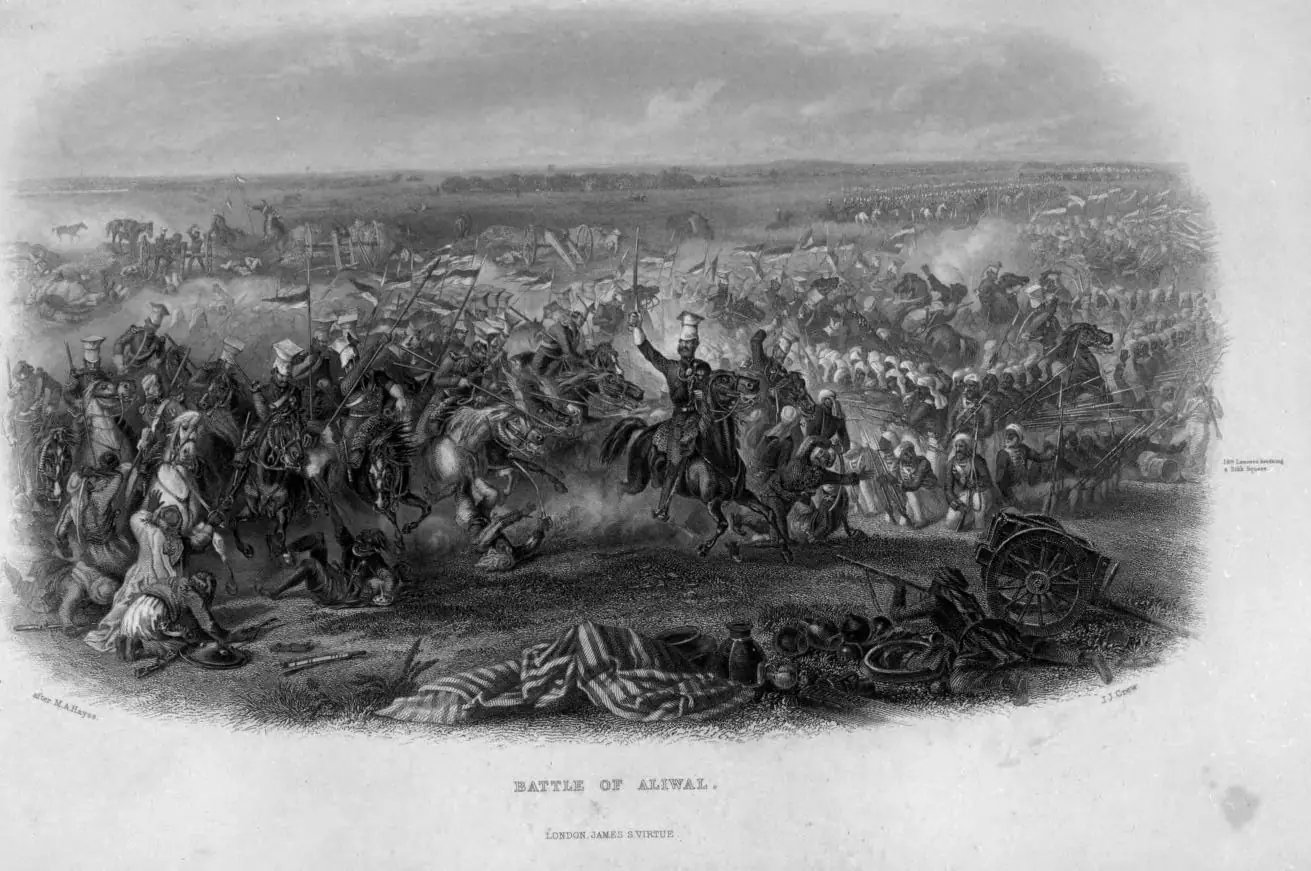
On 28 January 1846 Smith attacked across open ground. His infantry took Aliwal village on the Sikh left, and his cavalry swept round. The British 16th Lancers charged the Khalsa infantry, which formed squares in the European manner and stood; the lancers rode through them twice, losing heavily. The Sikh line broke towards the fords, and most of its guns were left behind or lost in the river.
03Before Sobraon
Aliwal freed Smith’s division to rejoin Gough. Thirteen days later the Company stormed the Sikh entrenchments at Sobraon, and the war ended. Cunningham, who served as a political officer in the campaign, wrote that the Khalsa soldiers fought well and their commanders failed them. Smith was made a baronet ‘of Aliwal’, and the town of Aliwal North in South Africa, founded when he governed the Cape, is named after the battle.
Aliwal removed the Sikh threat to the Company’s rear and set the stage for the decisive battle at Sobraon.