Cite
MLA
“Jaisalmer Fort (Sonar Qila).” Hindu History, 2026, https://www.hinduhistory.in/places/jaisalmer-fort/. Accessed .
APA
Hindu History. (2026). Jaisalmer Fort (Sonar Qila). Retrieved , from https://www.hinduhistory.in/places/jaisalmer-fort/
01Jaisal leaves Lodurva
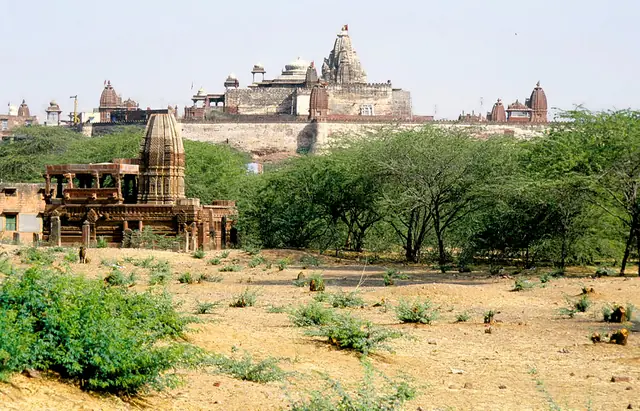
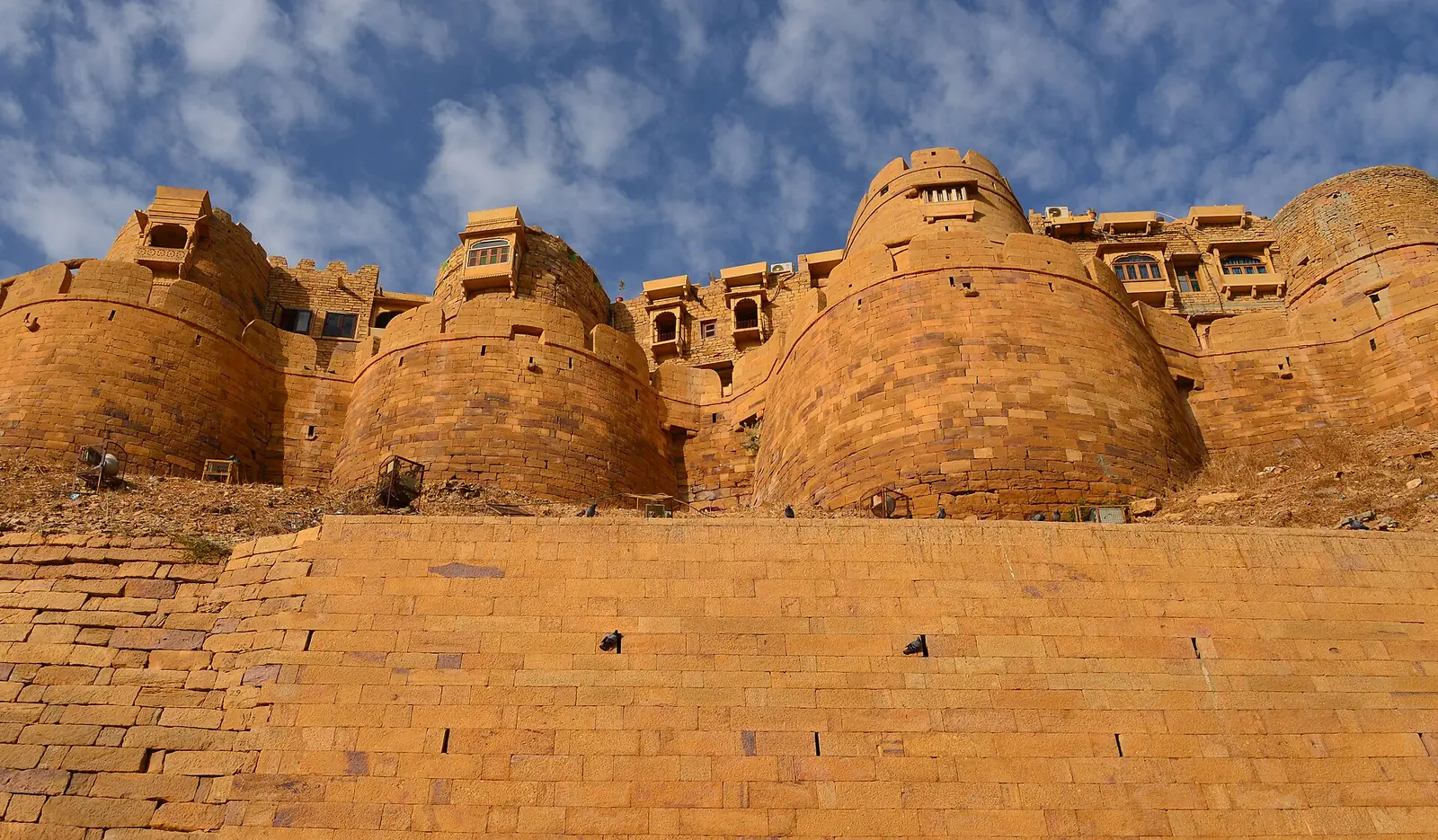
The Bhatis, who trace their line to the Yadavas of Mathura, had held Lodurva on the open plain sixteen kilometres away. In 1156 Rawal Jaisal moved up to the hill of Trikuta, eighty metres above the desert, and began the fort. It was built without mortar from the yellow stone of the hill itself, which is why the fort and the town below share one colour. Three rings of wall and ninety-nine bastions climb the slope; the gate road turns four times through the Akhai Pol, Suraj Pol, Ganesh Pol and Hawa Pol before it reaches the Dussehra Chowk, the square before the Raj Mahal, the palace of the rawals.
02Two and a half sakas
Jaisalmer speaks of its two and a half sakas. A saka is the last act of a fort that cannot hold: the women commit jauhar and the men put on saffron and ride out to die. The first came at the end of the thirteenth century, when Alauddin Khalji’s army besieged the fort for a long time, by the Bhati chronicles after a Bhati raid on a treasure caravan; the women went into the fire and the men fell under Rawal Mularaj and his brother Ratan Singh. The second is placed in the fourteenth century under Rawal Duda. The half saka, in Rawal Lunkaran’s time in the sixteenth century, is called half because the men fell fighting but there was no jauhar.
03Temples, manuscripts and a living town
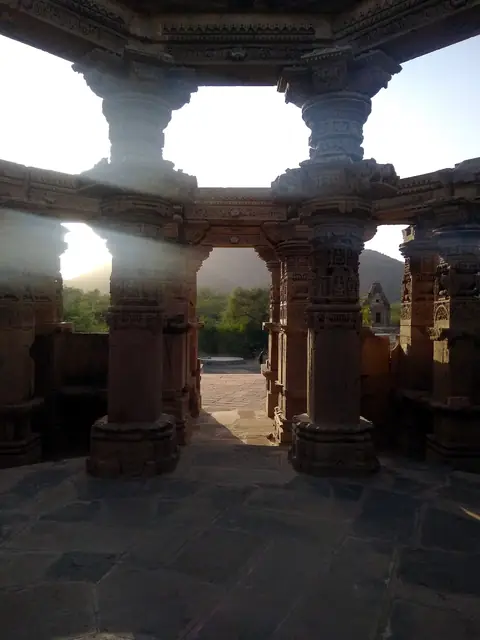
Inside the walls stand the Laxminath temple of the royal house and a group of seven Jain temples of the twelfth to sixteenth centuries, the oldest dedicated to Parshvanatha, their yellow stone carved as fine as lace. Below one of them is the Jinabhadra Suri Gyan Bhandar, a library of palm-leaf and paper manuscripts gathered in the fifteenth century, among the oldest in India. The fort never emptied: families still live in its lanes, which makes it one of the very few living forts in the world, though water seeping from the houses now weakens its walls. Satyajit Ray set his film Sonar Kella here in 1974. In 2013 UNESCO inscribed it among the Hill Forts of Rajasthan.
The life of this place
- 1156 CERawal Jaisal founded the fort on Trikuta hill.
- Late 13th centuryThe first saka, during the siege by Alauddin Khalji’s army.
- 12 December 1818Maharawal Mulraj II signed a treaty with the East India Company.
- 1949 CEJaisalmer joined the Union of India and then Rajasthan.
- 2013 CEUNESCO inscribed the fort among the Hill Forts of Rajasthan.
In Jaisalmer town, 285 km west of Jodhpur. The Jain temples open to visitors in the morning; go up to the ramparts at sunset.