
Cite
MLA
“Sir M. Visvesvaraya.” Hindu History, 2026, https://www.hinduhistory.in/people/m-visvesvaraya/. Accessed .
APA
Hindu History. (2026). Sir M. Visvesvaraya. Retrieved , from https://www.hinduhistory.in/people/m-visvesvaraya/
Life in moments
- 011861
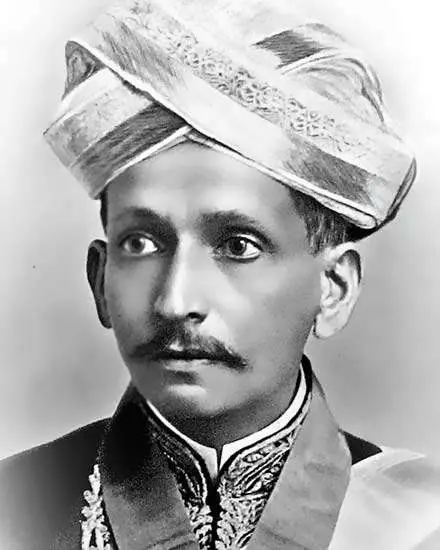
Born at Muddenahalli, Karnataka, in 1861
- 021903
His automatic sluice gates were fitted at Khadakwasla in 1903
- 031912
Diwan of Mysore from 1912 to 1918
- 041955
Awarded the Bharat Ratna in 1955
- 05
His birthday, 15 September, is kept as Engineers’ Day
01Gates, floods and dams
Visvesvaraya studied at Central College, Bangalore, and took his engineering degree at the College of Science in Poona, joining the Bombay Public Works Department in 1884. He designed automatic sluice gates that rose with the water, first fitted at the Khadakwasla reservoir near Pune in 1903 and later at Tigra in Gwalior and at the KRS. After the Musi river flood of 1908 drowned thousands in Hyderabad, the Nizam called him to plan its flood control and drainage. In Mysore he was chief engineer of the Krishna Raja Sagara dam on the Kaveri, which watered the Mandya plain and fed the Shivasamudram power station.
02Diwan of Mysore
Maharaja Krishnaraja Wadiyar IV made him Diwan in 1912. In six years he started the University of Mysore, the Bank of Mysore, the government soap factory, the Bhadravati iron works and a chamber of commerce, and pushed schooling into the villages. His motto was industrialise or perish. He resigned in 1918 over a matter of principle and spent his long retirement writing on planning for India. He was knighted in 1915 and given the Bharat Ratna in 1955. He lived to a hundred, punctual and upright to the end, and died in Bangalore in 1962.