Cite
MLA
“Kanishka.” Hindu History, 2026, https://www.hinduhistory.in/people/kanishka/. Accessed .
APA
Hindu History. (2026). Kanishka. Retrieved , from https://www.hinduhistory.in/people/kanishka/
Life in moments
- 01127
His reign is now usually dated from about 127 CE
- 021993
The Rabatak inscription naming him was found in Afghanistan in 1993
- 031908
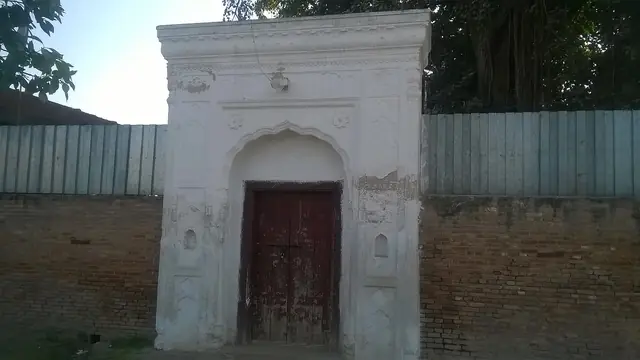
Spooner began digging his stupa site at Shah-ji-ki-Dheri, Peshawar, in 1908
- 04
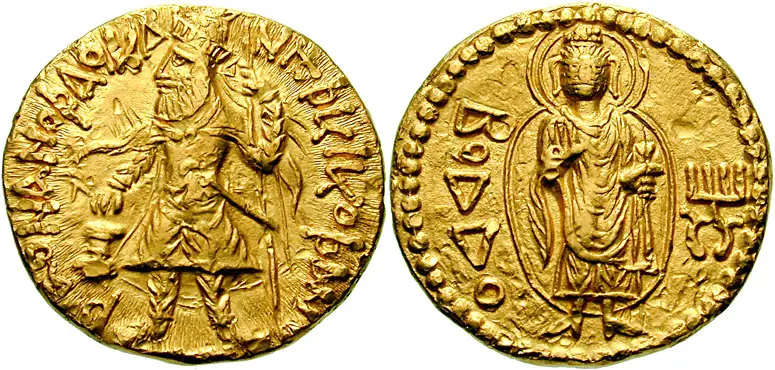
His coins show Oesho (Shiva) with a trident
- 05
His headless statue from Mat is in the Mathura museum
01An empire on the Silk Road
The Kushans came from the Yuezhi people of Central Asia and by the first century CE ruled Bactria and the passes into India. Kanishka took the empire to its widest. The Rabatak inscription, found in northern Afghanistan in 1993 and written in Bactrian in Greek letters, says that in his first year his rule reached as far as Saketa, Kaushambi, Pataliputra and Champa, though how far that rule was direct is debated. He began an era of his own, now most often placed at about 127 CE. Mathura flourished under him, and the headless standing statue of Kanishka found at Mat near Mathura is in the Government Museum there.
02Coins, councils and the Peshawar stupa
Kanishka’s gold coins show him standing in a long coat and boots, sacrificing at a fire altar, and on the reverse a range of gods: Oesho, four-armed Shiva with trident, Mithra, the moon god Mao, and on a few the standing Buddha, labelled Boddo. Buddhist tradition remembers him as the patron of the Fourth Council, held in Kashmir, and as the builder of a great stupa at Purushapura. Excavations at Shah-ji-ki-Dheri outside Peshawar, begun in 1908 by D. B. Spooner, turned up a gilded reliquary inscribed with Kanishka’s name, now in the Peshawar Museum. Ashvaghosha and the physician Charaka are traditionally placed at his court.