
Cite
MLA
“Dimasa Kachari Kingdom.” Hindu History, 2026, https://www.hinduhistory.in/dynasties/dimasa-kachari/. Accessed .
APA
Hindu History. (2026). Dimasa Kachari Kingdom. Retrieved , from https://www.hinduhistory.in/dynasties/dimasa-kachari/
01Dimapur
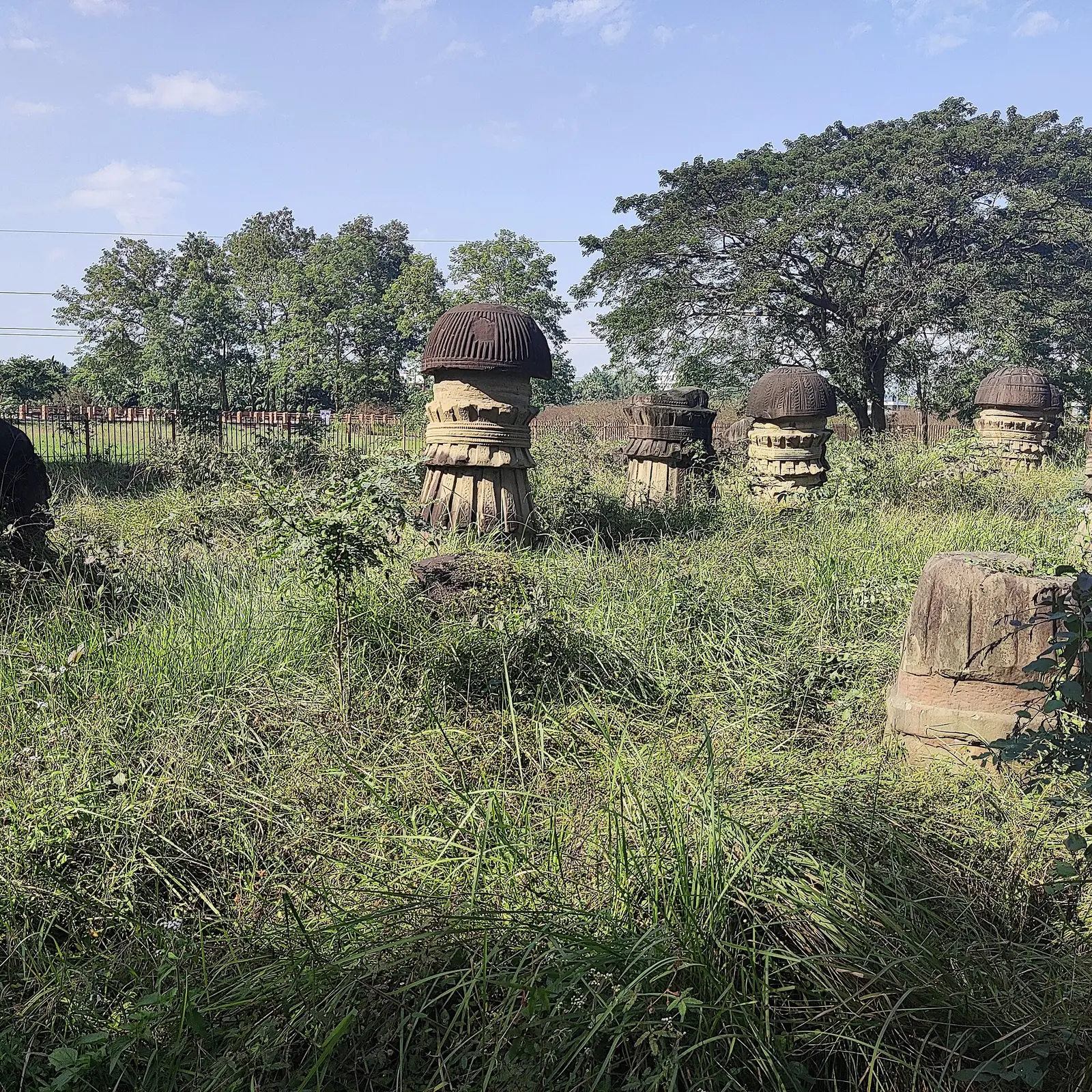
The Ahom Buranjis call these kings Timisa, and place them at Dimapur on the Dhansiri. What remains of the city is a brick wall with a carved gateway and rows of tall stone pillars topped with rounded domes, cut with lotuses, birds and elephants. Ahom accounts meet the Kacharis in the time of Sukaphaa in the thirteenth century, holding the country between the Dikhou and the Kolong. In 1520 a Dimasa king struck a coin in the name Viravijay Narayan, naming the goddess Chandi; it is the earliest Hindu coin of the Brahmaputra valley. In 1536 the Ahom king Suhungmung sacked Dimapur, and the Dimasa king Detsung was killed.
02Maibang in the hills
The court moved south into the hills and settled at Maibang on the Mahur river. There the kings built in stone, and a small house cut from a single rock still stands. Satrudaman, the strongest of the Maibang kings, took the plains of Cachar and part of Sylhet early in the seventeenth century and struck coins to mark it, and he fought the Ahoms and the Jaintia king over Dimarua. The Kacharir Niyam, the written rules of the kingdom, was set down under Tamradhwaj Narayan. When Tamradhwaj refused tribute, the Ahom king Rudra Singha sent armies that destroyed Maibang in 1706; Tamradhwaj fled to the Jaintia king, who imprisoned him, and had to ask Rudra Singha to rescue him.
03Khaspur and the last kings
In the eighteenth century a Dimasa prince married the heiress of the Koch chiefs of Khaspur in the Barak valley, and in 1745 the two houses became one, with Khaspur, near present Silchar, as the capital. Brahmins at the Khaspur court drew up the descent from Bhima and Hidimba, and in 1790 the brothers Krishnachandra and Govindachandra underwent a rite of purification by passing through a copper image of a cow, after which they were proclaimed Kshatriyas. Govindachandra, driven out by the Burmese, was restored by the British after the Treaty of Yandabo in 1826, but he could not control Senapati Tularam in the hills, and he was murdered in 1830. The British annexed the plains of Cachar in 1832.
The rulers
- 1Khorapha (Viravijay Narayan)Coin of 1520 naming Chandic. 1520
- 2DetsungKilled when the Ahoms sacked Dimapurto 1536
- 3SatrudamanTook Cachar and part of Sylhetc. early 17th century
- 4Birdarpa Narayanc. 1640s
- 5Tamradhwaj NarayanMaibang destroyed by Rudra Singha, 1706c. 1697–1708
- 6GopichandraFirst king at Khaspur1745–1757
- 7Harichandra1757–1772
- 8Lakshmichandra1772–1773
- 9Krishnachandra1790–1813
- 10GovindachandraLast king; murdered 18301813–1830
What they left
- The carved stone pillars and gateway of Dimapur
- The rock-cut house at Maibang
- The coin of 1520, the earliest Hindu coin of the Brahmaputra valley
- The palace ruins at Khaspur near Silchar
- The name Cachar, carried by districts of Assam today