
Cite
MLA
“Bhagwan Vishwakarma.” Hindu History, 2026, https://www.hinduhistory.in/devata/vishwakarma/. Accessed .
APA
Hindu History. (2026). Bhagwan Vishwakarma. Retrieved , from https://www.hinduhistory.in/devata/vishwakarma/
विश्वतश्चक्षुरुत विश्वतोमुखो विश्वतोबाहुरुत विश्वतस्पात्।
सं बाहुभ्यां धमति सं पतत्रैर्द्यावाभूमी जनयन्देव एकः॥
viśvataścakṣur uta viśvatomukho viśvatobāhur uta viśvataspāt |
saṃ bāhubhyāṃ dhamati saṃ patatrair dyāvābhūmī janayan deva ekaḥ ||
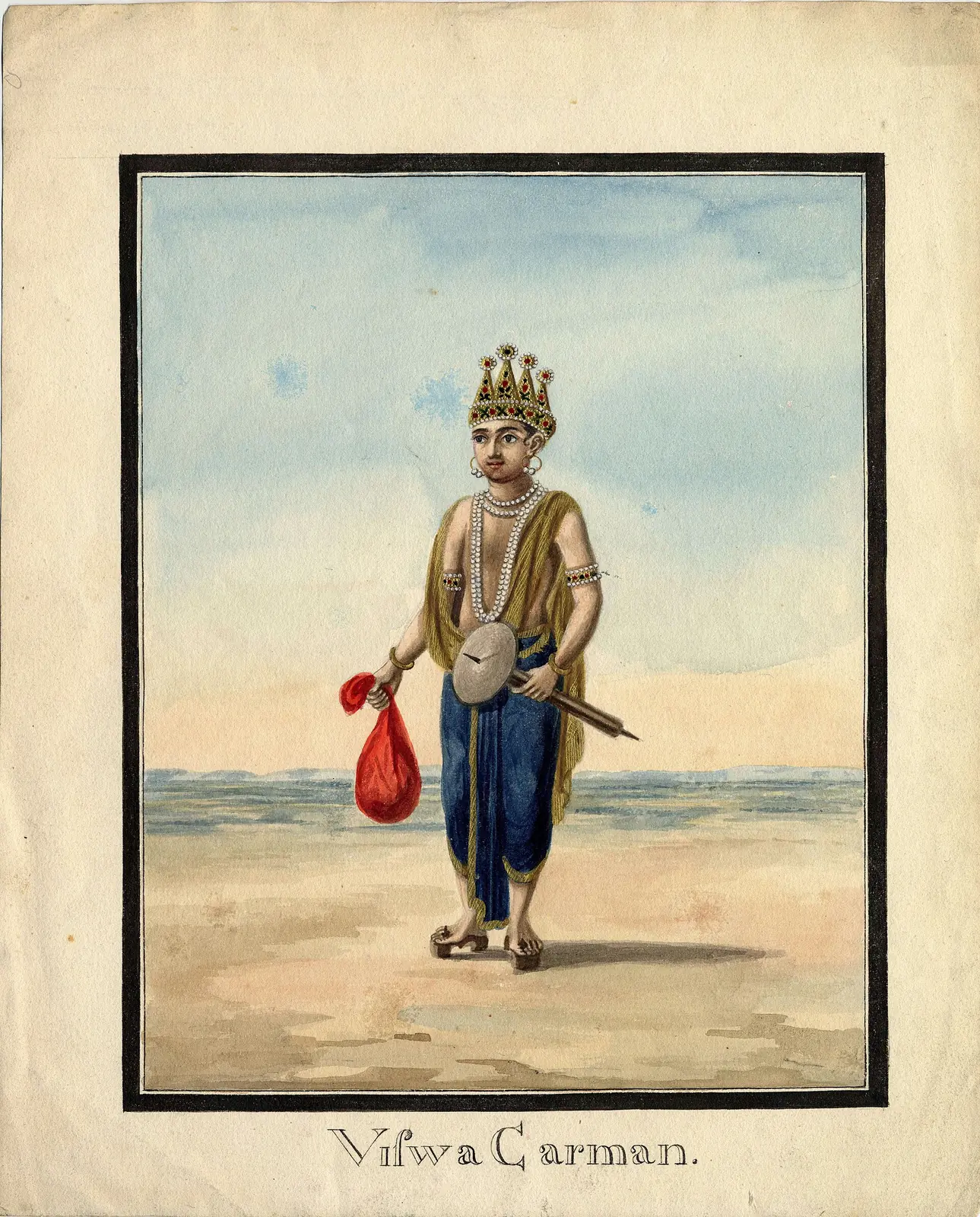
Two traditions. In western and north-western India he is an old, bearded, four-armed sage riding a hamsa, close to Brahma in form. In eastern India, where his puja is a great public festival, he is young and strong, with a black moustache, riding an elephant. In both forms he carries the tools of the craftsman.
01The all-maker of the Rigveda
Two hymns of the tenth mandala, Rigveda 10.81 and 10.82, have Vishvakarma Bhauvana as their rishi and Vishvakarma as their Deva. The first asks the question every maker asks: what was the standing-place, what was the support, when Vishvakarma, seeing all, made the earth and spread out the sky? Its third verse gives the answer as an image: eyes on every side, faces on every side, arms on every side, feet on every side, the one Deva blows heaven and earth into shape with his arms, as a smith works the bellows. The fourth verse asks what the wood was, what the tree, from which they carved heaven and earth. Sayana links him with Prajapati.
02What he built
In the Ramayana he built golden Lanka, later Kubera’s and then Ravana’s, and the vanara Nala, who laid Rama’s setu to Lanka, is his son. In the Mahabharata he built the sabhas of the guardians of the directions and the city of Dwarka for Shri Krishna. He made the Pushpaka vimana and, from the bones that Maharshi Dadhichi gave up, Indra’s vajra. When his daughter Sanjna could not bear the blaze of her husband Surya, Vishwakarma trimmed away an eighth of the Sun’s light and from it forged the Sudarshana chakra and Shiva’s trishula. The Skanda Purana says it was he who carved the wooden image of Jagannath at Puri.
03Vishwakarma Puja
Vishwakarma Puja falls on Kanya Sankranti, when the Sun enters Virgo, and because it follows the solar calendar it stays close to 17 September each year. In Bengal, Bihar, Jharkhand, Odisha and Assam, factories, workshops, printing presses, garages and railway sheds stop work for the day; tools and machines are cleaned, smeared with sandalwood paste and worshipped, and a murti of Vishwakarma on his elephant is set up among them. Kites fill the sky over Bengal. The Brahmavaivarta Purana names him as the father of the artisan communities, and in the south five crafts, the smiths of iron, copper and gold, the carpenters and the stone-carvers, are together called Vishwakarma. The Shilpa text Vishvakarmaprakasha carries his name.
In the texts
- Rigveda 10.81 and 10.82
- Valmiki Ramayana and Mahabharata
- Brahmavaivarta Purana
- Vishvakarmaprakasha