
Cite
MLA
“The Bhumij rising of Ganga Narayan Singh.” Hindu History, 2026, https://www.hinduhistory.in/battles/bhumij-revolt-1832/. Accessed .
APA
Hindu History. (2026). The Bhumij rising of Ganga Narayan Singh. Retrieved , from https://www.hinduhistory.in/battles/bhumij-revolt-1832/
The rising spread through the Jungle Mahals until Ganga Narayan Singh was killed in early 1833; the Company then broke up the district and governed the area as a special frontier tract.
01The quarrel over Barabhum
Raja Vivek Narayan Singh of Barabhum left two sons who fought over the gaddi. The elder, Lakshman Narayan, had the stronger claim by custom, but the Company backed the younger, Raghunath Narayan, and Lakshman was driven out. His son Ganga Narayan Singh grew up nursing the grievance. The Jungle Mahals had a long record of risings against the Company’s revenue system, which the British lumped together as the Chuar rebellion. In April 1832 Ganga Narayan killed the Barabhum diwan Madhab Singh at Vandih and raised the country.
02The hangama
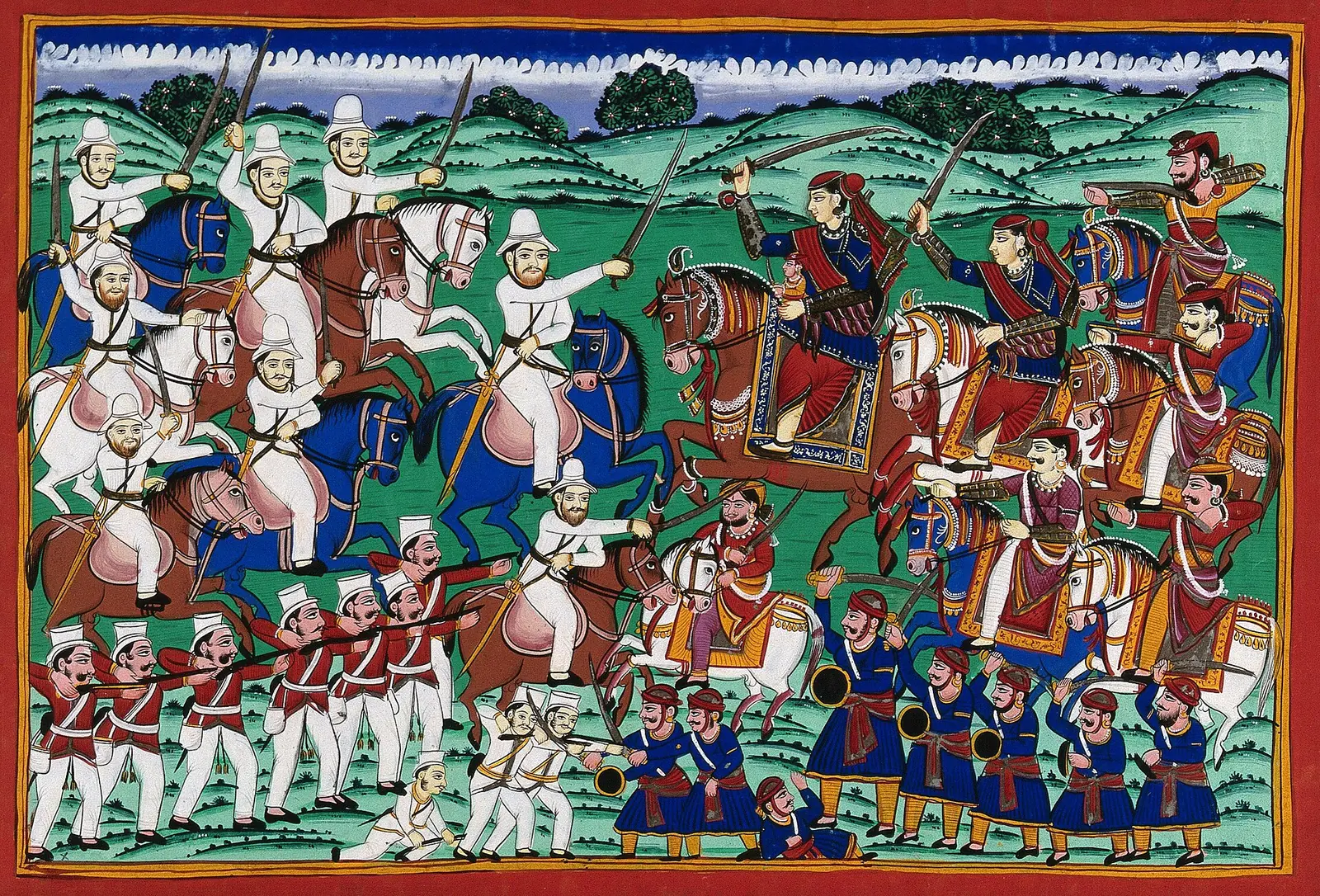
Bhumij fighters, joined by many local chiefs and villagers, attacked the court at Barabazar, the salt office and the police posts, and the Company’s writ ceased to run in much of Manbhum and Dhalbhum for months. Troops sent from Bengal could not catch Ganga Narayan in the forests. He moved west towards Singhbhum to win the Ho to his side, and in early 1833 he was killed in a fight with the Thakur of Kharsawan. Without him the rising collapsed.
Together with the Kol rising, the hangama made the Company abandon regular district rule in the Jungle Mahals and set up the South-West Frontier Agency.