Cite
MLA
“Ratnagiri Mahavihara, Odisha.” Hindu History, 2026, https://www.hinduhistory.in/places/ratnagiri-odisha/. Accessed .
APA
Hindu History. (2026). Ratnagiri Mahavihara, Odisha. Retrieved , from https://www.hinduhistory.in/places/ratnagiri-odisha/
01Doorway of green stone
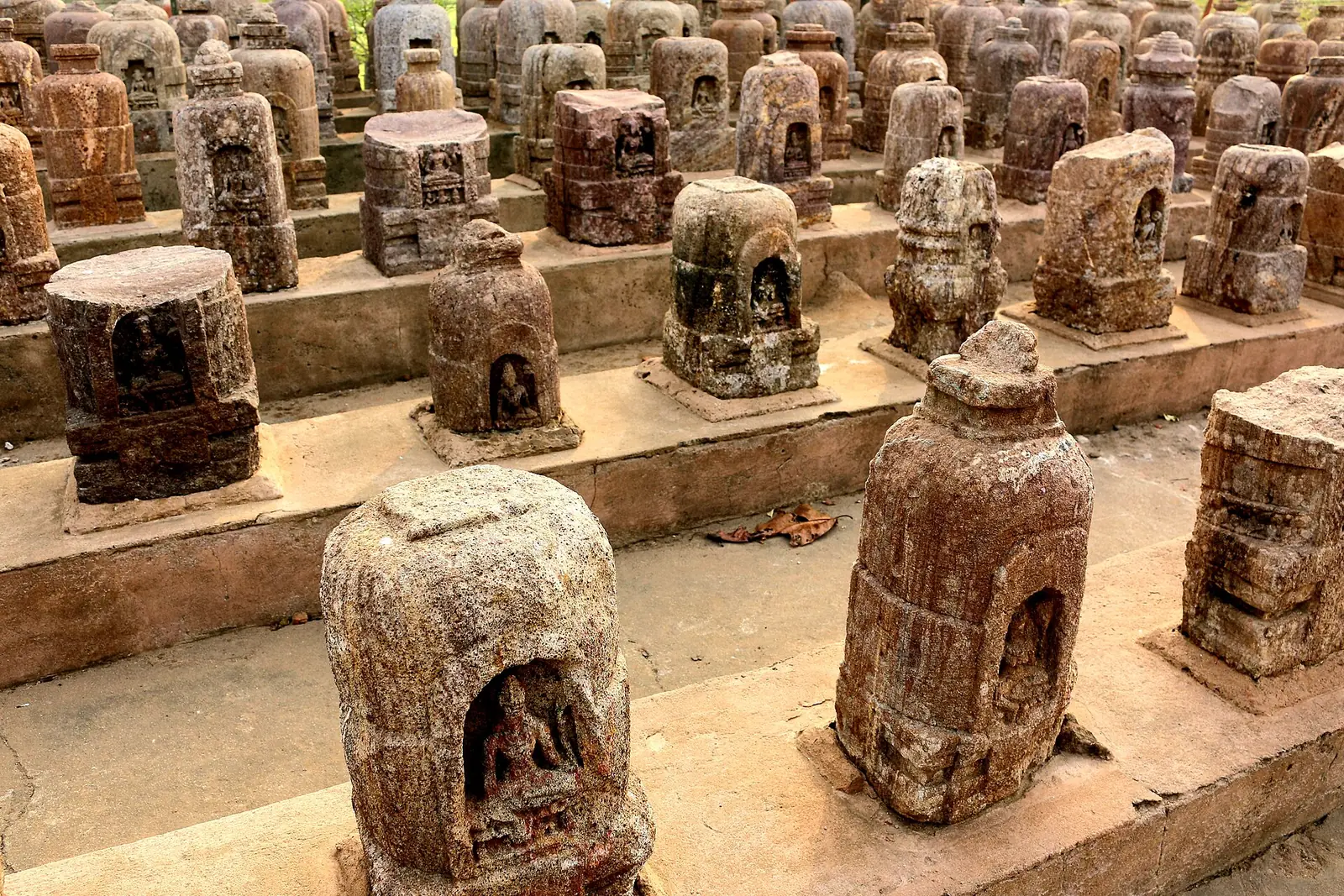
The largest building on the hill is Monastery 1, a square of cells round an open court, built in brick with door frames and pillars of carved khondalite and green chlorite. Its main doorway is cut with flying figures, scrolls of creepers and the river goddesses at the foot. Across the court, in the shrine facing the entrance, sits a colossal Buddha touching the earth, with Padmapani and Vajrapani at his sides. A smaller monastery stands beside it. Above both rises the main stupa, ringed by hundreds of small votive stupas of stone and brick, many carved with Buddha images and the creed of the dharma, given by pilgrims who came to the vihara.
02Debala Mitra’s dig
The mound was known to local people and to British officers in the nineteenth century, but it was opened properly only between 1958 and 1961, when Debala Mitra of the Archaeological Survey of India led the excavation. Her report, published by the ASI in two volumes, set out the stupa, the monasteries, the sculpture and the seals bearing the name Sri Ratnagiri Mahavihariya Arya Bhikshu Sangha, the community of noble monks of the great vihara of Sri Ratnagiri. The images show the monastery moving from Mahayana into Vajrayana over its long life. With Lalitgiri and Udayagiri a few kilometres away, Ratnagiri is now spoken of as the Diamond Triangle of Odisha’s Buddhist sites.
03New finds, 2024–25
In December 2024, after a gap of more than sixty years, the ASI’s Puri circle opened new trenches at Ratnagiri. The diggers found colossal Buddha heads, one of them among the largest ever found in Odisha, a stone palm about five feet long, inscribed pieces of the eighth and ninth centuries, and images of Tara, Hariti, Avalokiteshvara and other deities, with more votive stupas. Part of the old site lies under village houses, which limits the work. A site museum of the ASI keeps the best of the earlier finds, and the hill with its green-stone doorway is open to visitors.
The life of this place
- 1958–61 CEDebala Mitra of the ASI excavated the stupa and monasteries.
- December 2024The ASI resumed excavation and found colossal Buddha heads and inscribed relics.
About 100 km north-east of Bhubaneswar by road; combine with Lalitgiri and Udayagiri. The ASI museum is closed on Fridays.