
Cite
MLA
“Matsya Avatar.” Hindu History, 2026, https://www.hinduhistory.in/devata/matsya/. Accessed .
APA
Hindu History. (2026). Matsya Avatar. Retrieved , from https://www.hinduhistory.in/devata/matsya/
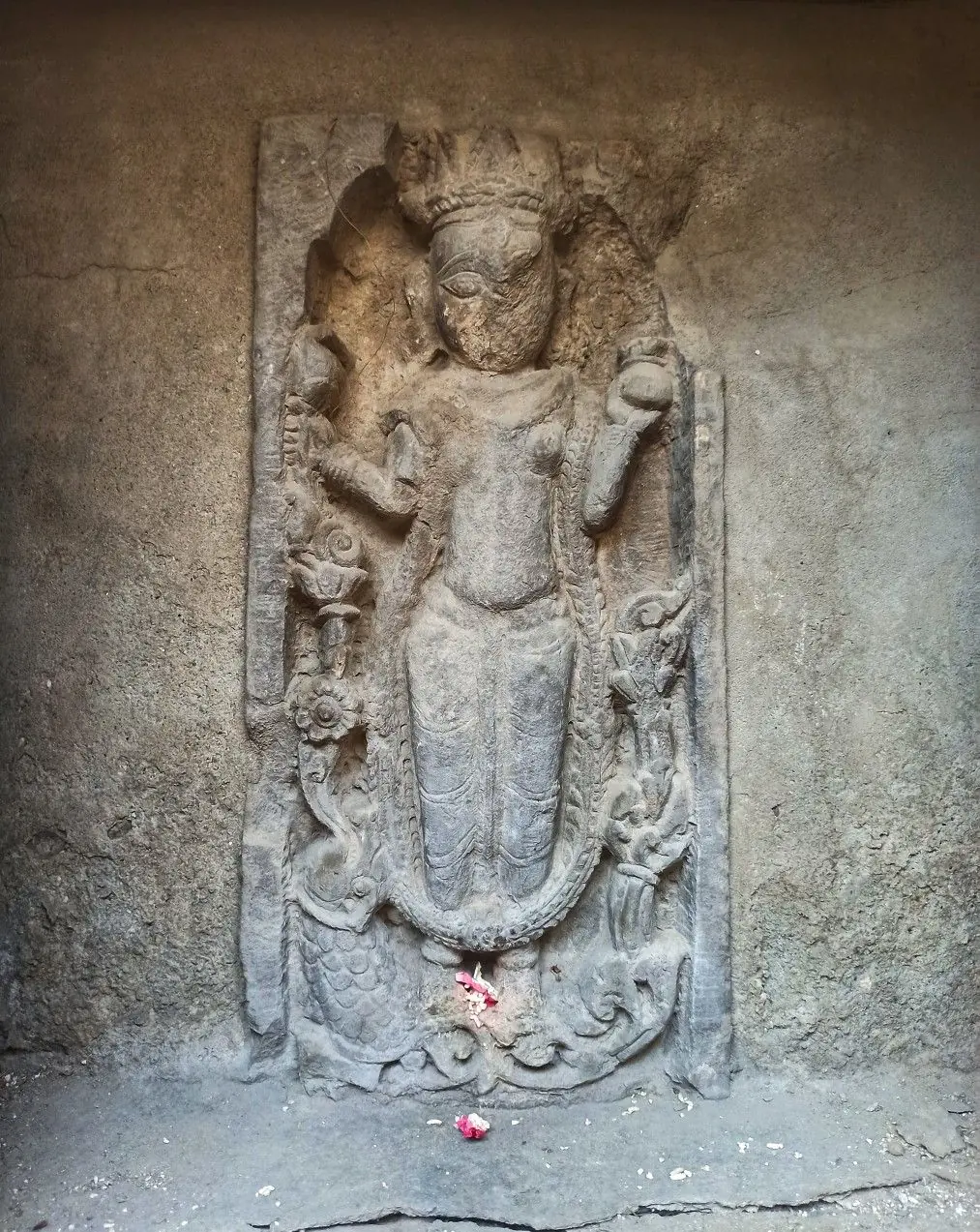
Either a great fish with a horn, or Vishnu’s four-armed upper body rising from a fish’s tail, holding conch and discus, the other hands in abhaya and varada.
01The fish in Manu’s palms
The Shatapatha Brahmana (1.8.1) tells it first. Manu found a small fish in the water brought for his morning wash, and it asked him to protect it, promising to save him in return. He kept it in a jar, then a pond, then the sea, as it grew. It warned him of a coming flood, told him to build a boat, and when the waters rose, it towed the boat to a northern mountain. The Bhagavata Purana (8.24) names the king Satyavrata, later Vaivasvata Manu, and the fish as Bhagwan himself.
02The Vedas recovered
In the Bhagavata’s telling, at the end of a day of Brahma, as he grew sleepy, the asura Hayagriva stole the Vedas that came from his mouth and hid in the deep. Matsya, with a single golden horn, let Satyavrata tie the boat to it with the serpent Vasuki as rope, and while the flood raged he taught the king the Matsya Purana and the truths of the Self. He then slew Hayagriva and returned the Vedas to Brahma for the new creation. Jayadeva’s Dashavatara stotra opens with this scene.
03Worship of Matsya
Matsya Jayanti falls on Chaitra Shukla Tritiya. Matsya is shown on nearly every Dashavatara panel, from the Gupta-era stones to the painted lintels of Bengal, and at Chamba a tenth-century relief of him stands in the Bansi Gopal temple. Temples where he is the main murti are rare; the best known is Vedanarayana Swamy at Nagalapuram in Andhra Pradesh, where the Vijayanagara rulers honoured him.
In the texts
- Shatapatha Brahmana 1.8.1
- Bhagavata Purana 8.24
- Matsya Purana
- Mahabharata, Vana Parva (Matsyopakhyana)