
Cite
MLA
“Agni.” Hindu History, 2026, https://www.hinduhistory.in/devata/agni/. Accessed .
APA
Hindu History. (2026). Agni. Retrieved , from https://www.hinduhistory.in/devata/agni/
अग्निमीळे पुरोहितं यज्ञस्य देवमृत्विजम्। होतारं रत्नधातमम्॥
agnim īḷe purohitaṃ yajñasya devam ṛtvijam | hotāraṃ ratnadhātamam ||
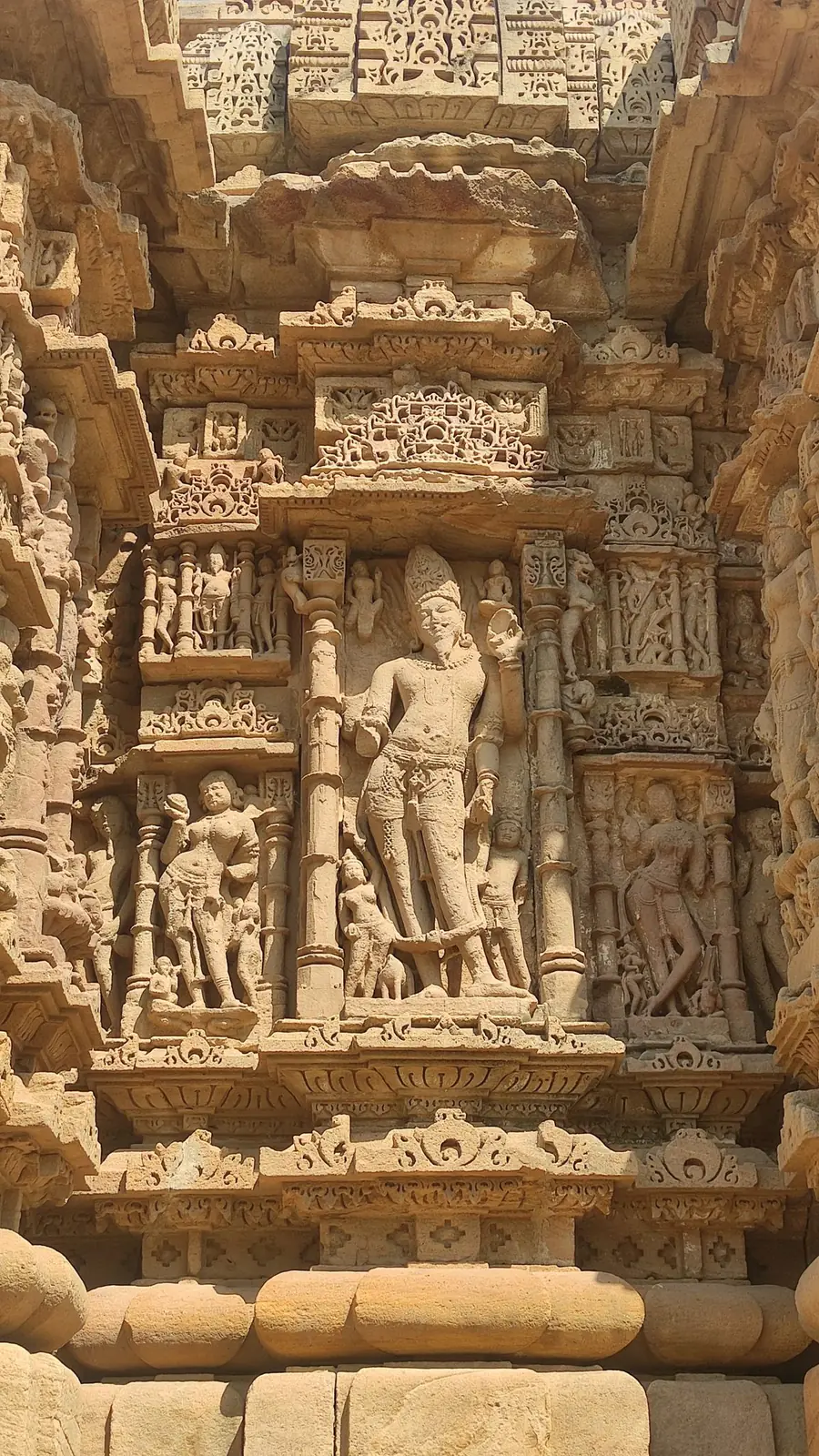
Red-bodied, with two faces in some texts, flames rising from his head, seven tongues, holding a sruva ladle, a vessel of ghee or a spear (shakti), and riding a ram. He guards the south-east among the dikpalas, often with his consort Svaha.
01The first word of the Veda
The Rigveda opens with him: agnim īḷe purohitam, I praise Agni, the household priest (Rigveda 1.1.1). Only Indra has more hymns. He is born from the friction of two sticks, lives hidden in the waters and the plants, sits in every home hearth and rises to the sky as the sun. Every oblation spoken with svāhā is carried by him to the Deva named. The Mundaka Upanishad (1.2.4) counts his seven tongues: Kali, Karali, Manojava, Sulohita, Sudhumravarna, Sphulingini and Vishvaruchi.
02Witness of every samskara
The sacred fire runs through a Hindu life from birth to death. Bride and groom walk around him in the saptapadi, and he is the witness that makes the vow binding. A household that keeps the Vedic fires performs the Agnihotra at sunrise and sunset. At death the body is given to him, and the Rigveda’s funeral hymn (10.16) asks him to carry the departed gently to the fathers. In the Ramayana, Sita walks through his flames and he returns her unharmed to Rama.
03Kathas of Agni
In the Adi Parva of the Mahabharata, Agni, sick from too much ghee at a king’s twelve-year yajna, asks Krishna and Arjuna to let him consume the Khandava forest, and in return has Varuna give Arjuna the Gandiva bow and Krishna the Sudarshana. In the Kumara Khanda of the Shiva Purana he carries Shiva’s seed, too fiery to hold, until he passes it to the Ganga. The Kena Upanishad shows him humbled, unable to burn a single blade of grass without Brahman’s power.
In the texts
- Rigveda 1.1 and 10.16
- Mundaka Upanishad 1.2.4
- Kena Upanishad, Khanda 3
- Mahabharata, Adi Parva (Khandava-daha)
- Agni Purana