Cite
MLA
“The Khasi rising of U Tirot Sing.” Hindu History, 2026, https://www.hinduhistory.in/battles/anglo-khasi-war-1829/. Accessed .
APA
Hindu History. (2026). The Khasi rising of U Tirot Sing. Retrieved , from https://www.hinduhistory.in/battles/anglo-khasi-war-1829/
After four years of hill warfare Tirot Sing surrendered in January 1833 and died a prisoner in Dhaka in 1835; the Khasi chiefs accepted Company supremacy.
01The road and the attack
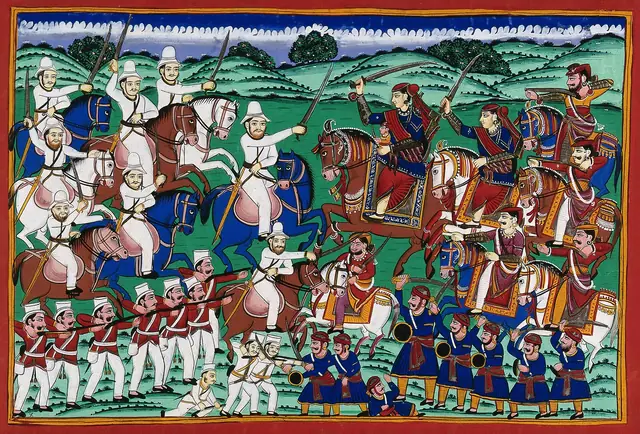
After the Burmese war, David Scott planned a road through the hills, with a sanatorium at Nongkhlaw, to link Assam with Sylhet. Tirot Sing agreed in a durbar in 1827. Within two years he and his council believed the Company meant to take the country, and they ordered the work stopped. When it went on, the Khasis attacked the Company post at Nongkhlaw on 4 April 1829 and killed the two British officers there, Lieutenants Bedingfield and Burlton, and many of their men.
02Four years in the hills
Company troops marched in from Assam and Sylhet and burnt the villages that supported the rising. Tirot Sing and his allies among the other Khasi chiefs took to the forests and ravines, fighting with swords, bows and a few muskets, ambushing columns and raiding posts. The Company slowly won over or wore down the chiefs one by one. Wounded and hunted, Tirot Sing gave himself up in January 1833. He was sent to Dhaka as a state prisoner and died there in 1835.
The Khasi Hills passed under Company control, and Tirot Sing is remembered in Meghalaya as its first freedom fighter; his death day, 17 July, is observed every year.