
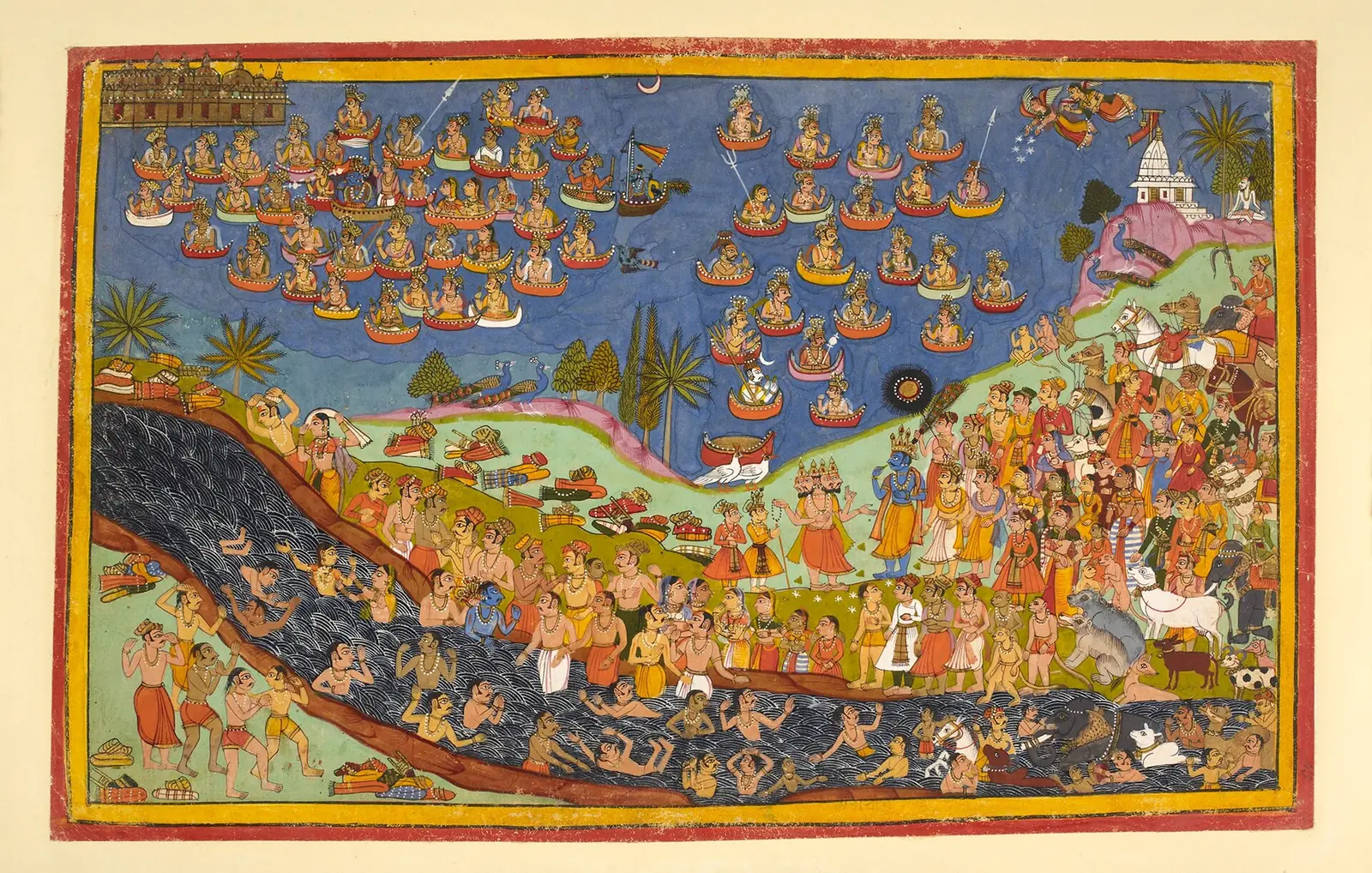
01Agastya tells of Ravana
After the coronation the rishis came to Ayodhya to bless Rama, and Maharshi Agastya told him who his enemy had been. Ravana was the grandson of the rishi Pulastya, son of Vishrava and the rakshasi Kaikasi, half-brother of Kubera. With Kumbhakarna and Vibhishana he did fierce tapas to Brahma. Ravana asked not to be slain by devas, danavas, yakshas or rakshasas, scorning men too much to name them. When Kumbhakarna came to ask his boon, the devas sent Saraswati to his tongue and he asked for sleep. Vibhishana asked only that his mind stay in dharma even in danger. Ravana drove Kubera from Lanka and took the Pushpaka.
02Kailasa, and Hanuman’s childhood
Returning from victory over Kubera, Ravana found his chariot stopped near Kailasa and tried to lift the mountain. Mahadev pressed it down with his toe and pinned Ravana’s arms beneath. He cried out so loud the worlds shook, and sang Shiva’s praise until Mahadev released him and gave him the name Ravana, the one who roared, and the sword Chandrahasa. Agastya told too of Hanuman. As an infant, son of Vayu and Anjana, he leapt at the rising sun thinking it a fruit, and Indra’s vajra struck his jaw, his hanu. Vayu withdrew from the worlds in grief until the devas restored the child and showered him with boons. The rishis, troubled by his mischief, made him forget his strength until someone reminded him of it.
03The allies take leave
When the time came for Sugriva, Vibhishana and the vanaras to go home, Rama told Vibhishana to rule Lanka in dharma. Hanuman bowed and asked for one thing: as long as he could hear Rama’s katha on earth, let his life stay in his body. Rama embraced him and said that as long as the worlds last his katha will last, and so long Hanuman’s life will remain. Then he took the moon-white necklace from his own neck and tied it on Hanuman. Devotees remember this boon when they keep a seat for Hanuman wherever the Ramayana is recited.
04Sita goes to the forest
Sita was with child and asked to visit the ashramas by the Ganga. Rama asked his companion Bhadra what the people said of him, and Bhadra, pressed, told him they praised the victory but murmured that the king had taken back a wife who had lived in Ravana’s house. In Valmiki it is this talk of the citizens; the washerman who quarrels with his wife is from later tellings. Rama, as king, chose the people’s trust over his own heart and told Lakshmana to leave Sita near Valmiki’s ashrama. On the far bank of the Ganga Lakshmana wept as he told her. Sita sent word that she would bear it, and asked Rama to rule his people well. Some traditions, the Ramcharitmanas among them, close with the coronation and Rama’s reign and do not tell this part.
05Lava, Kusha and Madhupura
Shatrughna, sent to rid the rishis of the rakshasa Lavana, son of Madhu, stopped for a night at Valmiki’s ashrama. That night Sita gave birth to twin sons. Valmiki performed the protective rites with the top and the lower part of a bundle of kusha grass, and the boys were named Kusha and Lava. Shatrughna went on to the Yamuna, waited until Lavana went out hunting without the trident Shiva had given his father, met him at the city gate and slew him. On that site he built the city of Madhupura and ruled it, coming back to see Rama only in the twelfth year. Valmiki taught the twins the whole Ramayana, set to the seven notes.
06The Ashvamedha at Naimisha
Rama performed an Ashvamedha in the Naimisha forest on the Gomati. He would take no other wife; a golden image of Sita sat beside him for the rites. Valmiki came with his two disciples and told them to sing the Ramayana in the streets and before the king. Rama listened day after day, learned whose sons they were, and sent word to Valmiki: let Sita come and prove herself before the assembly. Valmiki brought her, and declared before everyone that in thousands of years of tapas he had never spoken an untruth, and that Sita was pure and these were Rama’s sons.
07Sita returns to the Earth
Sita stood in ochre robes, eyes lowered, hands folded, and spoke: if I have never thought of anyone but Rama, may Madhavi, the goddess Earth, give me a place. The ground opened. A divine throne rose, borne by nagas, and the Earth herself took Sita in her arms and seated her on it, and she went down into the earth as flowers fell from the sky. Rama’s grief turned to anger at the Earth until Brahma calmed him. He lived on, ruling, with the golden Sita at every yajna.
08Into the Sarayu
Kala, Time himself, came as an ascetic with a message from Brahma, on the condition that no one enter while they spoke, on pain of death. Durvasa arrived at the door and threatened to curse all Ayodhya, so Lakshmana went in to save the city. On Vasishtha’s counsel Rama gave him up, since to abandon a good man is equal to death. Lakshmana went to the Sarayu, held his breath in yoga and was taken up by the devas. Rama set Kusha on the throne at Kushavati and Lava at Shravasti, and with Bharata, Shatrughna and the people of Ayodhya walked to the Sarayu at Gopratara. He entered the water and returned into his own Vaishnava form, as Brahma and the devas looked on. Rama had reigned eleven thousand years.
Famous verses
यावद्रामकथां वीर श्रोष्येऽहं पृथिवीतले। तावच्छरीरे वत्स्यन्तु मम प्राणा न संशयः॥
O hero, for as long as I shall hear the katha of Rama upon this earth, so long may my life remain in this body; of this there is no doubt.Valmiki Ramayana, Uttara Kanda 39.16 (Baroda Critical Edition)