
01The march and the refugee
Hearing Hanuman’s report, Rama embraced him and said that this embrace was all he had to give. The army marched south and camped on the shore. In Lanka, Vibhishana told his brother plainly to return Sita before ruin came. Ravana called him a traitor to his face. Vibhishana rose into the sky with four companions and came to Rama’s camp. Sugriva suspected a spy. Rama answered with a vow: whoever comes to me even once and says I am yours, I give him freedom from fear of every being. That same day he had Vibhishana anointed king of Lanka with seawater.
02Nala’s setu
For three nights Rama lay on kusha grass on the shore, asking Samudra for a way. No answer came. On the fourth day he took up his bow in anger and the sea boiled. Samudra rose with folded hands and said that Nala, son of Vishwakarma, could build a bridge and the waters would hold it. The vanaras hauled trees and rocks. On the first day Nala laid fourteen yojanas, then twenty, twenty-one, twenty-two and twenty-three: a hundred yojanas long and ten wide, finished in five days. The squirrel who rolled in the sand to help is loved in later and regional tellings; Valmiki does not tell it. The Shivalinga Rama worshipped at Rameswaram is told in the Skanda Purana’s Setu Mahatmya, the Adhyatma Ramayana and the Ramcharitmanas.
03Angada at the gate, the serpent-noose
Ravana sent spies, Shuka and Sarana, who were caught and let go by Rama. He tried to break Sita with a conjured head made to look like Rama’s. Rama sent Angada as a last envoy. In Valmiki’s telling the rakshasas seized him and he sprang up with them clinging to him, shook them off and broke the top of Ravana’s palace before leaping back; the scene of Angada planting his foot that no rakshasa could lift is Tulsidas’s, in the Ramcharitmanas. Lanka was besieged at its four gates. In the first night battles Indrajit, unseen in the sky, bound Rama and Lakshmana in serpent-arrows. Garuda came, and at his touch the nagas fled.
04Kumbhakarna wakes
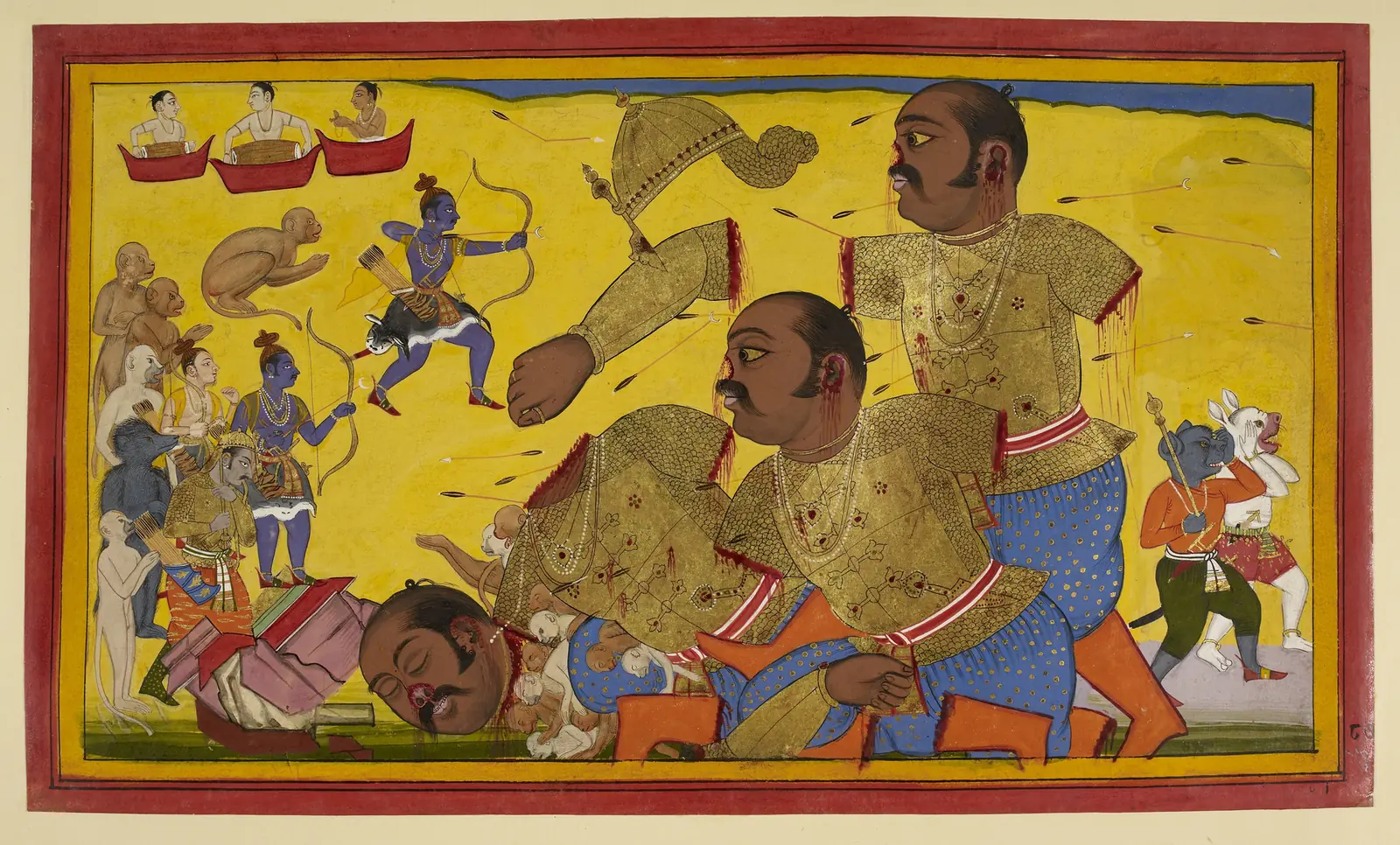
Prahasta fell to Nila. Ravana came out himself, struck Lakshmana down with a shakti and met Rama, who broke his chariot, his bow and his crown, and then let him go: you are tired, go and rest, and come back to fight. Shamed, Ravana had Kumbhakarna woken with drums, conches and elephants driven over his body. The giant told his brother he had done wrong, and went to fight for him anyway. He swallowed vanaras by the handful and carried Sugriva off unconscious, until Sugriva woke and bit off his ears and nose. Rama’s arrows took his arms, then his legs, then his head, which fell on Lanka and crushed its gates and walls.
05The mountain of herbs and Indrajit’s end
Indrajit returned invisible and loosed the Brahmastra; Rama, Lakshmana and most of the army fell. Vibhishana and Hanuman found old Jambavan alive, and he sent Hanuman to the Himalaya, to the herb mountain between Rishabha and Kailasa. Unable to tell the glowing herbs apart, Hanuman tore off the whole peak and flew back with it; at their scent the fallen rose. Indrajit next cut down an illusory Sita before Hanuman’s eyes, then slipped away to the Nikumbhila grove to complete a yajna that would make him unbeatable. Vibhishana led Lakshmana there. The yajna was broken, and after a long duel Lakshmana slew Indrajit with an arrow charged with Indra’s astra.
06Aditya Hridayam and the last battle
Ravana’s spear struck Lakshmana in the chest; Sushena the healer sent Hanuman once more for herbs, and Lakshmana rose. As Rama stood weary before the final fight, Maharshi Agastya came and taught him the Aditya Hridayam, the hymn to Surya; in the Gita Press edition it is sarga 105. Indra sent his own chariot with Matali at the reins. Each time Rama cut off one of Ravana’s heads, another grew in its place. Matali reminded him of the Brahma-astra Agastya had given him. Rama loosed it, and it pierced Ravana’s heart. That Ravana kept amrita in his navel, and that Vibhishana told Rama to strike there, is the Ramcharitmanas’s telling.
07Through the fire
Vibhishana wept for his brother, and Rama told him enmity ends at death; perform his rites. Mandodari’s lament over Ravana is among the most moving passages of the kanda. Vibhishana was crowned. Then Sita was brought, and before the whole army Rama spoke hard words to her. She asked Lakshmana to build a pyre, called on Agni as witness of her purity and entered the flames. Agni rose from the fire holding her and gave her back to Rama, and Brahma and the devas declared Rama to be Narayana himself. Dasharatha appeared from svarga to bless his son. In the Adhyatma Ramayana and the Ramcharitmanas the Sita who entered the fire was a shadow Sita, the true Sita having been kept by Agni since before the abduction; Valmiki tells it as above.
08Home to Ayodhya
In the Pushpaka Rama flew north with Sita, Vibhishana, Sugriva and the vanara chiefs, pointing out the battlefield, the setu, Kishkindha, Panchavati, Chitrakoot. They stopped at Bharadvaja’s ashrama at Prayag, and Hanuman went ahead to tell Guha and then Bharata, who had lived as an ascetic at Nandigram for fourteen years with Rama’s padukas on the throne. Bharata placed the sandals on Rama’s feet himself. Vasishtha crowned Rama in Ayodhya. Rama gave Sita a pearl necklace and she gave it to Hanuman. The lamps of Diwali for Rama’s return are the living tradition of Bharat; Valmiki describes a city decked with banners and flowers. A line much quoted as Rama’s, “even golden Lanka does not please me,” is found only in some manuscripts, not in the standard printed text.
Famous verses
सकृदेव प्रपन्नाय तवास्मीति च याचते। अभयं सर्वभूतेभ्यो ददाम्येतद्व्रतं मम॥
To one who comes to me for refuge even once, and asks, saying, I am yours, I give freedom from fear of all beings. This is my vow.Valmiki Ramayana, Yuddha Kanda 18.33 (Gita Press numbering)