
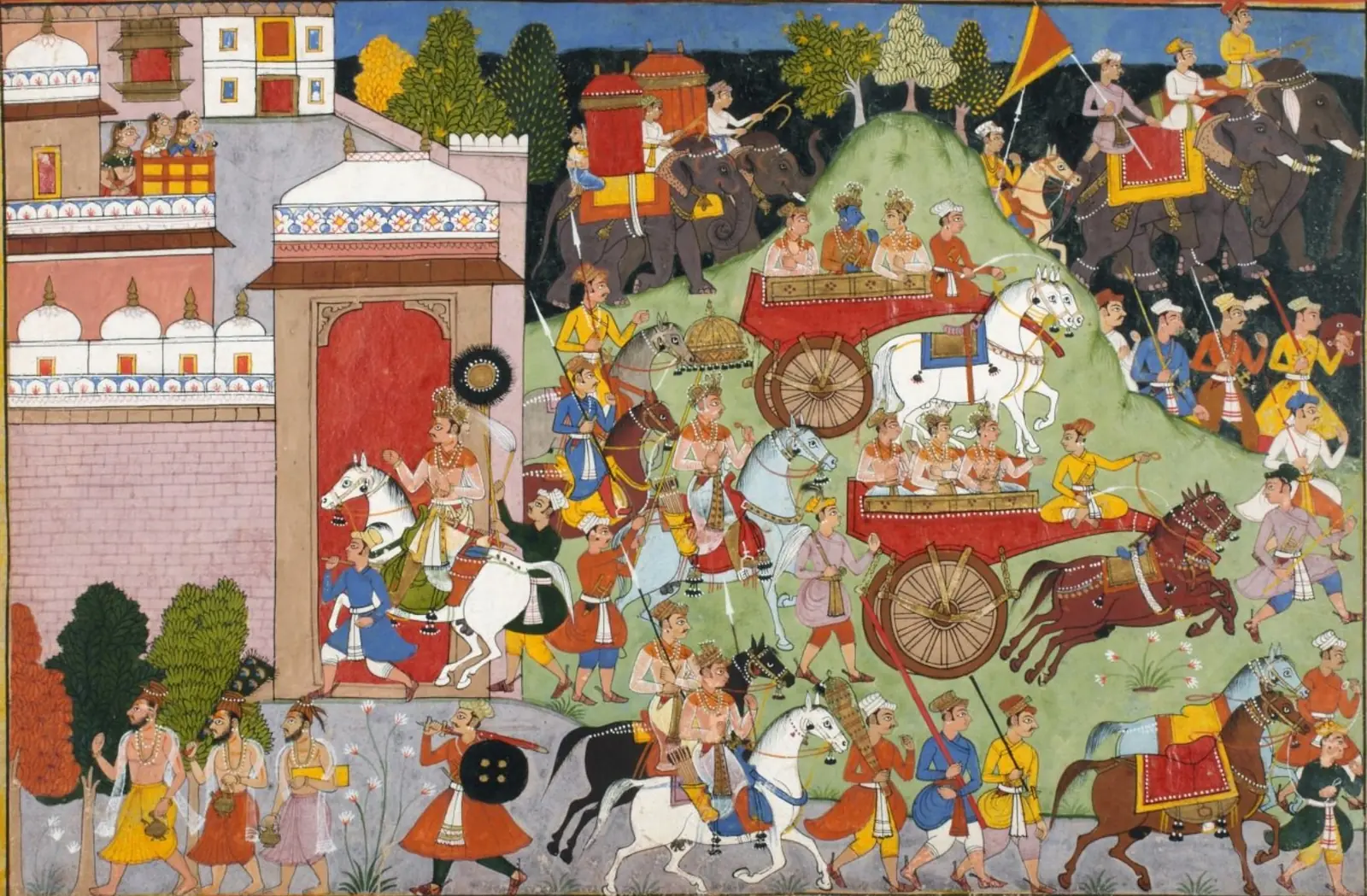
01Narada at the ashrama
The book begins with a question. Valmiki asks Devarshi Narada whether there is anyone now living who is truthful, steady in vows, grateful, learned, handsome, master of his anger and feared even by the devas in battle. Narada answers with one name, Rama of the Ikshvaku line, and tells the whole life in a hundred shlokas.
That same day comes the hunter, the krauncha bird, the cry of grief that became the first shloka, and Brahma’s command to compose. Valmiki then lays out his poem and teaches it to Lava and Kusha, who sing it in the streets of Ayodhya until Rama calls them to the palace to hear it.
02Dasharatha’s yajna
Ayodhya stood on the Sarayu, capital of Kosala, built by Manu himself. Its king Dasharatha had everything but a son. On the advice of his minister Sumantra he brought the young rishi Rishyashringa from Anga, performed the Ashvamedha, and then the putrakameshti yajna for sons.
The devas meanwhile went to Bhagwan Vishnu: Ravana, made safe by Brahma’s boon from every being but men, was tormenting the three worlds. Vishnu agreed to be born as a man. From the yajna fire rose a great being holding a golden vessel of payasa. Dasharatha gave half to Kausalya, and the rest to Sumitra and Kaikeyi; Sumitra received two shares. In the twelfth month, on Chaitra Shukla Navami under Punarvasu, Kausalya bore Rama. Kaikeyi bore Bharata, and Sumitra the twins Lakshmana and Shatrughna.
03With Vishvamitra
Rama was not yet sixteen when Maharshi Vishvamitra came to court and asked for him. Rakshasas were defiling his yajna. Dasharatha begged to go himself with an army instead, and only Vasishtha’s counsel made him let the boy go. Lakshmana went with his brother, as he always would.
On the bank of the Sarayu the sage taught them the mantras Bala and Atibala, so they would feel neither hunger nor tiredness. In the forest Rama killed the yakshi Tataka at the sage’s command. Pleased, Vishvamitra gave him the divine astras. At Siddhashrama, while the yajna burned, Rama struck Maricha with the Manava astra and flung him a hundred yojanas into the sea, and killed Subahu with the Agneya.
04Kathas on the road
On the walk to Mithila the sage told them kathas at every river. The descent of Ganga: how King Sagara’s sixty thousand sons were burned to ash, and how his descendant Bhagiratha’s tapas brought Ganga down from heaven onto Shiva’s locks and across the earth to wash their ashes. The birth of Kartikeya. Vishvamitra’s own long road from king to brahmarshi.
Near Mithila they came to an empty ashrama. Here Ahalya, wife of Gautama, had lived under her husband’s curse for ages, unseen by any creature, living on air, doing tapas. In Valmiki she is not turned to stone; the stone is the image of later tellings. When Rama arrived she shone out again, Rama and Lakshmana touched her feet, and Gautama returned to her.
05The bow of Shiva
King Janaka of Videha kept in his house the great bow of Bhagwan Shiva, handed down in his line. He had found Sita in a furrow while ploughing the ground for a yajna, and called her ayonija, not born of a womb. He had vowed she would marry only the man who could string that bow; kings had come and failed.
The bow was wheeled out in an iron chest on eight wheels, pulled by a crowd of strong men. Rama lifted it as if in play, strung it, and drew it until it broke in the middle with a crash like thunder; the people fell to the ground and only Vishvamitra, Janaka and the two princes stayed standing. In Valmiki there is no crowded svayamvara hall at that moment; that grand scene is the Ramcharitmanas’s.
06Four weddings and Parashurama
Messengers rode to Ayodhya and Dasharatha came with Vasishtha and the whole court. Four brothers married four princesses: Rama to Sita, Lakshmana to Urmila, Janaka’s daughters; Bharata to Mandavi and Shatrughna to Shrutakirti, daughters of Janaka’s brother Kushadhvaja. Janaka gave Sita’s hand with the words, “This is my daughter Sita, your partner in dharma.”
On the road home the sky darkened and Parashurama stood before them, axe on his shoulder, angry that Shiva’s bow had been broken. He held out the bow of Vishnu and dared Rama to string it. Rama took it, strung it, set an arrow and asked what it should strike. Parashurama bowed, gave up the worlds he had won by tapas to that arrow, and went back to Mahendra mountain.
Famous verses
तपःस्वाध्यायनिरतं तपस्वी वाग्विदां वरम्। नारदं परिपप्रच्छ वाल्मीकिर्मुनिपुङ्गवम्॥
The opening line of the poem: the ascetic Valmiki questioned Narada, foremost of sages, devoted to tapas and the study of the Veda, best of those who know speech.Valmiki Ramayana, Bala Kanda 1.1
मा निषाद प्रतिष्ठां त्वमगमः शाश्वतीः समाः। यत्क्रौञ्चमिथुनादेकमवधीः काममोहितम्॥
O hunter, may you find no rest for endless years, for you killed one of the pair of krauncha birds while it was lost in love.Valmiki Ramayana, Bala Kanda 2.15