
01The leap from Mahendra
Hanuman climbed Mahendra mountain, bowed to Surya, Indra, Brahma and his father Vayu, and pressed down so hard that springs burst from the rock and the creatures in its caves cried out. Then he leapt. Out at sea the mountain Mainaka rose from the water at Samudra’s request, offering him a place to rest, for Samudra owed a debt to Rama’s Ikshvaku forefathers. Hanuman touched its peak with his hand in courtesy and flew on. He would not stop until the work was done.
02Surasa, Simhika and the guardian of Lanka
The devas sent Surasa, mother of the nagas, to test him. She opened her jaws across his path; he grew, and she widened them further, until Hanuman suddenly became the size of a thumb, darted into her mouth and out again, and folded his hands to her. She blessed him. Next came Simhika, who seized flying creatures by their shadows. He let her swallow him and tore her apart from within. Landing on Lanka’s mountain at dusk, he shrank to the size of a cat to enter the city, and its guardian goddess barred his way. One blow of his left fist felled her. She remembered Brahma’s word: when a vanara overpowers me, the end of the rakshasas is near.
03Search through the night
All night he moved through Lanka’s mansions, its drinking halls and the inner rooms of Ravana’s palace, where he saw the Pushpaka standing like a hill of gold. He saw Mandodari asleep in splendour and for a moment his heart leapt, thinking she was Sita. Then he checked himself. Sita, parted from Rama, would neither sleep at ease nor wear ornaments nor touch drink. He searched again, despaired, and thought of what failure would mean for Rama, for Sugriva, for every vanara waiting on the shore. Then he bowed to Rama and Sita and turned to the one place left, the Ashoka grove.
04Sita under the shimshapa tree
Hidden in a shimshapa tree, Hanuman saw her: thin, in a single soiled garment, her hair in one braid, ringed by rakshasis of fearful shape. At dawn Ravana came with his women and pleaded and threatened. Sita placed a blade of grass between them before she answered, and told him to return her to Rama if he wished to live. Ravana gave her two months. After he left, the old rakshasi Trijata woke from a dream and told the others to stop tormenting Sita. She had seen Rama in white on a chariot of swans, and Ravana, shaven and smeared with oil, riding south on a donkey.
05The ring and the chudamani
Sita, worn out, was near to ending her life when she heard a soft voice from the branches telling Rama’s katha from Ayodhya onward. Hanuman came down, bowed and gave her Rama’s ring, engraved with his name. She held it as if she held Rama. He offered to carry her across the sea on his back that very hour. She refused: she would not willingly touch any man but Rama, and the glory of rescuing her was Rama’s to win. For a token she gave him her chudamani, the jewel from her hair, and told him a thing only Rama knew. At Chitrakoot a crow had clawed her, and Rama had sent a blade of grass after it charged as a Brahmastra; the crow, finding no shelter in all the worlds, came back and gave up one eye.
06The grove broken, the envoy bound
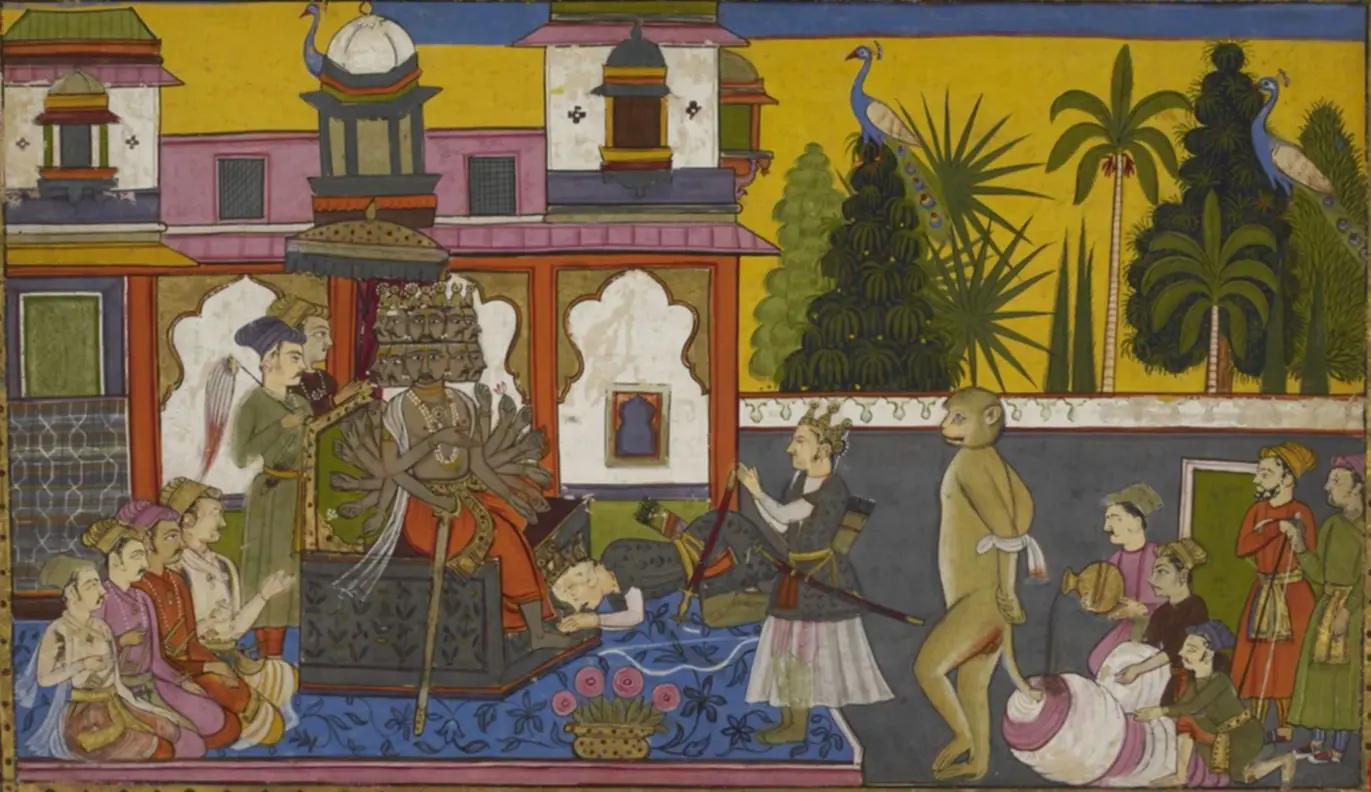
Hanuman did not want to leave without testing the enemy’s strength. He uprooted the Ashoka grove, sparing only the tree that sheltered Sita. Ravana sent the kinkaras, then Jambumali, then the sons of his ministers, then five generals. All fell. Prince Aksha came in a chariot and Hanuman seized him by the feet and dashed him to the ground. At last Indrajit bound him with the Brahmastra. Hanuman honoured Brahma’s weapon and let himself be held, and when the rakshasas added ropes of bark the astra’s hold fell away of its own accord. He walked into Ravana’s court a willing prisoner.
07Lanka on fire
Before Ravana he named himself Rama’s messenger and advised him to give Sita back. Ravana ordered him killed. Vibhishana objected that an envoy may not be put to death, so Ravana had his tail wrapped in cloth, soaked in oil and set alight. When Sita heard, she prayed to Agni, and the fire felt cool to Hanuman. He slipped his bonds, leapt from roof to roof and burned Lanka. Then fear struck him that Sita too might have burned, until he heard the charanas in the sky say she was unharmed. He saw her once more, leapt back across the sea and roared from Mahendra. The vanaras feasted in Sugriva’s Madhuvana, and Hanuman’s first word to Rama was that Sita had been seen.
08Read in homes today
Of all the kandas this is the one most often read on its own. Families read Sundara Kanda through on Tuesdays and Saturdays, in times of illness or debt, before a wedding or before going abroad, because it is the kanda in which hope returns: the lost one is found and the messenger comes home. Tulsidas’s Sundar Kand in the Ramcharitmanas is sung the same way in north Indian homes and Hanuman temples, often in one sitting.
Famous verses
जयत्यतिबलो रामो लक्ष्मणश्च महाबलः। राजा जयति सुग्रीवो राघवेणाभिपालितः॥
Victory to Rama of surpassing strength, and to mighty Lakshmana! Victory to King Sugriva, protected by Raghava!Valmiki Ramayana, Sundara Kanda 42.33 (Gita Press numbering)
दासोऽहं कोसलेन्द्रस्य रामस्याक्लिष्टकर्मणः। हनुमान् शत्रुसैन्यानां निहन्ता मारुतात्मजः॥
I am the servant of Rama, lord of Kosala, whose deeds are done without strain. I am Hanuman, son of the Wind, destroyer of enemy armies.Valmiki Ramayana, Sundara Kanda 42.34 (Gita Press numbering)