
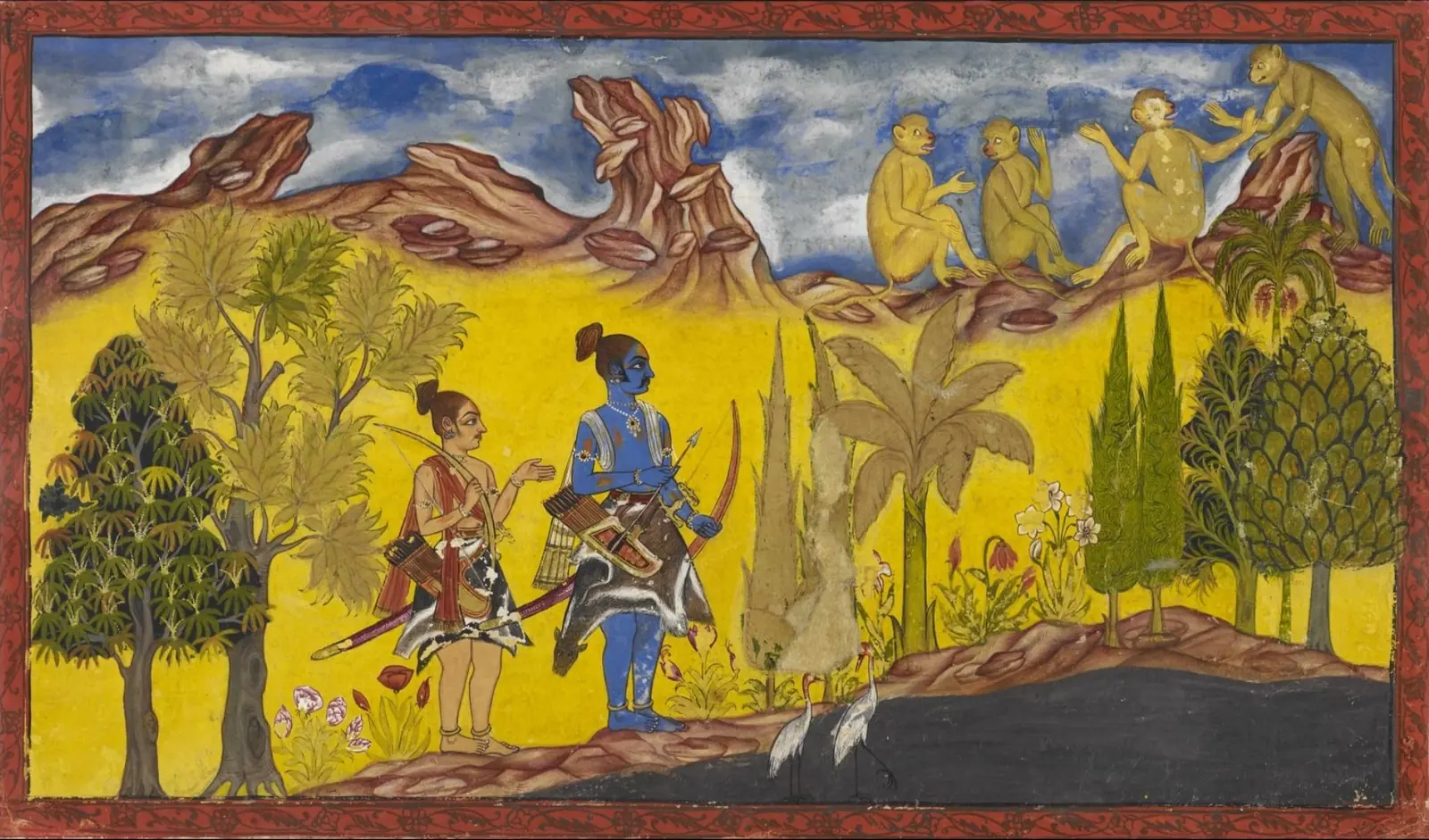
01Hanuman at Pampa
Sugriva sat on Rishyamuka with four counsellors and saw two armed men walking by the lake. He was sure his brother Vali had sent them. Hanuman, son of Vayu, went down dressed as a wandering bhikshu to find out who they were.
He spoke so well that Rama turned to Lakshmana in wonder: no one could speak like this without having mastered the Rigveda, the Yajurveda and the Samaveda, and in all that speech there was not one wrong word. When Hanuman learned who they were, he took his own form and carried both brothers up the hill on his shoulders. Tradition places Kishkindha on the Tungabhadra around Hampi and Anegundi, with Rishyamuka and Anjanadri among its hills.
02Friendship by fire
Hanuman kindled a fire with two sticks and Rama and Sugriva walked around it together, sworn friends. Sugriva brought out the bundle that had fallen from the sky. Rama could not see for tears. He asked Lakshmana whether he knew these ornaments, and Lakshmana said he did not know the armlets or the earrings, only the anklets, because he had touched her feet every day.
Then Sugriva told his story. Vali had chased the asura Mayavi into a cave and told Sugriva to wait at its mouth. After a year blood and roaring came out of it. Sugriva, thinking his brother dead, closed the cave with a rock and was made king. Vali came back, called it treachery, drove him out and took his wife Ruma.
03Seven sala trees
Sugriva had seen Vali’s strength. Vali had killed the buffalo-asura Dundubhi and flung the carcass far through the air; its blood fell on the ashrama of Matanga, whose curse was the reason Vali could never set foot on Rishyamuka. Sugriva wanted proof that Rama could match him.
Rama flicked the dried skeleton of Dundubhi ten yojanas with his big toe. Then he loosed one arrow through seven sala trees standing in a row; it passed through them, through the hill behind and into the earth, and came back to his quiver. Sugriva fell at his feet.
04The death of Vali
Sugriva roared a challenge at the gates of Kishkindha. The brothers fought, and they looked so alike that Rama held his arrow. Sugriva fled beaten and bleeding. The second time Lakshmana hung a flowering creeper round his neck as a mark. Tara, Vali’s wise queen, had heard from Angada that Sugriva had powerful friends, and begged Vali not to go. He went.
Rama shot him from behind a tree. Vali, dying, reproached him for striking from hiding. Rama answered that the whole land belonged to the Ikshvakus and Bharata ruled it by dharma; Vali had taken his younger brother’s wife while the brother lived, and a king punishes such a sin. Vali accepted it, asked Rama to protect Angada, and gave Sugriva his golden necklace. Tara’s lament over him is among the most piercing passages of the poem.
05The rains on Prasravana
Sugriva was crowned and Angada made yuvaraja. Rama would not enter the city during his exile; he spent the four months of the monsoon in a cave on Mount Prasravana with Lakshmana. Valmiki gives these sargas some of his loveliest descriptions of rain, and Rama’s grief runs through every cloud.
Autumn came, and Sugriva, back in his palace, forgot. Hanuman reminded him. Rama sent Lakshmana, who arrived at Kishkindha twanging his bow in fury. Tara came out to meet him and softened him with gentle words; Sugriva begged forgiveness, and the vanara and bear armies were called in from every mountain and forest, in numbers Valmiki counts by the crore.
06Four directions
Sugriva divided the host into four and gave each one month. To each he described the lands ahead in detail, the rivers, mountains and peoples; to the eastern party he named Yavadvipa, the island of barley, with its seven kingdoms and mines of gold. The southern party was the strongest, under Angada, with Jambavan, Nala, and Hanuman.
Rama gave Hanuman alone his signet ring, engraved with his name, as a token for Sita, because he trusted that Hanuman would be the one to find her. The month ran out in the south. The party lost its way in the cave of Svayamprabha, came out on the seashore, and, afraid to return empty-handed, sat down to fast to death.
07Sampati and Jambavan
As they spoke of Jatayu’s death, an old wingless vulture crawled out of a cave above them. He was Sampati, Jatayu’s elder brother, whose wings the sun had burned long ago when he shielded his brother in flight. Grieving, he told them what his eyes could see: Sita in Lanka, a hundred yojanas across the sea. As he spoke, new wings grew on him.
Who could leap a hundred yojanas? Each vanara named his limit. Old Jambavan then turned to Hanuman, sitting silent, and reminded him who he was: son of Vayu and Anjana, the child who leapt at the rising sun thinking it a fruit and was struck on the jaw by Indra’s vajra. Hanuman began to grow. He climbed Mount Mahendra, and the mountain shook under him.
Famous verses
नाहं जानामि केयूरे नाहं जानामि कुण्डले। नूपुरे त्वभिजानामि नित्यं पादाभिवन्दनात्॥
Lakshmana to Rama: I do not know these armlets, I do not know these earrings. The anklets I know, from bowing at her feet every day.Valmiki Ramayana, Kishkindha Kanda 6.22–23