
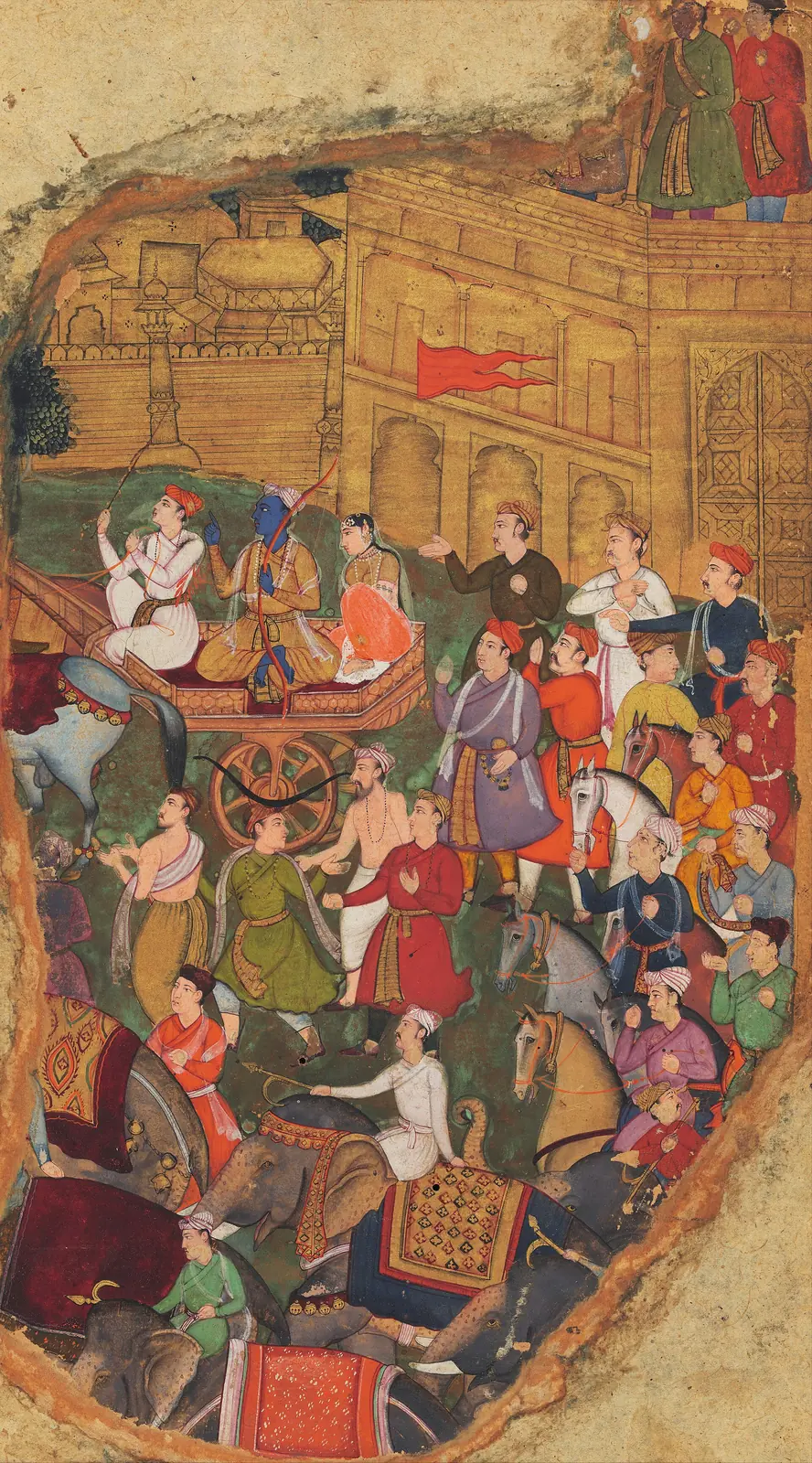
01A coronation is announced
Dasharatha was old and had seen bad omens. He called his council and the citizens and proposed that Rama, loved by all, be made yuvaraja. The hall roared its approval. The ceremony was fixed for the next day, under Pushya nakshatra, and Ayodhya spent the night hanging garlands, sprinkling the streets and raising banners. Bharata was away at his grandfather’s court in Kekaya with Shatrughna.
Vasishtha told Rama and Sita to fast that night and keep vigil. Rama lay on a bed of kusha grass in the temple of his house, and the city could not sleep for joy.
02Manthara and the two boons
Manthara, Kaikeyi’s hunchbacked maid who had come with her from Kekaya, saw the festive city from the palace roof. Kaikeyi’s first answer to the news was joy; she gave Manthara a jewel for it. Manthara worked on her all evening until fear for Bharata took hold.
Long ago, in the war of the devas against the asura Shambara, Kaikeyi had driven Dasharatha’s chariot and carried him wounded from the field, and he had granted her two boons. Now she lay on the floor of the kopa-bhavana, the chamber of anger, with her ornaments thrown off, and claimed them: Bharata to be crowned, and Rama to live in the Dandaka forest for fourteen years in bark and deerskin. The king begged all night. She did not move.
03Rama’s answer
In the morning Rama was called in and found his father unable to speak. Kaikeyi told him. He did not change colour. “Tell me what the king wants; I will do it, I promise it. Rama does not speak twice.” He went to Kausalya, who fell like a cut tree, and to Lakshmana, who wanted to take the throne by force; Rama calmed him with the word dharma.
Sita would not be left. A wife’s place, she said, was beside her husband, and the forest with him would be a palace. Lakshmana asked to come and would not be refused. Sumitra blessed her son with a line every Hindu mother knows. When Kaikeyi handed out bark garments, Vasishtha rounded on her for making Sita wear them.
04Ganga, Prayag, Chitrakoot
The citizens followed the chariot out of the city and slept with them on the bank of the Tamasa; Rama left before dawn so they would go home. At Shringaverapura on the Ganga, Guha, king of the Nishadas and Rama’s friend, received them. There the brothers matted their hair with banyan sap, Sumantra was sent back with the empty chariot, and Guha’s boatmen took them across.
At Prayag, where Ganga meets Yamuna, Maharshi Bharadvaja welcomed them and pointed them to Chitrakoot, ten krosha away. They crossed the Yamuna on a raft Lakshmana built, and on the hill of Chitrakoot by the Mandakini Lakshmana raised a hut of leaves and wood. Rama performed the vastu shanti before they entered it.
05Dasharatha dies
When Sumantra came back alone, Dasharatha broke. On the sixth night he told Kausalya the sin of his youth. Hunting by the Sarayu at night, he had heard a sound like an elephant drinking and loosed an arrow by sound alone. It killed a young ascetic filling a pitcher for his blind parents. The old father cursed him to die grieving for a son.
Valmiki does not give the boy a name. The name Shravana Kumar belongs to later tellings. Dasharatha died that night calling Rama’s name. His body was laid in a vessel of oil to wait for Bharata.
06Bharata comes home
Messengers rode to Rajagriha in Kekaya without telling Bharata why. He arrived to a silent city and learned everything from his mother, who expected thanks. He turned on her with words that burned. When Shatrughna dragged Manthara across the floor, Bharata had him let her go, saying Rama would never forgive harm to a woman.
He performed his father’s last rites and then refused the throne before the whole assembly. He set out with the army, the queens and the citizens to bring Rama back. Guha at first guarded the river against him and then wept when he understood. Bharadvaja tested him and, satisfied, fed the whole army by the power of his tapas.
07The sandals at Chitrakoot
Lakshmana saw the dust of an army from a tree and wanted to fight. Then Bharata came on foot and fell at Rama’s feet. Rama heard of his father’s death and offered water for him in the Mandakini. For days Bharata pleaded, the sage Jabali argued that a dead father’s word binds no one, and Rama answered that a king who breaks truth has nothing left to stand on.
In the end Bharata asked for Rama’s sandals. He would rule only as their servant, he said, and if Rama was not back the day after fourteen years he would enter fire. He lived at Nandigram outside Ayodhya in bark and matted hair, with the padukas on the throne. Rama left Chitrakoot for the ashrama of Atri, where Anasuya gave Sita garlands and unguents that would never fade.
Famous verses
तद्ब्रूहि वचनं देवि राज्ञो यदभिकाङ्क्षितम्। करिष्ये प्रतिजाने च रामो द्विर्नाभिभाषते॥
Rama to Kaikeyi: tell me, devi, what the king wishes. I will do it, I promise. Rama does not speak twice.Valmiki Ramayana, Ayodhya Kanda 18.30
रामं दशरथं विद्धि मां विद्धि जनकात्मजाम्। अयोध्यामटवीं विद्धि गच्छ तात यथासुखम्॥
Sumitra to Lakshmana: know Rama as your father Dasharatha, know Janaka’s daughter as me, know the forest as Ayodhya. Go happily, my son.Valmiki Ramayana, Ayodhya Kanda 40.9