
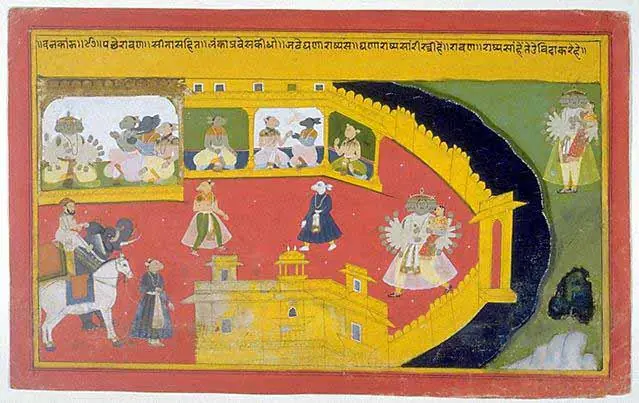
01Ten heads and a boon
The Uttara Kanda tells his birth. The rakshasa Sumali sent his daughter Kaikasi to the rishi Vishrava, son of Pulastya, and because she came to him at a fearful hour of dusk, he told her, her sons would be fierce. The first was born with ten heads and was named Dashagriva; after him came Kumbhakarna, Shurpanakha and Vibhishana. Kubera, lord of wealth, was Vishrava’s son by another wife. Dashagriva did tapas for ten thousand years, and at the end of each thousand cut off one of his heads and offered it into the fire. At the tenth, Brahma appeared, restored his heads, and granted him safety from devas, asuras, nagas, yakshas and rakshasas. Men he did not think worth naming.
02Kailasa, and the name Ravana
He took Lanka and the vimana Pushpaka from Kubera. Flying home over Kailasa, the vimana stopped dead, and Nandi told him the mountain was Shiva’s and no one passed over it. Dashagriva laughed at Nandi’s monkey-like face, and Nandi cursed him: creatures with faces like mine will destroy your race. Then Dashagriva put his arms under the mountain and lifted. Bhagwan Shiva pressed down with one toe and crushed his arms beneath it. His roar shook the three worlds. For a thousand years he sang Shiva’s praise until Shiva released him, named him Ravana, the one who made the worlds cry out, and gave him the sword Chandrahasa.
The Shiva Tandava Stotram that tradition credits to Ravana is not in Valmiki.
03The curses that held him back
In the Himalaya he found the maiden Vedavati at tapas, seeking Vishnu as her husband, and seized her by the hair. She cut off her hair with her own hand, entered fire, and vowed to be born again for his destruction; the Uttara Kanda says she was born again as Sita. Later, after he forced the apsara Rambha, her betrothed Nalakubara cursed him: if he ever again took a woman against her will, his head would split in seven. Ravana admits in the Yuddha Kanda that a curse is why he never forced Sita, only gave her months to yield. Hanuman, who saw him on his throne in Lanka, could not help exclaiming at his splendour.
04The fall of Lanka’s king
Everyone told him to give Sita back: Maricha, the old Malyavan of his mother’s family, Vibhishana, and in the end even Kumbhakarna. He heard none of them. He lost his son Akshakumara to Hanuman, then Prahasta, Kumbhakarna and Indrajit, and went out himself. On the last day Indra sent his chariot and charioteer Matali to Rama, and Agastya taught Rama the Aditya Hridayam on the field. Each head Rama cut off grew back. At last Rama loosed the Brahmastra Agastya had given him, and it pierced Ravana’s heart. When Vibhishana hesitated over the rites, Rama said that enmity ends with death; Ravana was now his own to honour too.
On Vijayadashami his effigy burns across north India.
Famous verses
अहो रूपमहो धैर्यमहो सत्त्वमहो द्युतिः। अहो राक्षसराजस्य सर्वलक्षणयुक्तता॥
Hanuman, seeing Ravana on his throne: what form, what steadiness, what strength, what splendour! How the king of the rakshasas is endowed with every mark of greatness!Valmiki Ramayana, Sundara Kanda 49.17