Cite
MLA
“Indra.” Hindu History, 2026, https://www.hinduhistory.in/devata/indra/. Accessed .
APA
Hindu History. (2026). Indra. Retrieved , from https://www.hinduhistory.in/devata/indra/
यो जात एव प्रथमो मनस्वान्देवो देवान्क्रतुना पर्यभूषत्। यस्य शुष्माद्रोदसी अभ्यसेतां नृम्णस्य मह्ना स जनास इन्द्रः॥
yo jāta eva prathamo manasvān devo devān kratunā paryabhūṣat | yasya śuṣmād rodasī abhyasetāṃ nṛmṇasya mahnā sa janāsa indraḥ ||
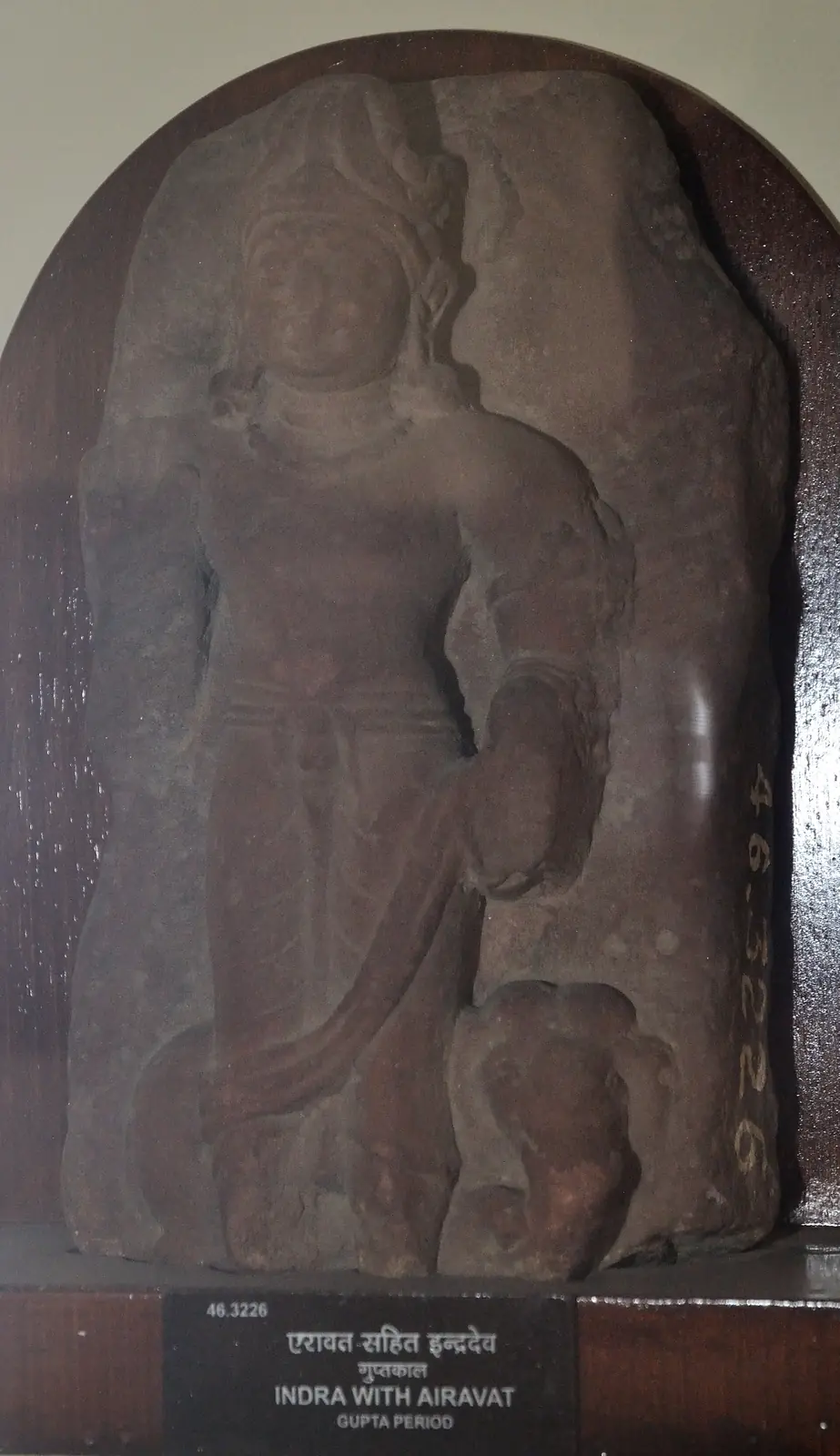
Seated on the white elephant Airavata, holding the vajra and often an ankusha; in temple carvings he guards the east among the eight dikpalas, sometimes with Shachi beside him.
01Vritra and the waters
About a quarter of the Rigveda’s hymns are for Indra. The best known (Rigveda 1.32) tells how Vritra, the coiled serpent, held back the waters, and Indra, strong with soma, struck him with the vajra Tvashtr had made, and the rivers ran down to the sea like lowing cows. The Mahabharata adds that the vajra was shaped from the bones of the rishi Dadhichi, who gave his body for the devas. Hymn 2.12 sings refrain after refrain, sa janāsa indraḥ: he, O people, is Indra.
02Indra in the Itihasa
In the Itihasa and Puranas, Indra is the office of king of heaven, held by a different soul in each manvantara; the present Indra is Purandara. He is Arjuna’s father in the Mahabharata and gives him celestial weapons in Svarga. The Bhagavata Purana (10.24–25) tells how the cowherds of Vraja, on young Krishna’s advice, worshipped Govardhan hill instead of Indra; Indra sent seven days of storm, and Krishna held up the hill on one finger until Indra came to bow. That is why Annakut is kept the day after Diwali.
03Where he is still honoured
Indra has few temples of his own, but he is on almost every one, guarding the eastern quarter. In Kathmandu, Indra Jatra in Bhadrapada raises a great pole for him and brings out the Kumari in her chariot. In Tamil Nadu, Bhogi, the first day of Pongal, was once Indra’s day of thanks for rain. Ancient texts describe the Indradhvaja festival, the raising of Indra’s banner by kings. Khmer and Cham temples show him on a three-headed Airavata.
In the texts
- Rigveda 1.32 and 2.12
- Mahabharata, Vana Parva
- Bhagavata Purana 10.24–25 (Govardhan)