
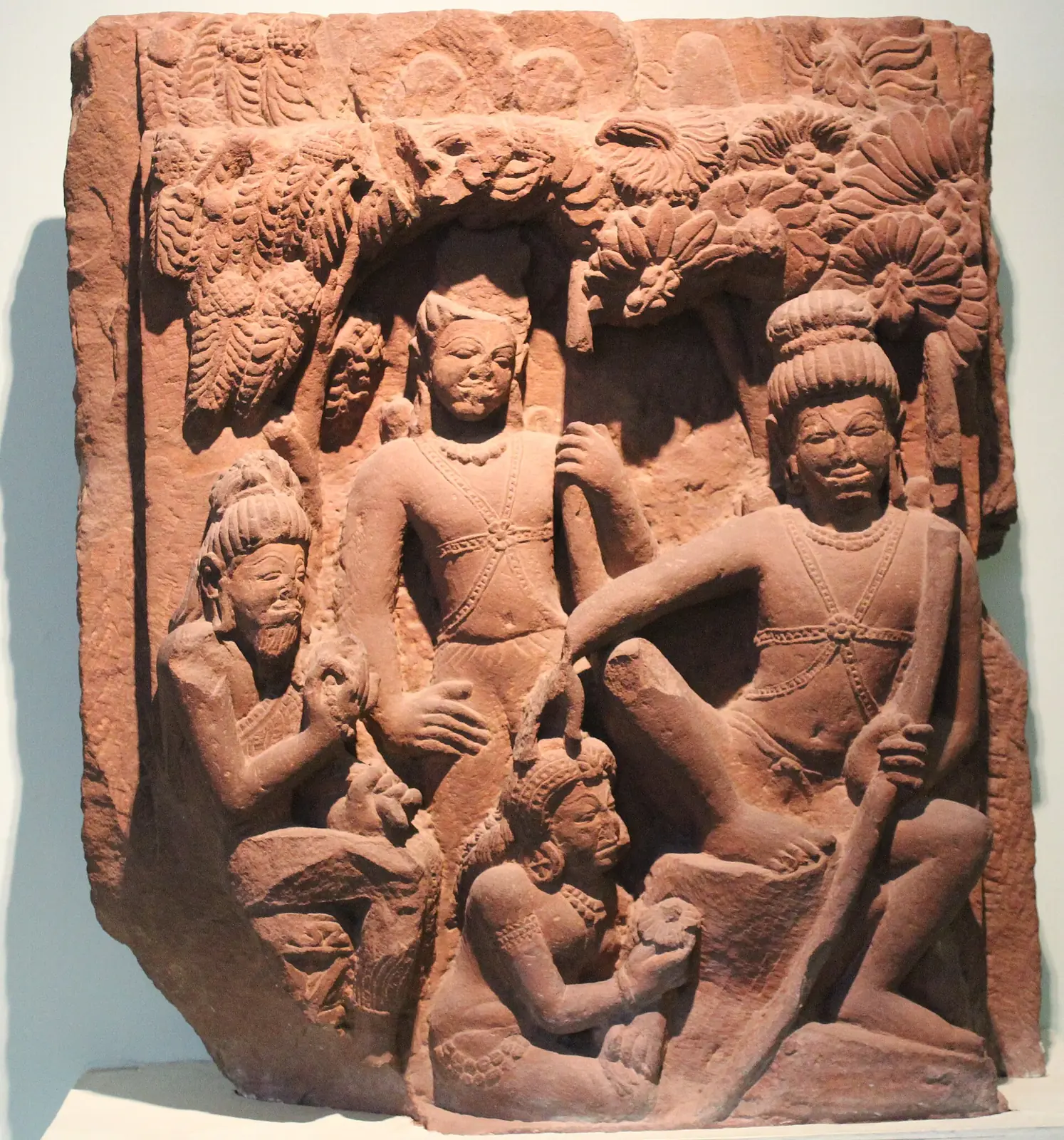
01The empty ashrama
Near Mithila, Vishvamitra brought the princes to an old ashrama that looked deserted, and told them whose it had been. Maharshi Gautama lived there with his wife Ahalya. One day, while Gautama was away, Indra came to her in the rishi’s form. The Bala Kanda says she knew him for the king of the devas and, in a moment’s folly, did not refuse; in the account given in the Uttara Kanda she was wholly deceived. Gautama returned, saw Indra leaving in his own shape, and cursed him.
02Like a flame wrapped in smoke
Ahalya’s curse was to live on in the ashrama for thousands of years, unseen by any creature, taking only air, lying on ashes, until Rama came; his hospitality would make her pure again. When Rama stepped into the ashrama she became visible, shining, Valmiki says, like a flame wrapped in smoke, like the full moon behind mist, like sunlight thrown back from water. The brothers touched her feet. She received them as guests, flowers fell from the sky, and Gautama returned to her.
In Valmiki she is never a stone. The stone woken by the dust of Rama’s feet is the image of the Adhyatma Ramayana and the Manas.
03First of the panchakanya
Her son Shatananda was Janaka’s purohita, and when Rama reached Mithila Shatananda’s first question was about his mother: had she been freed? Every morning devout Hindus recite the line that names five women whose remembrance destroys great sin: Ahalya, Draupadi, Sita, Tara and Mandodari. Ahalya’s name comes first. In Mithila the village of Ahiyari, near Darbhanga, keeps a shrine, the Ahalya Asthan, where tradition places Gautama’s ashrama.