
No invasion, battle layer or destruction has been found in the Harappan cities. They declined over centuries as rivers shifted and the climate dried, the 2019 Rakhigarhi genome shows no steppe ancestry in a Harappan, and Harappan practices such as fire altars continue into later Bharat.
The proof
- George Dales, "The Mythical Massacre at Mohenjo-daro", Expedition (1964), showed the "massacre" skeletons lay in different levels and were not victims of a single attack.
- Vasant Shinde and colleagues, Cell (2019): the Rakhigarhi woman’s genome has no ancestry from steppe pastoralists or Iranian farmers.
- Fire altars were excavated at Kalibangan and Lothal.
01The claim
The textbook version ran like this. Around 1500 BCE a fair-skinned race of horse-riding Aryans poured through the north-western passes, smashed the cities of the Indus, enslaved or drove south the dark-skinned natives, and brought the Vedas with them. From this one story came a whole politics: north against south, "Aryan" against "Dravidian", upper caste as conquerors, and Hindu dharma itself as a foreign import. Generations of Indian schoolchildren learned it as settled fact.
02Where it came from
European scholars noticed in the 1780s that Sanskrit, Greek and Latin were related. Max Müller made "Aryan" his master word and guessed a Vedic date to fit the Bible-era chronology of his time. He later protested that an ethnologist who speaks of an Aryan race is as great a sinner as a linguist who speaks of a long-headed grammar, but the race idea had already left the study. Risley, who ran the 1901 census, claimed that a caste’s social rank followed the width of its members’ noses. When Harappa and Mohenjo-daro were dug in the 1920s, the story needed a villain for their end, and Wheeler supplied one.
03The massacre that never was
Wheeler pointed to groups of skeletons found in Mohenjo-daro’s upper levels and to the god of the Rigveda who breaks forts, and concluded that Indra stood accused. In 1964 George Dales of the University of Pennsylvania went back to the records. The bodies came from different periods, some after the city was already half-abandoned. There was no burnt layer of conquest, no weapons scattered in the streets, no defenders’ last stand. Later study of the bones found signs of disease and hardship, not a single day of slaughter. Archaeologists now describe a slow decline from about 1900 BCE as the Ghaggar-Hakra dried and trade with Mesopotamia fell away.
04What the ground and the genes show
In 2019 a team led by Vasant Shinde read the genome of a woman buried at Rakhigarhi in Haryana. Her ancestry was a mix of ancient South Asian hunter-gatherers and an Iran-related line that separated from Iranian plateau peoples before farming began, and most South Asians today descend largely from people like her. Honesty needs the other half too. A companion study (Narasimhan and others, Science, 2019) found that steppe-related ancestry did enter South Asia in the second millennium BCE and is present, in varying amounts, in many groups today. Scholars still argue what that movement meant. What it does not show is a conquest that destroyed the Harappan cities.
05Continuity you can see
At Kalibangan in Rajasthan and at Lothal in Gujarat, excavators found rows of fire altars, pits lined with clay and ash. The seated yogi on the seal many call Pashupati, the conch-shell bangles, the swastika, the standard weights and the layout of villages carry on into historic India. The Sarasvati, praised in the Rigveda as the best of rivers, is the river along whose dry bed hundreds of Harappan sites now lie. None of this settles every question, and the Indus script is still unread. It does settle that the old picture of a burnt civilisation and a new race arriving with a new religion is wrong.
06What to read
Begin with George Dales, "The Mythical Massacre at Mohenjo-daro" (Expedition, 1964), short and decisive. Then the Rakhigarhi paper by Shinde and others in Cell (2019) and, beside it, Narasimhan and others in Science (2019), so that you know both sides of the genetic evidence. Jonathan Mark Kenoyer’s Ancient Cities of the Indus Valley Civilization (1998) is the best plain guide to the cities. B. B. Lal’s The Sarasvati Flows On (2002) argues for continuity, and Edwin Bryant’s The Quest for the Origins of Vedic Culture (2001) lays out the whole debate fairly.
Read on
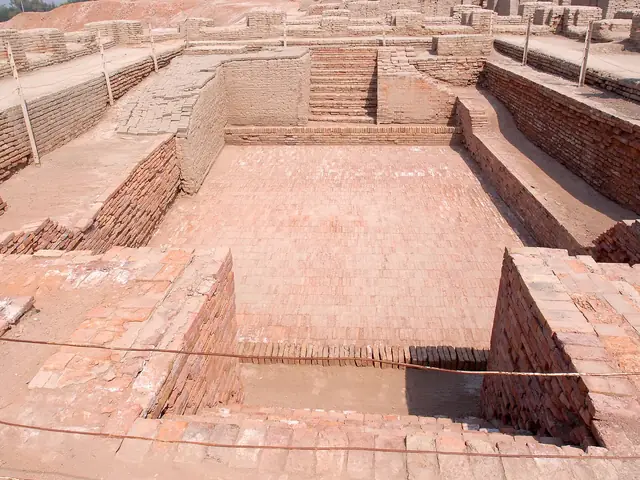
The Sindhu–Sarasvati Civilisation
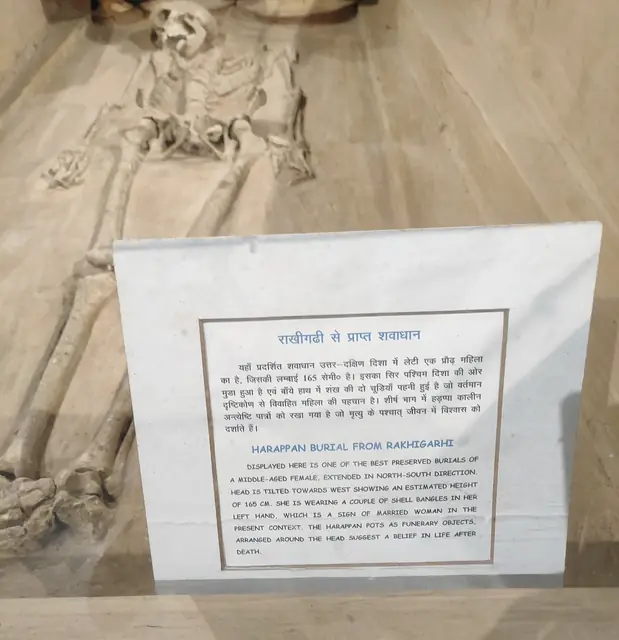
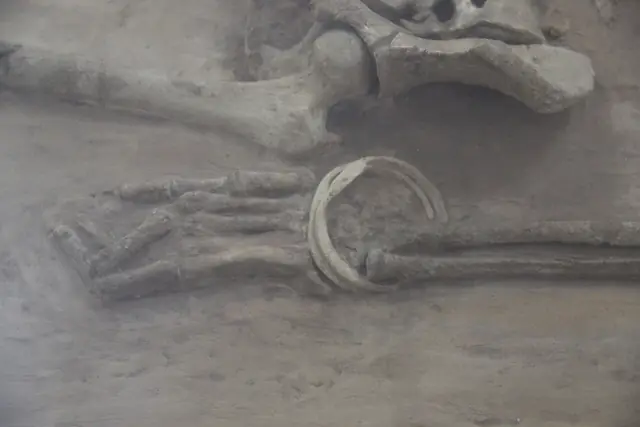
The Rakhigarhi genome
The first ancient genome recovered from a person of the Sindhu–Sarasvati cities, a woman buried at Rakhigarhi more than 4,000 years ago.
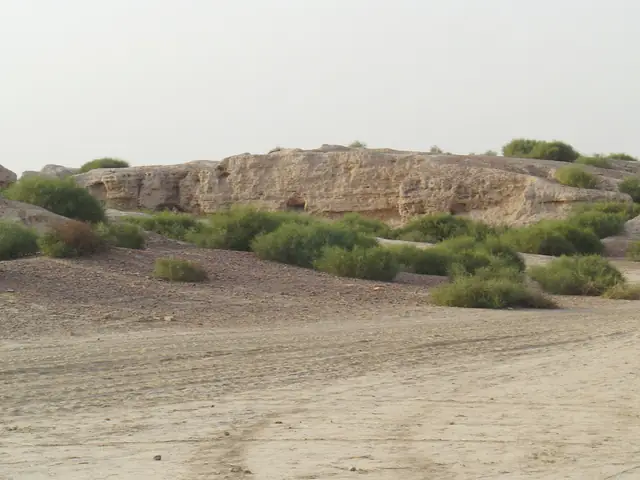
Rakhigarhi
The largest Sindhu–Sarasvati city found in India, in the old Drishadvati basin of Hisar district. A genome from its cemetery, published in 2019, showed the people of the cities carried no steppe ancestry.
Kalibangan
A Harappan town on the dry bed of the Ghaggar, the river many identify with the Vedic Sarasvati, where B. B. Lal and B. K. Thapar found the oldest ploughed field yet excavated and rows of fire altars.
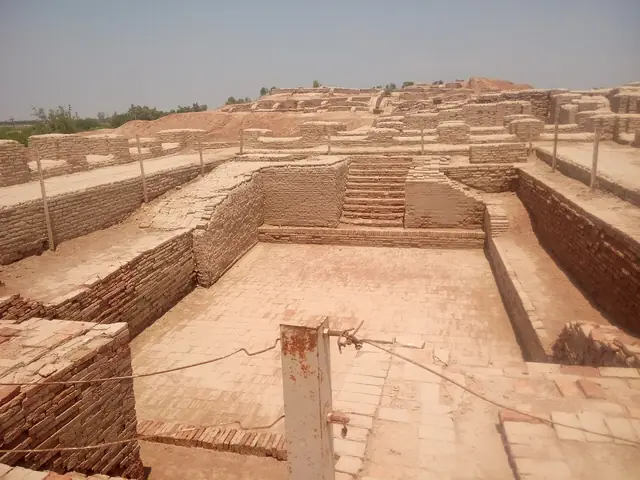
Mohenjo-daro
The largest city of the Sindhu–Sarasvati civilisation, on the Sindhu in Sindh, with its Great Bath, its grid of baked-brick streets and covered drains. The bronze dancing girl and the yogi seal many see as Pashupati were found here.
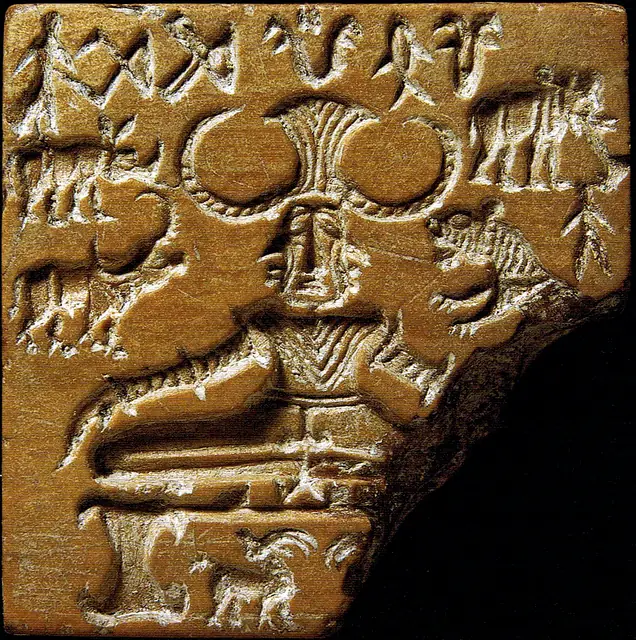
The Pashupati seal
A small steatite seal of a figure seated in a yogic posture, wearing a horned headdress and surrounded by animals, whom many see as Pashupati, Lord of creatures.