01Shiva’s second Kailasa
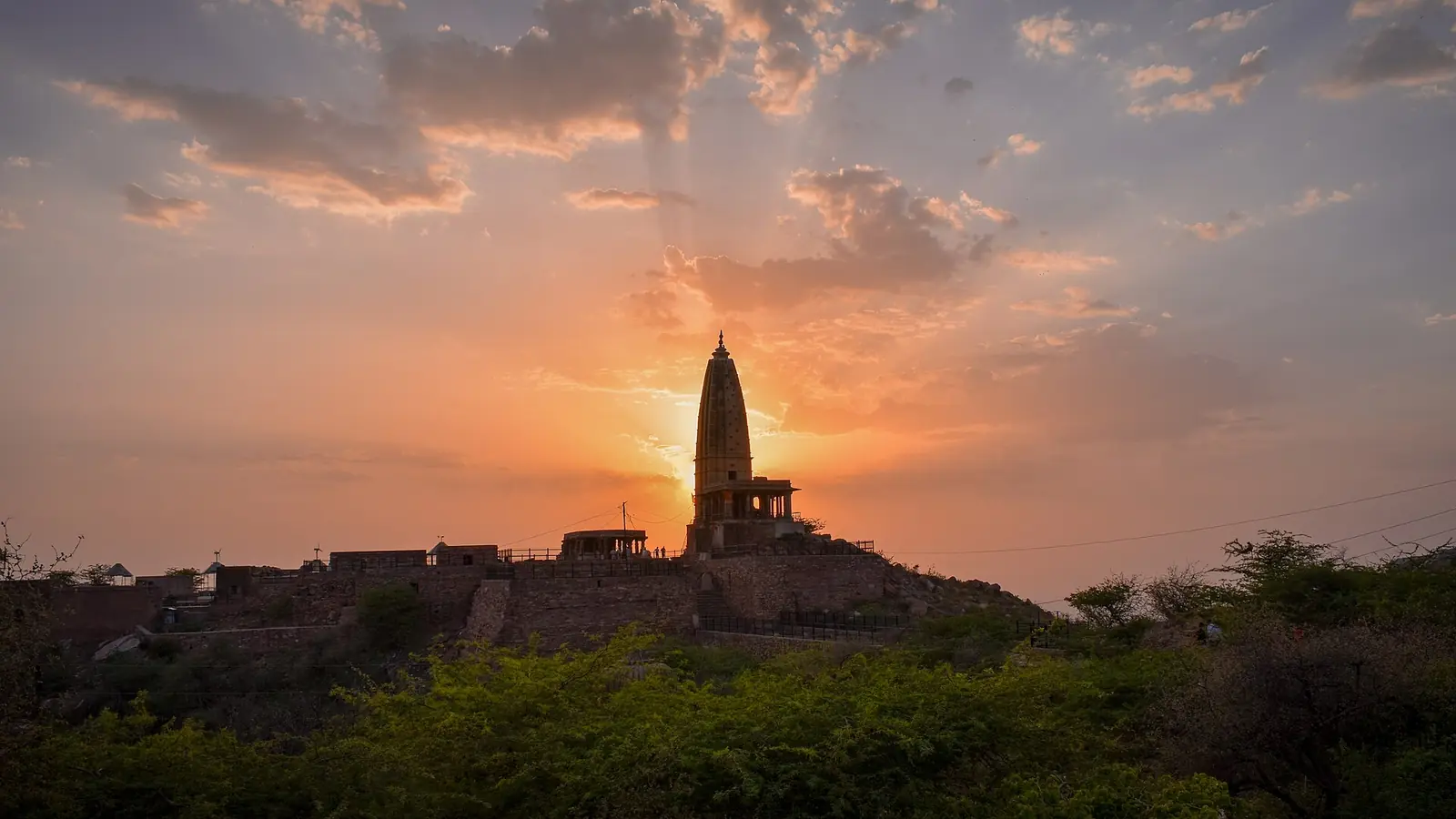
Harshagiri, the mountain of joy, rises above the plain of Sikar, visible far along the old salt road north from Shakambhari. A Pashupata ascetic of this country, Allata, also called Bhavarakta, built a stone temple to Shiva as Harsha on its summit, completing it in 956 with gifts from kings, salt merchants of Shakambhari and horse traders from the north. The long Sanskrit inscription set up in 973, in the reign of the Chahamana king Vigraharaja II, praises the hill as a piece of heaven and Shiva’s home on earth beside Kailasa, and gives the Chahamana line from its founder. The Chahamanas held Harsha as their kuladevata, and after Allata’s death in 970 his pupil Bhavadyota added a courtyard, garden, well and cattle trough.
02The ruins on the hill
The old temple faced east and was ringed by smaller shrines. Today it is a field of fallen stone: carved pillars, a sanctum doorway and panels of Shiva, Parvati, the Matrikas and dancers, some still in place, others taken away to museums. On an inner wall Parvati stands at her tapas among five fires. In 1718 Shiv Singh of Sikar built a new Shiva temple beside the old one, partly from its ruins, and worship continues there. Below the hill, the village of Harsh keeps the name. The climb is long but the summit gives a view across the Shekhawati plain, and wind turbines now share the ridge.
The life of this place
- 956Allata completes the temple of Harsha.
- 973The Harsha inscription is set up under Vigraharaja II.
- 1718Shiv Singh of Sikar builds a new temple beside the ruined one.
About 14 km from Sikar; a road now reaches near the top.