
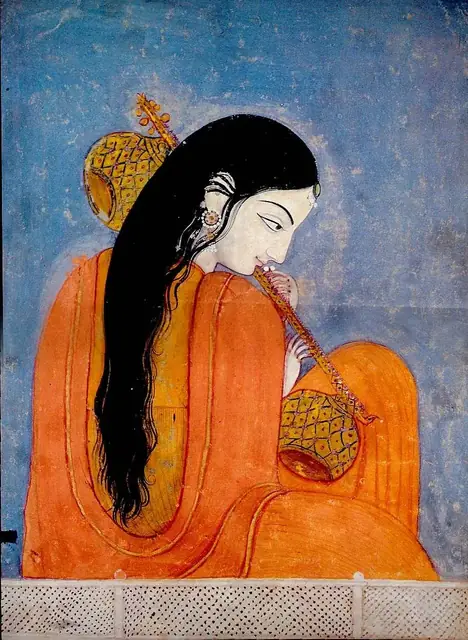
स्याम मने चाकर राखो जी।
गिरधारी लाला चाकर राखो जी॥
चाकर रहसूँ बाग लगासूँ नित उठ दरसण पासूँ।
ब्रिंदाबन की कुंजगलिन में तेरी लीला गासूँ॥
चाकरी में दरसण पाऊँ सुमिरण पाऊँ खरची।
भाव भगति जागीरी पाऊँ तीनूँ बाताँ सरसी॥
मोर मुकुट पीतांबर सोहै गल बैजंती माला।
ब्रिंदाबन में धेनु चरावे मोहन मुरलीवाला॥
हरे हरे नित बाग लगाऊँ बिच बिच राखूँ क्यारी।
साँवरिया के दरसण पाऊँ पहर कुसुम्मी सारी॥
जोगी आया जोग करणकूँ तप करणे संन्यासी।
हरी भजनकूँ साधू आया ब्रिंदाबन के बासी॥
मीरा के प्रभु गहिर गंभीरा सदा रहो जी धीरा।
आधी रात प्रभु दरसन दीन्हें प्रेमनदी के तीरा॥
Syam mane chakar rakho ji,
Girdhari Lala chakar rakho ji.
Chakar rahasun bag lagasun nit uth darsan pasun,
Brindaban ki kunjgalin mein teri lila gasun.
Chakari mein darsan paun sumiran paun kharachi,
bhav bhagati jagiri paun tinun batan sarasi.
Mor mukut pitambar sohai gal baijanti mala,
Brindaban mein dhenu charave Mohan Murliwala.
Hare hare nit bag lagaun bich bich rakhun kyari,
sanvariya ke darsan paun pahar kusummi sari.
Jogi aya jog karankun tap karne sannyasi,
Hari bhajankun sadhu aya Brindaban ke basi.
Mira ke prabhu gahir gambhira sada raho ji dhira,
adhi rat prabhu darsan dinhen premnadi ke tira.
Meaning
Shyam, keep me as your servant. Dear Girdhari, keep me as your servant.
As your servant I will plant a garden and rise every day to see you. In the bowered lanes of Vrindavan I will sing your leelas.
For wages I will get your darshan; for spending money, your remembrance; for an estate, loving devotion. All three bargains are good ones.
He is lovely in a peacock crown and yellow silk, the vaijayanti garland at his throat; in Vrindavan he grazes the cows, Mohan with the flute.
Every day I will plant green gardens with flower-beds between, and wearing a saffron-red sari I will have darshan of the dark one.
The yogi came to practise yoga, the sannyasi to do tapas; the sadhu who lives in Vrindavan came to sing of Hari.
Meera’s Lord is deep and grave; be patient, my heart. At midnight the Lord gave darshan on the bank of the river of love.
About this bhajan
A queen asks to be hired as a gardener. Meera works out the terms like a servant negotiating a post: wages in darshan, pocket money in remembrance, an estate of devotion. Then the song moves to Vrindavan and its kunj-lanes, where tradition says Meera lived for a time before going on to Dwarka. The closing line, the midnight darshan by the river of love, is one of the few places where she speaks of the meeting itself.
Meera padavali; text as on Kavita Kosh